

Providing the developers with the options to configure various widths for different columns, as well as min-width, based on the supported features of the CSS Grid Layout, will be a nice enhancement enabling richer customization opportunities.


Basically, we have just a limitation that we could not use host directives if the directive is not standalone:
see for example :
https://angular.io/guide/directive-composition-api#adding-directives-to-a-component
and about cdk (they are not ready as well):
https://github.com/angular/components/issues/26036#issuecomment-1588683306
Thanks
Diego
Built-in editors lack the option to set accessible labels. This can be worked around by declaring an editor template.
A built-in setting for the label would be nice to have. The column title can be used as a default.
`@progress/kendo-intl` incorrectly formats timezone offsets whose minute component is non-zero.
For example, a JavaScript `Date` with the historical Warsaw offset `UTC+01:24` is formatted as `+01:04` instead of `+01:24`.
This affects all tested `Z`, `X`, and `x` timezone format variants.
Environment
- `@progress/kendo-angular-intl`: `24.2.0`
- `@progress/kendo-intl`: `3.2.1`
- Browser/Node timezone: `Europe/Warsaw`
- Operating system: Windows
- Format: `yyyy-MM-ddTHH:mm:ssZZZZZ`
The same formatting implementation appears in `@progress/kendo-intl` versions `3.1.2` and `3.2.1`.
Reproduction
const { formatDate } = require('@progress/kendo-intl');

process.env.TZ = 'Europe/Warsaw';

const date = new Date(1900, 0, 1, 16, 0, 0);

console.log(date.toString());
console.log(date.getTimezoneOffset());
console.log(formatDate(date, 'yyyy-MM-ddTHH:mm:ssZZZZZ'));
Actual Result
Mon Jan 01 1900 16:00:00 GMT+0124
-84
1900-01-01T16:00:00+01:04
Expected Result
1900-01-01T16:00:00+01:24Date#getTimezoneOffset() returns -84, meaning the local timezone is 84 minutes ahead of UTC:
84 minutes = 1 hour 24 minutesOther Examples
The issue is not limited to positive offsets:
getTimezoneOffset() | Expected | Actual |
|---|---|---|
-84 | +01:24 | +01:04 |
210 | -03:30 | -03:05 |
UTC is also formatted differently depending on the token, but that behavior may be intentional:
| Offset | Expected ISO representation | ZZZZZ result |
|---|---|---|
0 | +00:00 or Z | Z |
Tested Format Specifiers
All applicable format variants use the same incorrect minute calculation:
Z      -> +0104
ZZ     -> +0104
ZZZ    -> +0104
ZZZZ   -> GMT+01:04
ZZZZZ  -> +01:04

X      -> +0104
XX     -> +0104
XXX    -> +01:04
XXXX   -> +0104
XXXXX  -> +01:04

x      -> +0104
xxx    -> +01:04
xxxxx  -> +01:04
Changing from ZZZZZ to XXXXX or XXX therefore does not resolve the problem.
Suspected Root Cause
The current formatter appears to perform approximately this calculation:
const offset = date.getTimezoneOffset() / 60;
const hoursMinutes = Math.abs(offset).toString().split('.');
const minutes = hoursMinutes[1] || 0;
For an 84-minute offset:
84 / 60 = 1.4The decimal portion "4" is then treated as four minutes and padded to "04".
However, the fractional part represents a fraction of an hour:
0.4 hours * 60 = 24 minutesLikewise, for 210 minutes:
210 / 60 = 3.5The formatter produces 03:05, although 0.5 hours is 30 minutes.
Suggested Fix
Timezone offsets should remain integer minute values throughout formatting:
function formatTimeZone(date, info, options) {
    const totalMinutes = date.getTimezoneOffset();
    const absoluteMinutes = Math.abs(totalMinutes);
    const hours = Math.floor(absoluteMinutes / 60);
    const minutes = absoluteMinutes % 60;
    const sign = totalMinutes <= 0 ? '+' : '-';

    // Continue applying shortHours, separator, optionalMinutes,
    // localizedName and zZeroOffset options using hours and minutes.
}
The important calculations are:
const hours = Math.floor(Math.abs(offsetMinutes) / 60);
const minutes = Math.abs(offsetMinutes) % 60;
Converting the offset to a decimal hour and splitting its string representation is not reliable.
Suggested Regression Tests
it('formats a positive timezone offset with minutes', () => {
    const date = new Date(2024, 5, 25, 12, 7, 5);
    vi.spyOn(date, 'getTimezoneOffset').mockReturnValue(-84);

    expect(formatDate(date, 'yyyy-MM-ddTHH:mm:ssZZZZZ'))
        .toBe('2024-06-25T12:07:05+01:24');
});

it('formats a negative timezone offset with minutes', () => {
    const date = new Date(2024, 5, 25, 12, 7, 5);
    vi.spyOn(date, 'getTimezoneOffset').mockReturnValue(210);

    expect(formatDate(date, 'yyyy-MM-ddTHH:mm:ssZZZZZ'))
        .toBe('2024-06-25T12:07:05-03:30');
});
Other useful cases include:
-345 -> +05:45
-330 -> +05:30
210 -> -03:30
0 -> Z or +00:00, depending on the selected token
Impact
This can corrupt serialized date-time values when they are passed to systems that honor the emitted offset, including .NET DateTimeOffset.
Example:
Intended: 1900-01-01T16:00:00+01:24
Emitted:  1900-01-01T16:00:00+01:04
These values represent instants 20 minutes apart.
The issue affects:
- Historical dates from regions that previously used local mean time.
- Current timezones with half-hour or quarter-hour offsets.
- Any test or custom
Dateimplementation returning a non-whole-hour offset.
Examples of modern fractional offsets include UTC+05:30, UTC+05:45, UTC+09:30, and UTC-03:30.
Additional Context
We initially encountered this with Europe/Warsaw and 1900-01-01. The JavaScript runtime correctly reports Warsaw's historical offset as UTC+01:24. The incorrect UTC+01:04 value is introduced only during Kendo formatting.
We have implemented a temporary application-level workaround that formats the date portion with Kendo and calculates the timezone offset directly from integer minutes.
When dateinput format is "d/M/y" and "allowCaretMode" is enabled, users are unable to enter valid dates. Tested with dateinput and datepicker components.
Steps to reproduce
- Setup a kendo-dateinput component with "allowCaretMode" set to "true" and the "format" set to "d/M/y" (see stackblitz below).
- Enter a valid single-digit day and valid single-digit month into the input.
- Try typing a year.
- Observe that only one character of the year can be entered and the input locks up, preventing the user from completing a valid date.
- Try typing a double digit month.
- Observe that only one character of the month can be entered and the input locks up.
- Try typing a double digit day.
- Observe that only one character of the day can be entered and the input locks up.
Stackblitz example - angular v22 + kendo v24
https://stackblitz.com/edit/angular-kendo-dateinput-bug-rdocwtvr
Expected Behaviour:
The user should be able to enter a full year, month, and day after typing a valid single-digit day and month.
Observed Behaviour:
After entering a single-digit day and month, the input locks up, preventing the user from typing more than one character for the year or month. This prevents users from entering valid dates, making the input unusable in this scenario.
Thanks

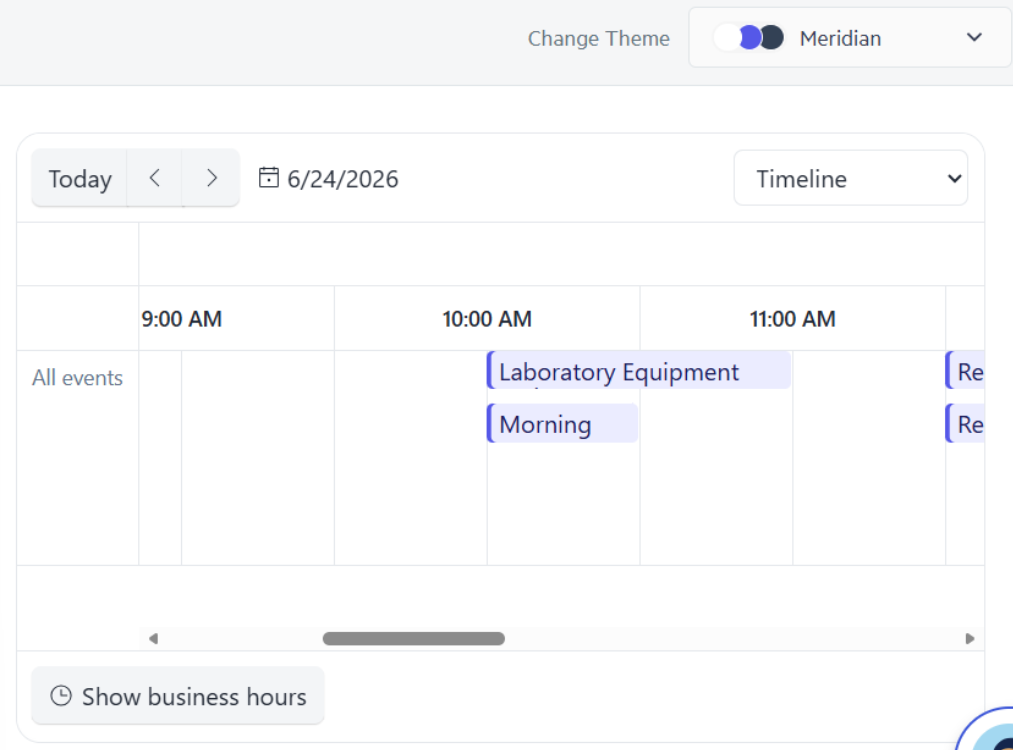
For example, a way to set in the data for the event "Morning" to display first instead of "Laboratory Equipment". It cannot depend on the time range.
Thank you!

Signal Forms are now stable with Angular@22.
It would be nice to have an ability to use all kendo widgets with new form API.
The built-in kendoDropDownFilter directive normalizes text using String.prototype.toLowerCase() when caseSensitive: false. This is locale-insensitive and produces incorrect results for languages with non-standard case-folding rules, most notably Turkish.
The correct fix is to use String.prototype.toLocaleLowerCase(locale), which respects locale-specific case rules. The DropDownFilterSettings interface should expose a locale option for this:
filterSettings = {
  caseSensitive: false,
  operator: 'startsWith',
  locale: 'tr-TR'   // ← proposed new option
};
Affected components: kendoDropDownFilter directive (used with AutoCompleteComponent, ComboBoxComponent, MultiColumnComboBoxComponent, DropDownListComponent, MultiSelectComponent).
For the Kendo DatePicker, if you try to set the size on a kendo-datepicker with plain text, it will not render and give a console error of "ERROR TypeError: Cannot read properties of undefined (reading 'nativeElement')".
Errors:
// HTML
<kendo-datepicker size="small" ... />
---
But on the other hand, it does work if you create a field of type "DateInputSize" and pass that variable to the size.
Works:// TS
protected size: DateInputSize = 'small';
// HTML
<kendo-datepicker [size]="size" ... />
Hi,
When the first day of the week is changed dynamically through a custom IntlService, the Calendar weekday headers are updated, but the date cells are not repositioned. (The first day is changed as described in your guide: https://www.telerik.com/kendo-angular-ui/components/knowledge-base/calendar-first-day )
Reproduction (forked from your example): https://stackblitz.com/edit/angular-tqvypgwg
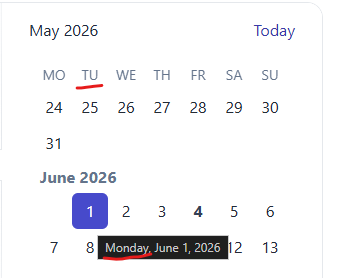
Click on "Set first day to Monday ": the weekday headers are updated to start with Monday, but the date cells remain in their previous positions.
Best regards,
Michael
When the user wants to select a date, the filter closes up and the user is not able to select any date from the calendar.
The issue is happening on tablet device in portrait mode and we found out that it's happening on your documentation too. To reproduce the issue, please go to the "Angular Grid Filter Menu" in your documentation:
https://www.telerik.com/kendo-angular-ui/components/grid/filtering/filter-menu/
Please open the dev tools and set the browser on any tablet portrait size or use Galaxy Tab S4.
In your first example (Angular Grid Filter Menu), please click on the "Date" filter in the grid. When the popup opens up, please click on the calendar icon
of the date input field.
When the calendar shows up, try to select any date. You'll see that the filter closes up and the user is not able to select any date. Demo video attached for reference.
Please fix this bug as we support Samsung Galaxy tablet devices and we're using this feature in our project.
You're docs say
Open the example in a new window to evaluate it with Axe Core or other accessibility tools. for the Kendo angular grid
When i do that i see the attached error, which is the same issue i get in our product when running playwright axe
That suggests to me that it is not WCAG 2.2 compliant
Ensure elements with an ARIA role that require child roles contain them
more informationElement Location:
.demo-frame.loaded.demo-module--wrap--718a6 > .demo-module--demoWrap--d1437 > .demo-module--explorerWrap--4bf1f.flex-grow-1 > .demo-module--demoBody--97eee > iframe #k-fbe44131-4768-4755-93c3-e321b714780e<div role="grid" kendodragtargetcontainer="" kendodroptargetcontainer="" mode="manual" class="k-grid-aria-root" id="k-fbe44131-4768-4755-93c3-e321b714780e" aria-label="Data table" aria-rowcount="62" aria-colcount="5">To solve this problem, you need to fix the following:
Element has children which are not allowed: div[tabindex]
Related Node
In firefox, open the Kendo Radio Button documentation and slowly resize the window (https://www.telerik.com/kendo-angular-ui/components/inputs/radiobutton)
The radio button will kind of jiggle around and occasionally the white dot in the radio button will become off-center.

This also seems to happen in response to some material bouncy (cubic-bezier) animation transitions.
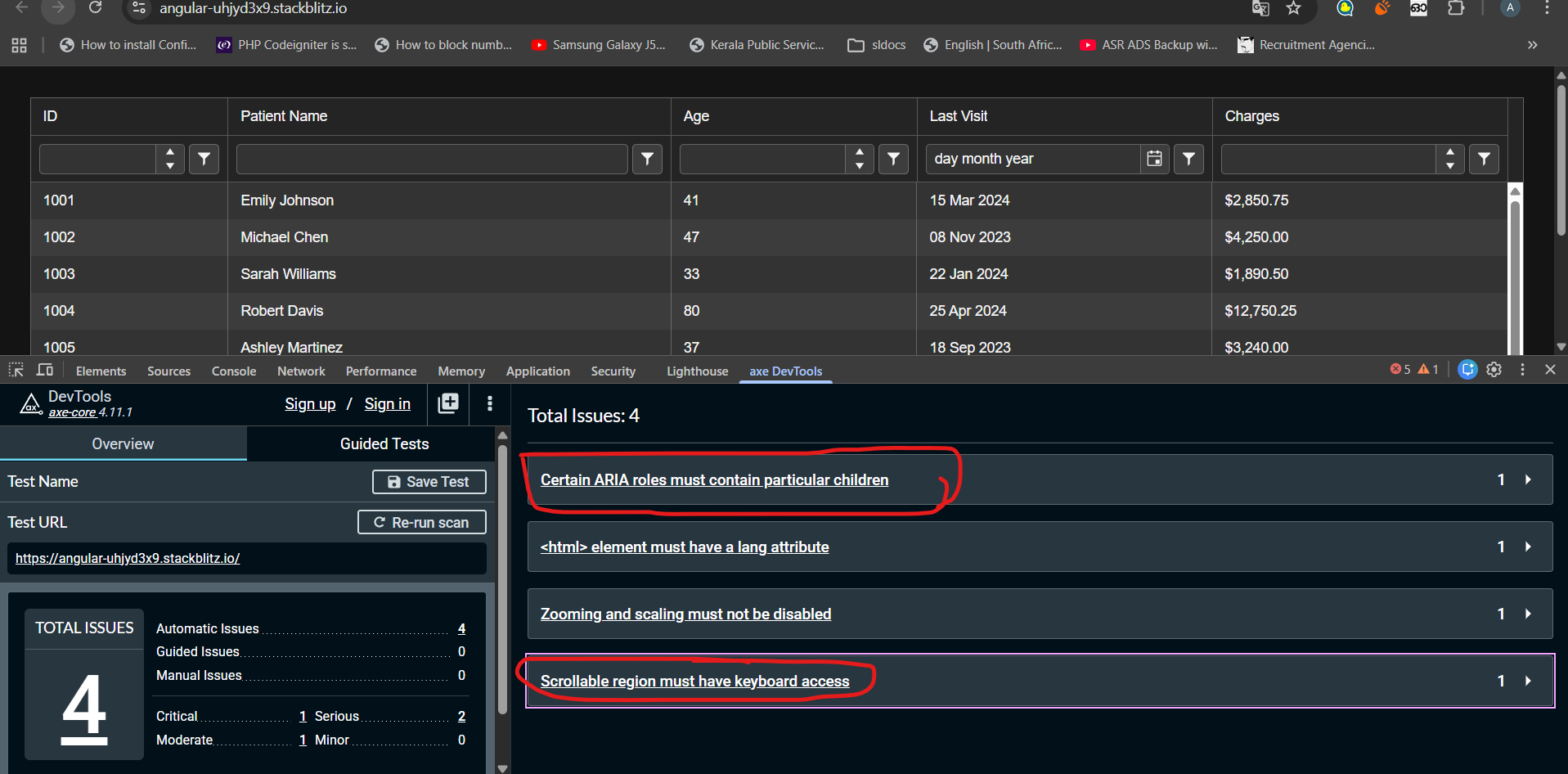
I have tested kendo grid accessibility with AXE Dev tool. Found following errors that seems difficult to fix.
1)Certain ARIA roles must contain particular children
2)Scrollable region must have keyboard access
Any suggestion to fix these above-mentioned issues could be very helpful. Noticed these issues even exist in kendo grid demos published in kendo documentation. Check the link below
stack blitz link : https://stackblitz.com/edit/angular-uhjyd3x9?file=src%2Findex.html
When a tooltip of a dialog is shown and the dialog is closed, the tooltip is still present and is moved into the top left corner.
We use e.g. `kendo-dialog-titlebar` and the close button has a tooltip.
Hi,
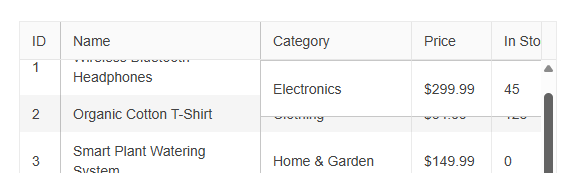
if I use both the features locked columns and sticky rows, the sticky rows do not stick in the locked columns.
For me it would be logical if they would stick there too (now the UI looks inconsistent):
Reproduction (forked from your example): https://stackblitz.com/edit/angular-wak7v99i
Can you please take a look at it?
Best regards,
Michael
Hi,
if I change the [placeholder] input on a kendo-editor, the changes are not reflected.
Reproduction (forked from your example): https://stackblitz.com/edit/angular-uqbchubd
Can you please take a look at it?
Best regards,
Michael
The DrawerAnimation interface isn't exposed in the index file.
DrawerItem, DrawerMode, and DrawerPosition are all exported but DrawerAnimation is missing.