

The rendering extensions are currently loaded by the Telerik.Reporting.Processing.RenderingExtensionManager all at once in the main thread when the report processing starts. This is redundant because one report processing requires one rendering extension to be loaded.

It would be really useful if EntityDataSouce was updated to support Entity Framework Core contexts. EF Core depends on Standard 2.0 so can run on .NET Core or the full framework.
In the Standalone Report Designer File menu, please add the shortcuts next to menu items, like Ctrl + S for Save and Ctrl+Shift+S for Save All.
I changed several reports and then wanted to know how to save all reports at once.

At the moment it's only possible to have your reports in old-fashioned projects.
It should be possible to add/design reports to SDK-style projects. That should work no matter what target framework is (.NET Core, .NET Standard or .NET Framework).

While customising templates/CSS, I noticed the .trv-parameters-wrapper div as follows:
<div tabindex="300" class="trv-parameters-wrapper" aria-label="Parameters area. Contains 4 parameters.">
<div class="trv-parameter-container k-card"></div>
</div>
I’m working on a project that requires generating Section 508-compliant PDFs, and I’m using Telerik Reporting to build the accessible reports. However, I’ve run into a problem with how screen readers—specifically NVDA—are interpreting table content.
In my report’s table, some values like 12/01/2023 aren’t being read as dates, and values like (192,340.00)—which represent negative numbers—aren’t being interpreted as “negative” or addressing the parenthesis.
As soon as I set an AccessibleDescription on a cell (especially the first cell in a row), NVDA stops reading the rest of the row. It seems like the table reading order is broken, and the screen reader exits the table structure or skips over the remaining cells to go to the next row.
This is obviously a problem for users relying on screen readers, and I’m not sure how to fix it. Has anyone else dealt with this in Telerik Reporting, or know a workaround to make screen readers read both the custom alt text and maintain proper row navigation?
My report has a Text Watermark as part of the PageSettings, and is configured for Accessibility. The report contains a Page Header and Page Footer. In the Page Footer, there are two TextBoxes.
When I generate an accessible PDF with Telerik Reporting and use the Adobe Reader > Read Out Loud functionality, it doesn't read the content of the second TextBox in the Page Footer.
When an HtmlTextBox contains a large HTML ordered list that exceeds a single page height, the generated PDF is cut at the pixel-level page boundary rather than at a text line boundary. This results in a line of text being visually split mid-glyph — part of the line appears at the bottom of one page, and the remainder is orphaned at the top of the next page.
To reproduce, create an HtmlTextBox that contains an <ol> with lots (>40) <li> items, so they span more than one physical page and export to PDF. Observe the page boundary where the list crosses a page — the split occurs mid-line.
Expected behaviour:
The renderer splits the HtmlTextBox content at a complete line boundary, consistent with how a plain TextBox behaves.
Actual behaviour:
The split occurs at the pixel-level page margin, cutting through a rendered text line.
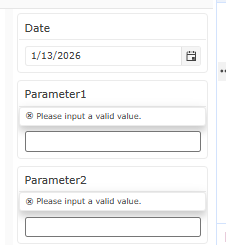
Please note the spelling error in the k-notificaiton-error class name. Should be k-notification-error:
<div class="trv-parameter-error k-notification k-notificaiton-error" style="">
<span class="k-notification-status k-icon k-i-x-outline"></span>
<span class="trv-parameter-error-message k-notification-content">Parameter value cannot be empty.</span>
</div>
Because of this, error messages are rendered with incorrect color (should be red):
React Report Viewer throws error ts(7016) on importing it in a TypeScript project:
Could not find a declaration file for module '@progress/telerik-react-report-viewer/dist/cjs/main'. 'C:/Users/dnikolov/Desktop/ReactTypesScript/my-app/node_modules/@progress/telerik-react-report-viewer/dist/cjs/main.js' implicitly has an 'any' type.
  Try `npm i --save-dev @types/progress__telerik-react-report-viewer` if it exists or add a new declaration (.d.ts) file containing `declare module '@progress/telerik-react-report-viewer/dist/cjs/main';`
The attached report generates different PDF documents when rendered by the Standalone Designer and REST Service, both targeting the .NET Framework 4.6.2:
- The PDFs have different sizes
- When using the 'Read out loud' functionality of the Adobe Reader, the items are read in a different order. The order in the PDF generated by the designer is correct, and the one in the service-generated PDF is wrong.
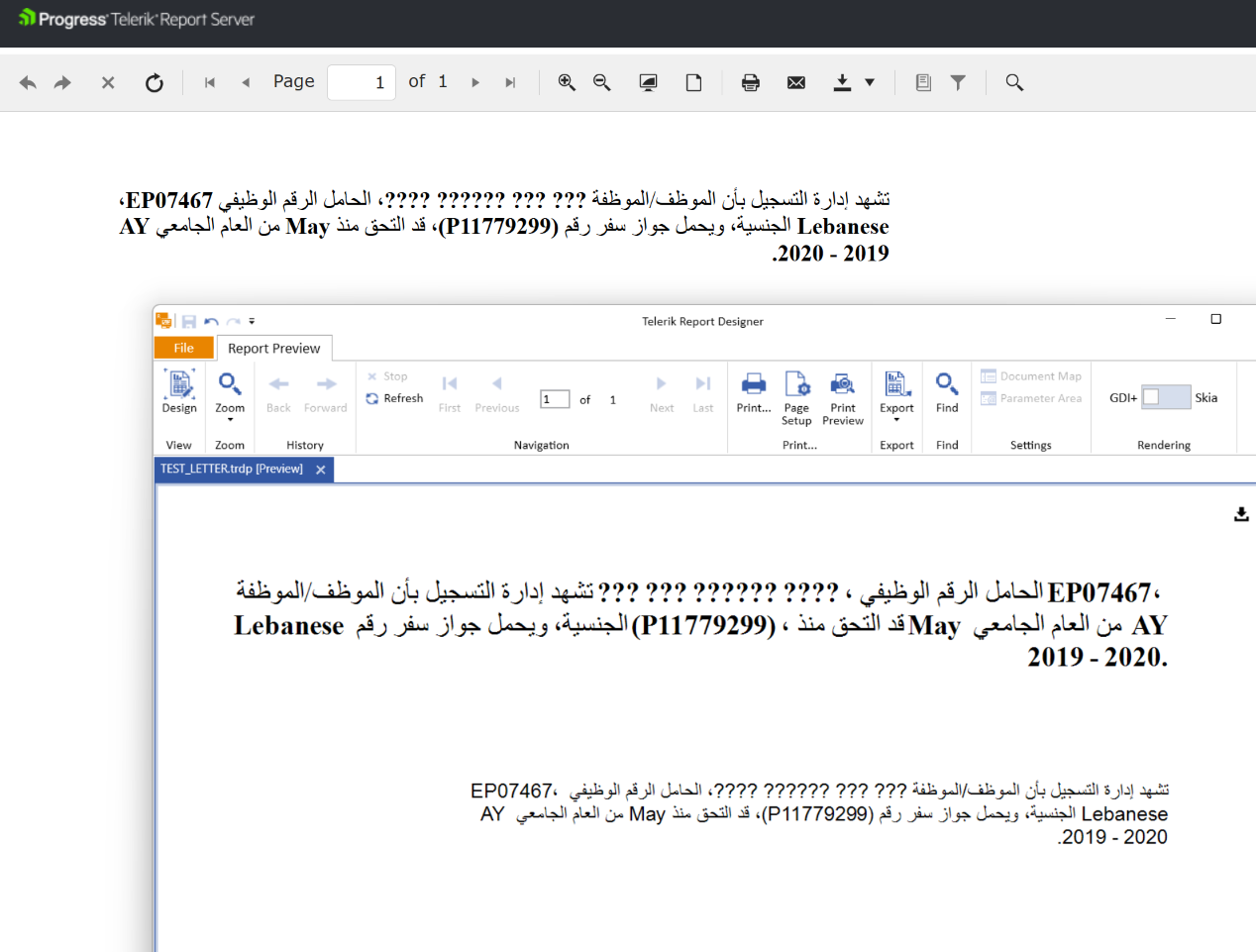
I have a Telerik report designed in the Standalone Report Designer. In the HTML5 Report Viewer, the report seems to be correct, but when I export the report in PDF, the word order changes.
The problem occurs in the HTMLTextBox when rendering in PDF and previewing in the Standalone Designer with both Skia and GDI+.
In the TextBox, the same text is displayed as expected.
When previewing in the HTML Report Viewer, the Arabic text seems fine.

I am using the ObjectDataSource component of the Standalone Report Designer. However, I get errors mentioning that types from `System.Private.CoreLib` cannot be loaded. This used to work in version 19.3.26.121. The workaround in the latest version is to manually register the `System.Private.CoreLib` assembly in the designer through `assemblyReferences` (File -> Options -> Add).

Currently, the GetDesignerResource endpoint of the Web Report Designer service is case-insensitive, which can lead to issues if the URL is made lowercase at some point, such as by a URL rewrite rule, or similar scenarios.
For example, the following reference to the Web Report Designer script will load return the file:
<script src="api/reportdesigner/designerresources/js/webReportDesigner"></script>But if lowercase is used, for example, like this:
<script src="api/reportdesigner/designerresources/js/webreportdesigner"></script>The request will return a 404(Not Found) response.
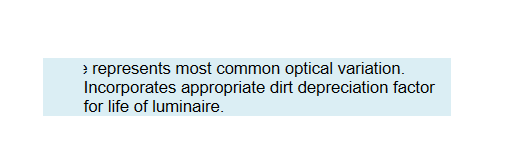
Using the text-indent CSS setting results in part of the text on the first line being cut off:
I cannot localize the messages of the Angular and React report viewers using the suggested approaches:
- Angular Report Viewer Localization - Telerik Reporting
- Localizing the React Report Viewer - Telerik Reporting
The only alternative is to use the approach from the Localization of the HTML5 ReportViewer Explained - Telerik Reporting article, which I can do only by loading the string resources script in index.html of the SPA.