

Bug report
Reproduction of the problem
If the title of the View is not initially set and setOptions method is used then the views in the Scehduler toolbar are displayed with: 'kendo.ui.DayView', 'kendo.ui.WorkWeekView', 'kendo.ui.WeekView'...
Open the Dojo - https://dojo.telerik.com/dCcHVbSb
Current behavior
Expected/desired behavior
The default titles should be displayed even after setOptions is used.
Environment
- Kendo/Telerik version: 2026.3.1015
- Browser: [all ]
The Kendo Chart widget's documentation describes the setting messages.noData. However, it is missing in the typescript typings.
The documentation matches the source code, but the typings do not.

there is no binding for noData
e.g.
noData?: boolean | undefined; interface ChartOptions {
name?: string | undefined;
autoBind?: boolean | undefined;
axisDefaults?: ChartAxisDefaults | undefined;
categoryAxis?: ChartCategoryAxisItem | ChartCategoryAxisItem[] | undefined;
chartArea?: ChartChartArea | undefined;
dataSource?: any|any|kendo.data.DataSource | undefined;
legend?: ChartLegend | undefined;
panes?: ChartPane[] | undefined;
pannable?: boolean | ChartPannable | undefined;
pdf?: ChartPdf | undefined;
persistSeriesVisibility?: boolean | undefined;
plotArea?: ChartPlotArea | undefined;
renderAs?: string | undefined;
series?: ChartSeriesItem[] | undefined;
seriesColors?: any;
seriesDefaults?: ChartSeriesDefaults | undefined;
theme?: string | undefined;
subtitle?: string | ChartSubtitle | undefined;
title?: string | ChartTitle | undefined;
tooltip?: ChartTooltip | undefined;
transitions?: boolean | undefined;
valueAxis?: ChartValueAxisItem | ChartValueAxisItem[] | undefined;
xAxis?: ChartXAxisItem | ChartXAxisItem[] | undefined;
yAxis?: ChartYAxisItem | ChartYAxisItem[] | undefined;
zoomable?: boolean | ChartZoomable | undefined;
axisLabelClick?(e: ChartAxisLabelClickEvent): void;
dataBound?(e: ChartDataBoundEvent): void;
drag?(e: ChartDragEvent): void;
dragEnd?(e: ChartDragEndEvent): void;
dragStart?(e: ChartDragStartEvent): void;
legendItemClick?(e: ChartLegendItemClickEvent): void;
legendItemHover?(e: ChartLegendItemHoverEvent): void;
legendItemLeave?(e: ChartLegendItemLeaveEvent): void;
noteClick?(e: ChartNoteClickEvent): void;
noteHover?(e: ChartNoteHoverEvent): void;
noteLeave?(e: ChartNoteLeaveEvent): void;
paneRender?(e: ChartPaneRenderEvent): void;
plotAreaClick?(e: ChartPlotAreaClickEvent): void;
plotAreaHover?(e: ChartPlotAreaHoverEvent): void;
plotAreaLeave?(e: ChartPlotAreaLeaveEvent): void;
render?(e: ChartRenderEvent): void;
select?(e: ChartSelectEvent): void;
selectEnd?(e: ChartSelectEndEvent): void;
selectStart?(e: ChartSelectStartEvent): void;
seriesClick?(e: ChartSeriesClickEvent): void;
seriesHover?(e: ChartSeriesHoverEvent): void;
seriesOver?(e: ChartSeriesOverEvent): void;
seriesLeave?(e: ChartSeriesLeaveEvent): void;
zoom?(e: ChartZoomEvent): void;
zoomEnd?(e: ChartZoomEndEvent): void;
zoomStart?(e: ChartZoomStartEvent): void;
}
After applying filter or page number, the table content gets changed but the screen reader didn't inform about the same.
Repro-Steps:
- Open the WPG - Home URL in browser.
- Now, navigate to table in table in scan mode.
- Observe the issue.
Actual Result:
After performing below action's, the table content gets changed but the narrator didn't announce about the content change:
- After applying filter (any), if data shown as well as if no content found.
- After selecting page no.
User Impact:

The details for this can be found in ticket #1519224
Given some XML that has child nodes and attributes, I'm binding to a grid with no problem. The child grid for each row (built using detailInit) get's the data from the parent row e.data.get("BillRows")
If those rows have attributes, the '@' signs breaks the javascript for the grid. As you can see in the ticket, every attribute needs to be renamed before I can build the child grid.
Should be a way to use attributes in XML bound to a datasource/grid for all levels of grids.
Rick
Bug report
Hyperlinks in a Spreadsheet cell do not work mobile devices.
Reproduction of the problem
- Open this example on a mobile device - https://dojo.telerik.com/ahixOKep
- Try to click on the links in the Product column.
Current behavior
The link in the cell does not work.
Expected/desired behavior
The link should work
Environment
- Kendo UI version: 2022.2.510
- Browser: [all]
Bug report
When custom Virtual DropDownList filter is set the value is not cleared from the DropDownList on Clear button click
Reproduction
https://dojo.telerik.com/ULIgEpis
1. Filter Ship Name column
2. Open the filter menu and hit Clear
3 Open Filter menu again
Expected/desired behavior
Value shall be cleared from the DropDownList
Environment
Kendo UI version: 2021.1.301
Browser: all
Bug report:
MultiColumnComboBox select event is triggered when the dataSource has items with empty text
Reproduce problem:
https://dojo.telerik.com/exAtuTUJ/6
The steps to reproduce this problem:
1. click the dropdown to show options
2. Click anywhere on the document(You will see the alert message, it prompts for trigger event).
Current behavior:
Trigger event anywhere you click on a document.
Expected behavior:
Trigger event only when you click the values in the MultiColumnComboBox component.
Environment:
- Kendo UI version: 2022.2.621
- jQuery version: 1.12.4
- Browser: all
Hello,
I think i have found a potential bug
In the dojo below please run it and notice the window opens fine, then close and reopen it a couple of times.
The animation => open: false is causing the window to reopen at a smaller/zoomed out size.
If you move the window it snaps to the correct size
https://dojo.telerik.com/oDuviZak/2
Reproduction of the problem
Open this web site:
https://demos.telerik.com/kendo-ui/spreadsheet/datasource
And follow the steps provided here:
https://www.screencast.com/t/UdEKYqIve
Current behavior
The first added cell value (or row) is removed when the user deletes an empty row.
If the ID is entered, the result is even stranger:
https://www.screencast.com/t/osmVOiY7al
Expected/desired behavior
It should behave and function like Excel. I think with local/static binding there are no issues.
Bug report
Recurring events are not rendered on the correct date when an event has to be displayed on different dates in different time zones.
Reproduction of the problem
- In our demos or the Dojo linked here create an event with starting time of 09 AM. Set the event to repeat every Monday. In the example below the timezone of the machine and the event is UTC +2 (Sofia)
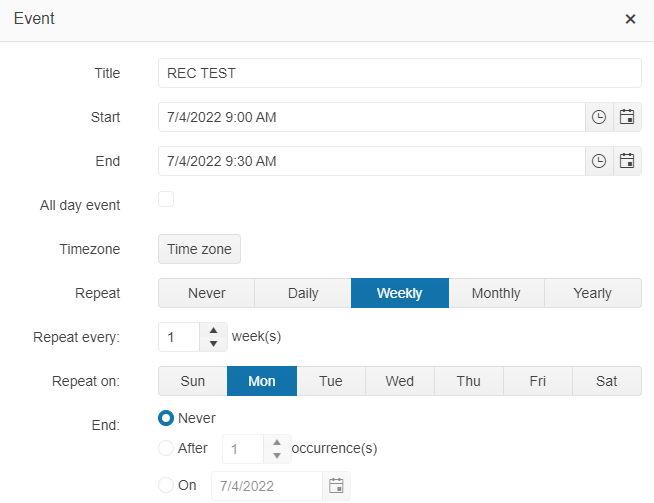
Below are two events recurring and nonrecurring created with the same starting date and time in UTC +2

- To simulate opening in different time zones change the Timezone on the machine with a difference of more than -9 hours, so the event to be expected to display on the previous day. For example, select UTS -10 Hawaii.
Current behavior
After changing the time zone on the machine from UTC +2 to UTC -10 the event is rendered at 8 PM, but it is still displayed on Monday. Thus, recurring and non-recurring events created with the same start date and time are displayed on different days when the time zone is changed:

Expected/desired behavior
The date of the recurring event should be changed according to the time zone. It should be possible to repeat events on a different days of the week when the Scheduler is opened at different timezone
Environment
- Kendo UI version: 2022.2.512
- Browser: [all ]
Bug report
Reproduction of the problem
Dojo example.
- Type in "f" in the MultiSelect's input area. It is filtered and shows 2 items in the list.
- Press "Ctrl + A" keys. The two items are selected.
- Clear the text in the input. The list is populated with all items in the dataSource.
- Press "Ctrl + A" keys again
Current behavior
All items are selected, but the first two ("Chai and Chang") are not highlighted as selected.
Expected/desired behavior
All items should be selected and highlighted as selected.
Environment
- **Kendo UI version: 2020.3.1118
- jQuery version: x.y
- Browser: [all]
Bug report
In some cases, when large numbers are set as smallStep and/or largeStep the tick label is not visible
Reproduction of the problem
- Open the Dojo - https://dojo.telerik.com/@NeliKondova/ezurIsAQ
Current behavior
The label of the third tick for the first and second Slider are not visible.
Expected/desired behavior
All tick labels in Slider should be rendered
Environment
- Kendo UI version: 2021.1.330
- Browser: [all ]
Bug report
When used in a regular HTML form, the CheckBox doesn't get reset by the Reset button.
Workaround: Consider using the Kendo Form instead of a regular HTML form.
Reproduction of the problem
- Open this Dojo example - https://dojo.telerik.com/ureSOHoB/5
- Click the Reset button
Current behavior
The CheckBoxes don't reset when clicking the Reset button
Expected/desired behavior
The CheckBoxes should reset when clicking the Reset Button
Environment
- Kendo UI version: 2023.2.829
- Browser: [all]
In Firefox on 4K screens, the Spreadsheet vertical and horizontal scrollbars cannot be revealed or dragged with the mouse. Scrolling works only with the mouse wheel. The issue is not reproducible in Chrome or on 2K screens. The same behavior is observed in the Kendo UI for jQuery, KendoReact and Kendo UI for Angular Spreadsheet.
Steps to reproduce
- Open the Spreadsheet overview demo in Firefox on a 4K screen (Windows with overlay scrollbars).
- Move the mouse to the right or bottom edge of the Spreadsheet and try to reveal or drag the scrollbar.
Actual behavior
The scrollbar is not shown, or it is very hard to reveal (it appears only occasionally in the top right corner), and it cannot be used.
Expected behavior
The scrollbar is revealed on hover and can be dragged.
Cause
Firefox uses overlay scrollbars, which hide automatically, and the scrollbar width is measured as 0. The Spreadsheet's internal fixed container then covers the whole scrollable area, including the scrollbar, so the mouse never reaches it. The mouse wheel keeps working because it is handled separately.
Environment
Windows 11, Firefox, 4K display, Kendo UI for jQuery 2026.3
### Bug report
When the title of the legend in the Kendo UI Chart widget is longer, the labels are not centered as per the default legend alignment.
### Reproduction of the problem
1) Create a Chart widget and set the title of the legend to "If the title is longer than the series names is not centered anymore is left aligned";
2) The title is centered, but the labels are aligned to the left.
A Dojo sample for reproduction: https://dojo.telerik.com/UBoTOBID
### Expected/desired behavior
The labels of the legend should be centered below the title.
### Environment
* **Kendo UI version: 2021.2.616
* **jQuery version: 1.12.4
* **Browser: [all]
The issue can be observed in the following dojo example:
https://dojo.telerik.com/OWAyaZuJ
Reproduction of the problem:
1. Open the Dojo.
2. Shrink the window until only a single event is visible. Note: The open() method is called on the last item of the Timeline in the dataBound event.
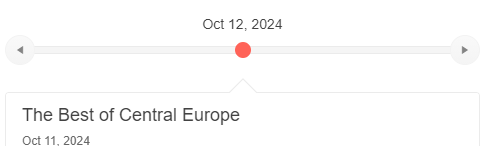
3. Run the example. The last item of the timeline has been opened, however the "back" button is not active.
Current Behavior:
The "back" button is not active when it should be.
Expected Behavior:
The button should be active, no matter the screen size.
Environment:
Kendo UI Version: [2021.2.616]
Browser: [all]
Bug report
When the value of the widget is set in the dataBound event handler the filtering events is fired and e.filter is undefined
Reproduction of the problem
- Open the Dojo
- Open the browser console and type something in the MultiSelect to filter the data.
Current behavior
The filtering event is fired a second time and the second time the e.filter is undefined.
Expected/desired behavior
Double-checlk if the filtering event should be fired a second time.
The e.filter and e.sender.dataSource.filter().filters[0] should return the same value.
Environment
- Kendo UI version: 2022.3.1109
- Browser: [all ]