

As a result of an EF Core issue, the ToDataSourceResult() is not able to perform the query when the DataSourceRequest object contains grouping.
The problem occurs using the query below, assembled by Telerik routine:
var temp = _db.Pessoa
    .OrderBy(item => item.Email)
    .Skip(0)
    .Take(40)
    .GroupBy(item => item.Email)
    .OrderBy(g => g.Key)
    .Select(g => new AggregateFunctionsGroup
    {
        Key = g.Key,
        ItemCount = g.Count(),
        HasSubgroups = false,
        Member = "Email",
        AggregateFunctionsProjection = new
        {
            Count_Referencia = _db.Pessoa
                    .Select(t => new
                    {
                        t.IdPessoa,
                        t.Referencia,
                        t.Nome_RazaoSocial,
                        t.Apelido_Fantasia,
                        t.CPF_CNPJ,
                        t.RG_IE,
                        t.Email
                    })
                    .OrderBy(item => item.Email)
                    .Where(item => item.Email == g.Key)
                    .Count()
        },
        Items = g
    })
    .ToList();
In the routine where the AggregateFunctionsGroup is created, the Items property must not only be the query itself, but also the fields specified in the main Select. Or, the call to the Select() method must simply be added:
var temp = _db.Pessoa
    .OrderBy(item => item.Email)
    .Skip(0)
    .Take(40)
    .GroupBy(item => item.Email)
    .OrderBy(g => g.Key)
    .Select(g => new AggregateFunctionsGroup
    {
        Key = g.Key,
        ItemCount = g.Count(),
        HasSubgroups = false,
        Member = "Email",
        AggregateFunctionsProjection = new
        {
            Count_Referencia = _db.Pessoa
                    .Select(t => new
                    {
                        t.IdPessoa,
                        ...
                    })
                    .OrderBy(item => item.Email)
                    .Where(item => item.Email == g.Key)
                    .Count()
        },
        Items = g.Select(t => new
        {
            t.IdPessoa,
            ...
        })
    })
    .ToList();
This way, the issue does not occur.

The grid must allow changes to be made in specific cells, without those changes being committed/saved unless the user clicks on the "Save" button in the toolbar. Basically the users enter in some values for editable currency columns that aren't locked, and (without saving) some columns (both locked and not locked) that are not editable must be refreshed as the value in those cells depend on the edited column. Those cells have client templates and client footer templates which need to be used by whatever is refreshing their cells.
Having this functionality provided built-in will be a nice addition:
https://docs.telerik.com/kendo-ui/knowledge-base/grid-update-particular-row-without-refresh
### Bug report
When opening the filter menu of a specified column through the classic ColumnMenu, the filter container is displayed with scrollbars when the dropdown of the filter operator is opened.
### Reproduction of the problem
1) Define a Grid and enable its classic ColumnMenu.
2) Open the filter menu of a specified column and then open the dropdown to select a filter operator.
3) The filter container has scrollbars. The "k-menu-popup" element has "overflow: auto";
Use the following demo to test the case and select the "classic" type for the ColumnMenu: https://demos.telerik.com/kendo-ui/grid/column-menu
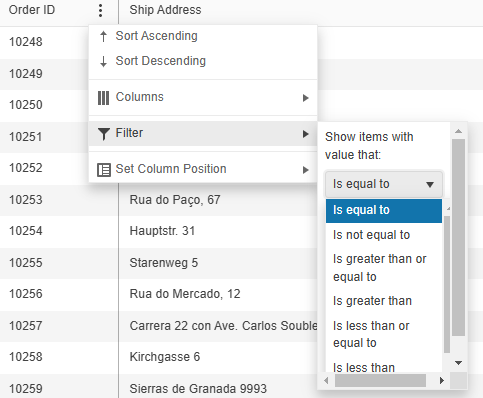
The issue does not appear when using version 2024.4.1112.
### Expected/desired behavior
The filter menu container must not change its appearance when the dropdown opens.
### Workaround:
<style>
.k-menu-popup {
    overflow: visible !important;
}
</style>* **Kendo UI version: 2025.1.211
* **jQuery version: 3.7.1
* **Browser: [all]


Bug report
When ParseFormats is set in the DatePicker editor used in the Grid popup, the picker does not show the field value to which it is bound.
Reproduction of the problem
- Add a DateOnly? field to the model:
public DateOnly? OrderDate { get; set; }
- Bind a Grid column to the field.
- Set the default value in the DataSource:
.Model(model =>
{
    model.Id(p => p.OrderID);
    model.Field(p => p.OrderDate).DefaultValue(new DateOnly());
})
- Configure Popup editing in the Grid.
- Add a DateOnly.cshtml editor in EditorTemplates:
@model DateOnly?

@(Html.Kendo().DatePickerFor(m => m).ParseFormats(new string[] { "MM/dd/yyyy" }).HtmlAttributes(new { title = Html.ViewContext.ViewData.TemplateInfo.GetFullHtmlFieldName("") }))
Current behavior
When editing a record. The value of the OrderDate field is not displayed in the DatePicker.
If you remove the ParseFormats option from the DatePicker, it shows the value as expected.
Expected/desired behavior
The field value should be displayed in the picker, even when ParseFormats is set.
Environment
- Kendo UI version: 2024.4.1112
- Browser: All

This should be applied when using a Telerik UI for ASP.NET Core Grid with PopUp Edit Mode.
Bug report
The column format applied through the .Format() option is ignored, if the column is bound to a nullable DateOnly field.
Reproduction of the problem
- Declare a nullable DateOnly field in the view model:
public DateOnly? PaymentDate { get; set; }
- Bind a column to the field and set its format:
columns.Bound(p => p.PaymentDate).Title("Date").Format("{0:MM/dd/yyyy}").Width(160);
Current behavior
The specified format is ignored, e.g., the Grid shows 2025-01-21, instead of 01/21/2025
Expected/desired behavior
The specified column format is applied.
Environment
- Kendo UI version: 2024.4.1112
- Browser: [all ]
Current configuration: server-side filtering
Desired behavior:
- Grid searches are "anded" to any existing filters
- When the search box is cleared the pre-existing filters are retained
### Bug report
When the Grid is initialized in a hidden container (for example, in a non-selected tab of a TabStrip) and its initial data binding is disabled (autoBind: false), the pager information is not visible when the data is loaded afterward.
### Reproduction of the problem
1. Initialize a Grid into a non-selected tab of a TabStrip and set its autoBind option to "false".
2. Select the tab and check how the empty Grid is rendered.
3. Call the read() method of the Grid's DataSource in the browser console to request the data.
4. The data is loaded, but the pager information remains hidden.
A Dojo sample for reproduction: https://dojo.telerik.com/njVgBvza
### Expected/desired behavior
The pager information must be available when the data is loaded into the Grid.
### Environment
* **Kendo UI version: 2024.4.1112
* **jQuery version: 3.7.1
* **Browser: [all]
Bug report
Dynamic Grid produces a RunTimeException when the Filterable() configuration is enabled
Reproduction of the problem
- Configure the dynamic Grid based on the following example.
- Set the .Filterable() API configuration of the Grid.
- Notice that the application throws a
System.ArgumentNullException: Value cannot be null.
Example
@model System.Data.DataTable

@(Html.Kendo().Grid<dynamic>()
    .Name("gridItem")
    .Columns(columns =>
    {
        foreach (System.Data.DataColumn dcolumn in Model.Columns)
        {
            columns.Bound(dcolumn.ColumnName).Title(dcolumn.Caption);
        }
    })
     ...
    .Filterable()
)
The aforementioned declaration will work in the previous 2024.3.1015 version of the suite.
Current behavior
The Grid makes the application throw a runtime error.
Expected/desired behavior
The Grid makes the application should not throw a runtime error.
Environment
- Kendo UI version: 2024.4.1112
- Browser: [all]
Enhancement
Expose the sorts TagHelper for the Grid's column filter datasource taghelper
Overview
Currently, the Grid's Column Filter Datasource Taghelper exposes the following inner child TagHelpers.
Unlike its HtmlHelper counterpart which happens to expose the .Sort() API configuration. For example:
.Columns(columns =>
{
    columns.Bound(p => p.ShipName).Filterable(ftb =>
    {
        ftb.Multi(true);
        ftb.Search(true);
        ftb.CheckAll(true);
        ftb.DataSource(dataSource => dataSource
            .Custom()
            ...
            .Sort(sort =>
            {
                sort.Add("ShipName").Ascending();
            })
        );
    });
})
### Bug report
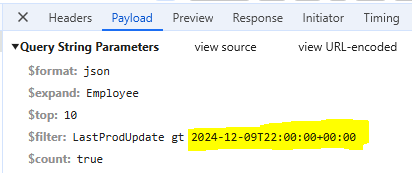
When the Grid is set up for OData-v4 binding, the columns that bind to DateOnly fields fail to filter. The date value in the filter expression contains the time portion and the following error is thrown:
"The binary operator GreaterThan is not defined for the types 'System.Nullable`1[System.DateOnly]' and 'System.Nullable`1[System.DateTimeOffset]'."
### Reproduction of the problem
1) Create a Grid that uses OData-v4 binding.
2) Bind a specified column to a DateOnly field.
3) Filter the column through the default column filter menu and open the browser DevTools to review the response of the request.
//Model
public DateOnly LastProdUpdate { get; set; }

//View
@(Html.Kendo().Grid<ProductViewModel>()
    .Name("grid")
     .Columns(columns =>
        {
            columns.Bound(p => p.LastProdUpdate).Format("{0:dd/MM/yyyy}");
        })
        ...
        .Filterable()
        .DataSource(dataSource => dataSource
        .Custom()
        .Type("odata-v4")
        .Transport(t =>
        {
            t.Read(read => read.Url("/odata/Products").Data("function() {return {'$expand': 'Employee'} }"));
        })
        .PageSize(10)
        .ServerPaging(true)
        .ServerFiltering(true)
        .ServerSorting(true)
     )
)
### Expected/desired behavior
The DateOnly fields must be filtered successfully as the DateTime fields.
### Environment
* **Kendo UI version: 2024.4.1112
* **Browser: [all]
Is it possible to implement template options for the "update" and "cancel" column commands of the Grid?
For example:
$("#grid").kendoGrid({
  columns: [{
    command: [{
        name: "edit",
        template: {
            update: "<button class='customUpdate'>Save</button>",
            cancel: "<button class='customCancel'>Cancel</button>",
          }
      }]
   }],
  ...
});
By default, when the "paste" command is added, the default option is "insert" mode ("Paste (Insert)"). Is it possible to add an option that allows setting the default paste mode to "replace" ("Paste (Replace)")?
Currently, when using the default Grid search functionality and the column filter menus, we observe the following:
- When a column filter is applied first, using the Search feature afterward overrides the column filters, applying the search filter with the "contains" operator to the specified columns.
- Conversely, when a search is performed first and then followed by a column filter, the grid generally functions as expected.
However, there’s a specific scenario where this does not work properly:
- If a search is performed and then a column filter is applied to a column where the search criteria are relevant, the Grid returns no data.
For example:
- After searching for "2018," the expected columns displayed in the filters (notably, the ContractNumber is among them).
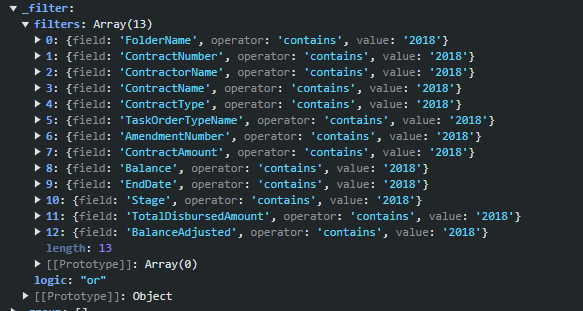
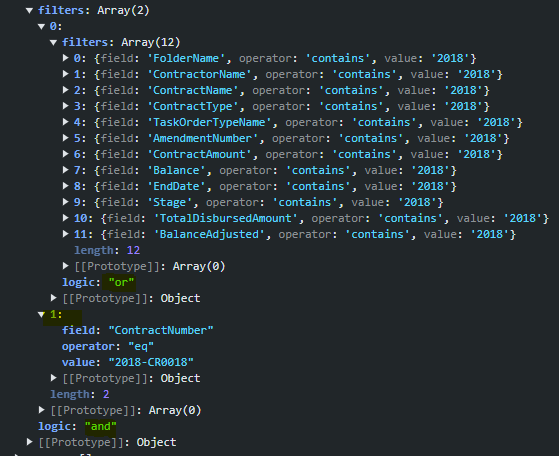
- When a column filter is subsequently applied to ContractNumber (e.g., setting it to "2018-CR0018"), the Grid removes the ContractNumber from the search filters and adds the column filter with an "AND" operator. This setup returns no data because of the search filters and the "AND" operator.
Expected Behavior and Alternative
This functionality behaves correctly in the Telerik UI for Blazor Grid component - the search and column filters are managed as separate objects.
Is it possible to enhance the Grid filtering similar to the Blazor Grid?

Hi, is there a way to configure the grid so that when it's grouped and later sorted, the grouping state (expanded/collapsed) is preserved?
Kind Regards
Erwin
It would be convenient to have built-in MultiColumnComboBox editing for the Grid.
I was hoping the component would show the addresses formatted in columns (as per a fields list) and then return the address concatenated into a single to the grid field (e.g. from .DataTextField("FullAddress")).
I'm in the process of rewriting all Kendo components to use CSP compatible templates. I'm looking at https://docs.telerik.com/aspnet-core/html-helpers/template/overview which shows how we'd use TemplateComponentName() for popup editors and that we would need to rewrite everything in the popup editor to use Kendo Template's AddHtml or AddComponent methods.
Original:
<div class="mb-2 row required">
	@Html.LabelFor(model => model.FileName, new { @class = "col-sm-4 col-form-label fw-bold text-sm-end" })
	<div class="col-sm-6">
		@(Html.Kendo().TextBoxFor(model => model.FileName).HtmlAttributes(new { @class = "w-100" }))
	</div>
</div>

<div class="mb-2 row">
	@Html.LabelFor(model => model.FileDescription, new { @class = "col-sm-4 col-form-label fw-bold text-sm-end" })
	<div class="col-sm-6">
		@(Html.Kendo().TextBoxFor(model => model.FileDescription).HtmlAttributes(new { @class = "w-100" }))
	</div>
</div>
Rewritten:
@(Html.Kendo().Template()
	.AddHtml("<div class='mb-2 row required'>")
	.AddHtml(@<text>
		@Html.LabelFor(model => model.FileName, new { @class = "col-sm-4 col-form-label fw-bold text-sm-end" })
	</text>)
	.AddHtml("<div class='col-sm-6'>")
	.AddComponent(c => c.TextBoxFor(model => model.FileName).HtmlAttributes(new { @class = "w-100" }))
	.AddHtml("</div></div>")

	.AddHtml("<div class='mb-2 row'>")
	.AddHtml(@<text>
		@Html.LabelFor(model => model.FileDescription, new { @class = "col-sm-4 col-form-label fw-bold text-sm-end" })
	</text>)
	.AddHtml("<div class='col-sm-6'>")
	.AddComponent(c => c.TextBoxFor(model => model.FileDescription).HtmlAttributes(new { @class = "w-100" }))
	.AddHtml("</div></div>")
)
While this works, this markup seems much harder to read than the original. Could this be made to be simpler? Ideally I'd like to be able to drop my existing mix of html and kendo components in one method and it'd parse through to render the template properly.