


When RadPanel is set to AutoSize, it should update its size automatically when changing the visibility of some control inside it.

Workaround:
 public class CustomRadPanel : RadPanel
    {
        public override string ThemeClassName
        {
            get
            {
                return typeof(RadPanel).FullName;
            }
            set
            {
                base.ThemeClassName = value;
            }
        }

        protected override void OnLayout(LayoutEventArgs e)
        {
            base.OnLayout(e);
            int maxHeight = 0;
            foreach (Control control in this.Controls)
            {
                if (control.Visible)
                {
                    maxHeight = Math.Max(control.Height, maxHeight);
                }
            }
            this.AutoSize = false;
            this.Height = maxHeight;
        }
    }

To reproduce:
- Drop RadMarkupDialog on the form
- In code set its DefaultFont and show it

WORKAROUND:
Create an instance of RadMarkupDialog prior showing it, not at design time.

Description: LostFocus event for the RadDropDownList fires after PopupClosed and before SelectedIndexChanging events no matter that the user have not leave the control yet.

To reproduce:
- add a RadDropDownList with items
- subscribe for the LostFocus event
- open the drop down list and close it: the LostFocus event fires

Workaround:
Use RadDropDownList Leave event:

this.radDropDownList1.Leave += radDropDownList1_Leave;

To reproduce:
- Add pie chart and drop down list with some items to a form.
- Then use the following code:

Private Sub RadForm1_Load(sender As Object, e As EventArgs) Handles MyBase.Load
    Dim series As New PieSeries

    series.DataPoints.Add(New PieDataPoint(50, "test"))
    series.DataPoints.Add(New PieDataPoint(50, "test2"))

    series.ShowLabels = True

    RadChartView1.Series.Add(series)

    TryCast(RadChartView1.Series(0).Children(0), PiePointElement).BackColor = Color.Red
    TryCast(RadChartView1.Series(0).Children(1), PiePointElement).BackColor = Color.Blue
End Sub

Private Sub RadChartView1_LabelFormatting(sender As Object, e As ChartViewLabelFormattingEventArgs) Handles RadChartView1.LabelFormatting
    e.LabelElement.Shape = New OfficeShape(True)
End Sub

Workaround:
e.LabelElement.SuspendPropertyNotifications()
e.LabelElement.Shape = New OfficeShape(True)
e.LabelElement.ResumePropertyNotifications()
Create a custom theme starting from Aqua theme. Change the Font for RadLabelElement-TextPrimitive to "Microsoft Sans Serif, 10pt". Save the theme and apply it to the entire application. Show several times a RadMessageBox with long text. The first time the RadMessageBox is sized correcly to its content. Each next showing, cuts off the text.

Workaround:  the possible workaround that I can suggest is to dispose the RadMessageBox instance after showing it:

Private Sub RadButton1_Click(sender As Object, e As EventArgs) Handles RadButton1.Click
    RadMessageBox.Show(Me, "If you have some veeeeery long sample text, the messagebox " & _
                       "should be resized according to its content.", "Caption", MessageBoxButtons.OK, My.Resources.image)
    RadMessageBox.Instance.Dispose()
End Sub
To reproduce:
- Add three line series and only set their point size.
- At runtime remove the second series.
- The points color is not updated corectly.

Workaround
- Set colors in code like this:
lineSerie1.BorderColor = Color.Red;
lineSerie1.BackColor = Color.Red;

lineSerie2.BackColor = Color.Green;
lineSerie2.BorderColor = Color.Green;

lineSerie3.BackColor = Color.Blue;
lineSerie3.BorderColor = Color.Blue;
Please refer to the attached screenshot.

To reproduce:

public RadForm1()
{
    InitializeComponent();

    Font f = new Font("Microsoft Sans Serif", 9.5f);
    this.radDropDownList1.DropDownStyle = Telerik.WinControls.RadDropDownStyle.DropDownList;
    this.radDropDownList1.Font = f;

    this.radDropDownList2.DropDownStyle = Telerik.WinControls.RadDropDownStyle.DropDown;
    this.radDropDownList2.Font = f;
}

Workaround:  If the text is not completely visible in RadDropDownList for a specific font you can increase the minimum height of the RadDropDownList and the DropDownListElement.TextBox.TextBoxItem.TextBoxControl.

public RadForm1()
{
    InitializeComponent();
    this.radDropDownList1.MinimumSize = new Size(0, 25);
    this.radDropDownList1.DropDownListElement.TextBox.TextBoxItem.TextBoxControl.MinimumSize = new Size(0, 25);
}
To reproduce:
- Try to set the  alignment:
radPopupEditor1.PopupEditorElement.PopupContainerForm.HorizontalPopupAlignment = HorizontalPopupAlignment.RightToRight;
radPopupEditor1.Popup.HorizontalPopupAlignment = HorizontalPopupAlignment.RightToRight;

- The property is reset when the popup is opened.

Workaround:
void radPopupEditor1_PopupOpening(object sender, CancelEventArgs e)
{
    RadPopupOpeningEventArgs args = e as RadPopupOpeningEventArgs;
    int width = radPopupContainer1.Width;

    args.CustomLocation = new Point(args.CustomLocation.X - width + radPopupEditor1.Width, args.CustomLocation.Y);
}
If you try to style the Right column menu of RadApplicationMenu, your changes will not be persisted and applied to the control.

Workaround:
FillPrimitive fill = (FillPrimitive)this.radRibbonBar1.RibbonBarElement.ApplicationButtonElement.DropDownMenu.RootElement.Children[0].Children[0].Children[2].Children[0].Children[2].Children[1].Children[0];
fill.BackColor = Color.Orange;
fill.BackColor2 = Color.Red;
To reproduce:

public Form1()
{
    InitializeComponent();
    this.radPropertyGrid1.SelectedObject = this;

    this.radPropertyGrid1.ContextMenuOpening += radPropertyGrid1_ContextMenuOpening;
}

private void radPropertyGrid1_ContextMenuOpening(object sender, Telerik.WinControls.UI.PropertyGridContextMenuOpeningEventArgs e)
{
    foreach (RadItem item in e.Menu.Items)
    {
        if (item.Text == "Sort")
        {
            item.Visibility = ElementVisibility.Collapsed;
            item.PropertyChanged += item_PropertyChanged;
        }
    }
}

Workaround:
private void radPropertyGrid1_ContextMenuOpening(object sender, Telerik.WinControls.UI.PropertyGridContextMenuOpeningEventArgs e)
{
    RadItem item = null;
    for (int i = 0; i < e.Menu.Items.Count; i++)
    {
        item = e.Menu.Items[i];
        if (item.Text=="Sort")
        {
            e.Menu.Items.Remove(item);
        }
    }
}

To reproduce:
CultureInfo culture = new CultureInfo("en-US");
culture.DateTimeFormat.FirstDayOfWeek = DayOfWeek.Monday;
culture.DateTimeFormat.CalendarWeekRule = CalendarWeekRule.FirstFourDayWeek;
this.radCalendar1.ShowRowHeaders = true;
this.radCalendar1.Culture = culture;
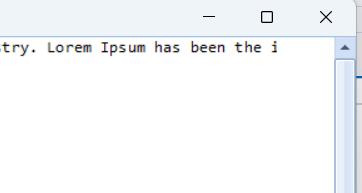
Text is clipped on the right when line numbers are hidden and word wrap is disabled.
In Microsoft Word, the drag-and-drop functionality for Structured Document Tags (Content Controls) allows users to reposition an entire content control and all its contents within the document using the mouse.
What it does
When a user selects the boundary/frame of a content control rather than the text inside it:
- The entire content control is treated as a single unit.
- The control, including its metadata (tag, title, locking settings, data binding, etc.), moves to a new location.
- The content control remains a content control after the move.
- Nested controls move together with the parent control.
- Users can reorganize document sections without cutting and pasting.
Typical workflow
- Hover over a content control until its boundary becomes visible.
- Click the control's tag or border to select the whole control.
- Drag it to another location in the document.
- Release the mouse button to drop it at the new location.
Common use cases
- Reordering form sections.
- Rearranging template building blocks.
- Moving clauses in legal documents.
- Organizing repeating sections or structured content in reports.
- Reorganizing content that is bound to custom XML data.
Important limitations
The behavior may be restricted when:
- The content control is configured as "Content Control Cannot Be Deleted".
- The document is protected.
- The control resides in certain structures (for example, specific table layouts or protected regions).
- Editing restrictions are applied.
Word allows users to treat a content control as a movable document object, enabling the entire SDT and its contents to be repositioned via drag-and-drop while preserving the control's structure and properties.

In this particular case, setting the IsAIEnabled property to false does not hide the PromptInput element in the following themes:
- Aqua
- Desert
- HighContrastBlack
- Office2007Black
- Office2010Silver
- Windows7
As a workaround, the PromptInput element can be removed by setting its visibility property to Collapsed:
gridView1.GridViewElement.PromptInputElement.Visibility = ElementVisibility.Collapsed;