

Feature Request - Show email sent / error notification using the report viewers built-in notification system.
It would be nice to have an option to have a message shown when the email with the report is sent or if there was an error sending.
Right now when you hit email and send the user does not know if it was successful or not. Being async is nice but I have noticed that it could take a few seconds to complete and if the user navigates away from the report viewer during this time the report has the possibility of not sending. Either way right now the user has no definitive method of knowing if the email was sent or not.

If a table-based item (Table, List, Crosstab) does not fit in a single page and needs to occupy more than one page, its bottom border is not drawn on the first page and its top border is not drawn on the second (subsequent) page. This behavior is by design and its purpose is to help the users visually distinguish the table as a single item. The table has only one top and bottom border and they are displayed at the beginning and at the end of the table, regardless how many pages the table actually occupies.
Since users might find this confusing, a table should have a property controlling this behavior. The default state of the property will preserve the current rendering. If the user explicitly sets the property, then the table will draw its top and bottom borders on every page it occupies.



When there are both ASCII characters and non-ASCII characters (such as Chinese) in the text box, the position of line wrapping in Linux Docker is incorrect. Some of the data get lost.
More information can be found in the forum thread TextBox's line wrap position is incorrect in docker.
When using the latest version of the Kendo Default Theme:
<link rel="stylesheet" href="https://unpkg.com/@@progress/kendo-theme-default@latest/dist/all.css" />the export in the Blazor Report viewer does not work.
Meanwhile, you can reference the older kendo CSS styles directly in the view with the ReportViewer. You may leave the new styles referenced on the layout page. It works with:
<link rel="stylesheet" href="https://unpkg.com/@@progress/kendo-theme-default@4.26.0/dist/all.css" />
It would be nice if we could subscribe to events such as
- When web report designer UI is Completely loaded
- When Report is done loading
- When Report is saved
Almost any object can be set to grow (CanGrow = True). Which makes the object grow if the text is too long.
I believe you need a function for making the text fit inside the object.
“ShrinkToFit = True”
This would shrink the text so that it fits inside the object. So if the font size is 20 and a long text wouldn’t fit inside the object, the font size would shrink until it fits.
Today we need to set several conditional formatting rules for this and it’s far from perfect.
The Web Report Designer does not entirely comply with CSP standards, necessitating the use of the 'unsafe-eval' directive in our CSP policies to enable its functionality.
This directive poses significant security risks and undermines the purpose of implementing CSP in the first place. Please remove this requirement.
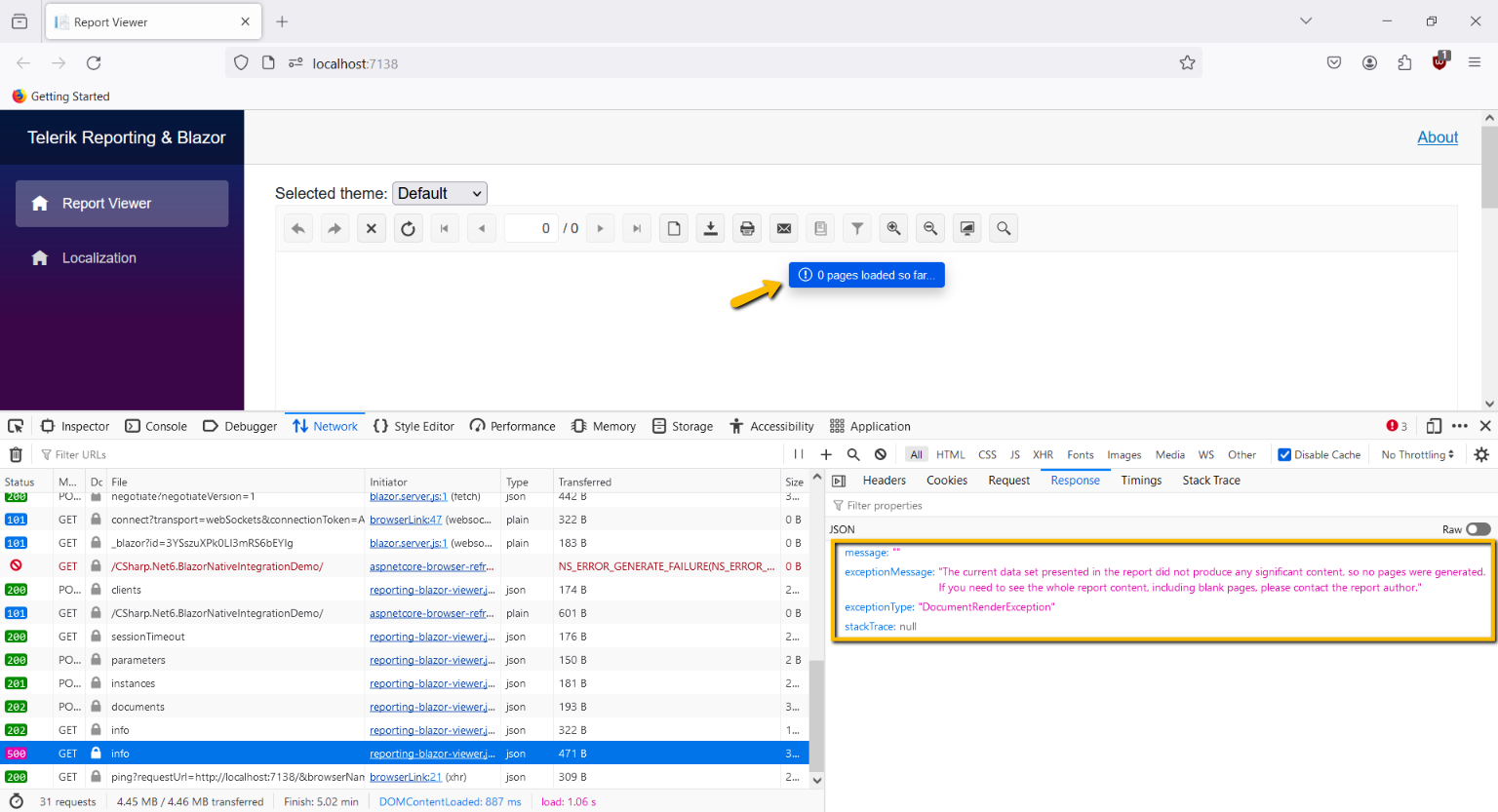
When the reporting service fails to generate a report document, the Get Document Info request returns a 500 response with the error message thrown from within the reporting engine. However, instead of displaying the error message in the viewport, the Native Blazor Report Viewer displays a message falsely suggesting that the report is still being rendered when the rendering has, in fact, failed.
We have an app that loads a list of reports. When a report is selected, a report viewer page is loaded. It contains a set of parameters. In this stage, we get a http 400 error because it is the hitting the GetParameters endpoint right away. The user has not selected any parameters. It should only hit this endpoint when the user has selected the parameters and runs the report.
This is not the behavior in the HTML viewer.
In the images attached, the Initial Load image is the error we get when the report viewer page is loaded.
The Report Source is the payload when the GetParameters endpoint is called. As you can see it's empty since the report is not ran yet.
In the Running image, the error is when the user runs the report.

Even though I set "parametersAreaVisible" to false, the parameter area is still visible. A bit of tweaking.
Let me make a change request in the telerikReportViewer-18.3.24.1112.js file:
function showParametersAreaIfNecessary(params) {
            parametersAreaNecessary = hasVisibleParameters(params) || !controller.isReportAutoRun();
            showParametersArea(parametersAreaVisible && parametersAreaNecessary);
        }
When groupings in a cross tab or merged row table span multiple pages the actual row label should be carried over to new page along with a label of some sort (if desired) to mark group is being continued from previous page.
The problem is not getting the error via Dot Net programming, but the complete layout destruction of the report as a result of the fact that a picture (in our case a thumbnail of a provider) is unavailable. Catching the report error is not an option. It is too complicated and even if we succeed  in obtaining the error, it will be very complicated to remove the unavailable url on the fly and re-render the report again.

This seems to be a "known issue" for about 8 years!

My question: Is it possible to keep the remaining report "intact" if such an error occurs? This shouldn't be too difficult for the development team..
Please provide support for GeoJson format to create World Map in Telerik Reporting.
The telerik configuration has to be provided by app.config / web.config. (http://docs.telerik.com/reporting/configuring-telerik-reporting)
In a huge solution this makes it necessarry to define the same settings multiple times. (app.config for UnitTests, web.config for WebFrontend, app.config for Workers.) I prefer to implement configuration just once programaticaly.

Please provide a public interface for configuration so that we can inject configuration from commandline / azure / configfiles / ...

For private fonts the feature is implemented but all methods are marked private. so I have to call this things by reflection:

            //<?xml version="1.0" encoding="utf-8"?>
            //<configuration>
            //  <configSections>
            //    <section name="Telerik.Reporting" type="Telerik.Reporting.Configuration.ReportingConfigurationSection, Telerik.Reporting, Version=11.0.17.406, Culture=neutral, PublicKeyToken=a9d7983dfcc261be" />
            //  </configSections>
            //  <Telerik.Reporting>
            //    <privateFonts>
            //      <add fontFamily="Poppins Medium" path="c:\poppins\Poppins-Medium.ttf" />
            //      <add fontFamily="Poppins Light" path="c:\poppins\Poppins-Light.ttf" />
            //      <add fontFamily="Poppins SemiBold" path="c:\poppins\Poppins-SemiBold.ttf" />
            //    </privateFonts>
            //  </Telerik.Reporting>
            //</configuration>

            var fontContainerType = typeof(Telerik.Reporting.DataSource).Assembly.GetType("Telerik.Reporting.Processing.Common.FontContainer");
            var fontContainer = fontContainerType.GetField("Instance", BindingFlags.Public | BindingFlags.Static).GetValue(null);

            var methodAdd = fontContainer.GetType().GetMethod("AddFont", BindingFlags.NonPublic | BindingFlags.Instance);
            methodAdd.Invoke(fontContainer, new object[] {"c:\\poppins\\Poppins-Medium.ttf", "Poppins Medium", "regular"});
            methodAdd.Invoke(fontContainer, new object[] {"c:\\poppins\\Poppins-Light.ttf", "Poppins Light", "regular"});
            methodAdd.Invoke(fontContainer, new object[] {"c:\\poppins\\Poppins-SemiBold.ttf", "Poppins SemiBold", "regular"});