

Hello,
Please consider a Grid feature that changes the component layout on mobile devices or narrow screens. The idea is to switch the column layout to a card layout or anything similar to this example: https://css-tricks.com/responsive-data-tables/
It is possible to implement a similar behavior with the Telerik Blazor Grid and MediaQuery components, but it requires reusing the column titles in the CSS code: https://blazorrepl.telerik.com/GnYPmHFR176Jg5Yg02
===
Telerik Blazor team: Everyone who is interested in this feature, please vote for it to help us prioritize. Also, share your opinion about which Grid features you strictly need in the "mobile" layout and which ones you are ready to sacrifice. Some features don't make sense in a card / listview layout anyway, but still, the mobile-friendly Grid may require completely different HTML markup and UX, so some features may need to be completely revamped.

When you type something in the grid searchbox, there will be a X at the end to clear the box.
However, if you restore the grid from previously stored state like localstorage, and if the box has value, the X is not there.
Thanks!

When the user presses ESC to exit edit mode from an EditorTemplate with a ComboBox / MultiColumnComboBox / MultiSelect, the cell value is cleared and this change persists in subsequent editing. The original data item value is cleared too, although this is not immediately obvious.
The issue occurs in version 14.1.0 and WebAssembly apps are more likely to suffer from it.
How to reproduce:
- Go to https://demos.telerik.com/blazor-ui/grid/editing-incell
- Go to the last Grid page, which has empty space below the last table row.
- Open any Grid cell for editing.
- Click on the empty space in the Grid below the last table row.
- The Grid does not exit edit mode like it should.
The regression was introduced in version 12.2.0. The last version that works correctly is 12.0.0.
The possible workarounds are:
- Remove the Grid Height, so that there is no empty space after the last Grid row. You can apply a max-height style to the Grid to prevent unlimited vertical expansion.
- Use an @onfocusout event in the Grid <EditorTemplate> to close the Grid edit mode programmatically:
@using System.ComponentModel.DataAnnotations
@using Telerik.DataSource
@using Telerik.DataSource.Extensions

<TelerikGrid @ref="@GridRef"
             OnRead="@OnGridRead"
             TItem="@Product"
             EditMode="@GridEditMode.Incell"
             OnCreate="@OnGridCreate"
             OnDelete="@OnGridDelete"
             OnUpdate="@OnGridUpdate"
             Height="600px">
    <GridToolBarTemplate>
        <GridCommandButton Command="Add">Add Item</GridCommandButton>
    </GridToolBarTemplate>
    <GridColumns>
        <GridColumn Field="@nameof(Product.Name)">
            <EditorTemplate>
                @{ var dataItem = (Product)context; }
                <span @onfocusout="@( async () => await OnGridCellFocusOut(nameof(Product.Name)) )">
                    <TelerikTextBox @bind-Value="@dataItem.Name" />
                </span>
            </EditorTemplate>
        </GridColumn>
        @* <GridColumn Field="@nameof(Product.Price)" DisplayFormat="{0:C2}" />
        <GridColumn Field="@nameof(Product.Quantity)" DisplayFormat="{0:N0}" />
        <GridColumn Field="@nameof(Product.ReleaseDate)" DisplayFormat="{0:d}" /> *@
        <GridColumn Field="@nameof(Product.Discontinued)" Width="120px">
            <EditorTemplate>
                @{ var dataItem = (Product)context; }
                <span @onfocusout="@( async () => await OnGridCellFocusOut(nameof(Product.Discontinued)) )">
                    <TelerikCheckBox @bind-Value="@dataItem.Discontinued" />
                </span>
            </EditorTemplate>
        </GridColumn>
        <GridCommandColumn Width="180px">
            <GridCommandButton Command="Delete">Delete</GridCommandButton>
        </GridCommandColumn>
    </GridColumns>
</TelerikGrid>

@code {
    private TelerikGrid<Product>? GridRef { get; set; }

    private ProductService GridProductService { get; set; } = new();

    private async Task OnGridCellFocusOut(string field)
    {
        await Task.Delay(100);

        if (GridRef is null)
        {
            return;
        }

        GridState<Product> gridState = GridRef.GetState();
        Product? editItem = gridState.EditItem as Product;

        if (editItem is null)
        {
            return;
        }

        GridCommandEventArgs args = new GridCommandEventArgs()
        {
             Field = field,
             Item = editItem
        };

        await OnGridUpdate(args);


        gridState.EditField = default;
        gridState.EditItem = default!;
        gridState.OriginalEditItem = default!;

        await GridRef.SetStateAsync(gridState);
    }

    private async Task OnGridCreate(GridCommandEventArgs args)
    {
        var createdItem = (Product)args.Item;

        await GridProductService.Create(createdItem);
    }

    private async Task OnGridDelete(GridCommandEventArgs args)
    {
        var deletedItem = (Product)args.Item;

        await GridProductService.Delete(deletedItem);
    }

    private async Task OnGridRead(GridReadEventArgs args)
    {
        DataSourceResult result = await GridProductService.Read(args.Request);

        args.Data = result.Data;
        args.Total = result.Total;
        args.AggregateResults = result.AggregateResults;
    }

    private async Task OnGridUpdate(GridCommandEventArgs args)
    {
        var updatedItem = (Product)args.Item;

        await GridProductService.Update(updatedItem);
    }

    public class Product
    {
        public int Id { get; set; }
        [Required]
        public string Name { get; set; } = string.Empty;
        public string Description { get; set; } = string.Empty;
        public decimal? Price { get; set; }
        public int Quantity { get; set; }
        [Required]
        public DateTime? ReleaseDate { get; set; }
        public bool Discontinued { get; set; }
    }

    #region Data Service

    public class ProductService
    {
        private List<Product> Items { get; set; } = new();

        private int LastId { get; set; }

        public async Task<int> Create(Product product)
        {
            await SimulateAsyncOperation();

            product.Id = ++LastId;

            Items.Insert(0, product);

            return LastId;
        }

        public async Task<bool> Delete(Product product)
        {
            await SimulateAsyncOperation();

            if (Items.Contains(product))
            {
                Items.Remove(product);

                return true;
            }

            return false;
        }

        public async Task<List<Product>> Read()
        {
            await SimulateAsyncOperation();

            return Items;
        }

        public async Task<DataSourceResult> Read(DataSourceRequest request)
        {
            return await Items.ToDataSourceResultAsync(request);
        }

        public async Task<bool> Update(Product product)
        {
            await SimulateAsyncOperation();

            int originalItemIndex = Items.FindIndex(x => x.Id == product.Id);

            if (originalItemIndex != -1)
            {
                Items[originalItemIndex] = product;
                return true;
            }

            return false;
        }

        private async Task SimulateAsyncOperation()
        {
            await Task.Delay(100);
        }

        public ProductService(int itemCount = 5)
        {
            Random rnd = Random.Shared;

            for (int i = 1; i <= itemCount; i++)
            {
                Items.Add(new Product()
                {
                    Id = ++LastId,
                    Name = $"Product {LastId}",
                    Description = $"Multi-line\ndescription {LastId}",
                    Price = LastId % 2 == 0 ? null : rnd.Next(0, 100) * 1.23m,
                    Quantity = LastId % 2 == 0 ? 0 : rnd.Next(0, 3000),
                    ReleaseDate = DateTime.Today.AddDays(-rnd.Next(365, 3650)),
                    Discontinued = LastId % 2 == 0
                });
            }
        }
    }

    #endregion Data Service
}
Hi Telerik Support
Facing an issue with Keyboard navigation in Telerik Grid component.
When we use TAB to navigate, the grid header gets focus only for the first time. After completing one round of navigation, second time after the Toolbar buttons, if we TAB out, focus goes to the pager sections skipping the grid header part.
Pls refer the REPL sample from Telerik website:
Steps to reproduce:
1) Use ALT + W and then use TAB key to navigate
2) First focus goes to the Toolbar button (Add Product), then goes to the Grid Header and then if we TAB again focus goes to the Pager section
3) After the Pager section, if we do steps 1 and 2 again, we can see that it skips the Grid Header focus second time onwards.
I would like to add some custom actions into the popup window. I know I can implement a custom edit popup with an entirely custom content and actions. However, this requires a lot of custom work to just add one additional action in the popup. Please provide an easier option to add custom actions in the edit window.
I have a Grid with row selection and column virtualization. After selecting all rows and zooming out my browser to 80% or less, the column virtualization stops working - data is not loaded in the cells on vertical scroll.

OnChange and OnBlur event for editors (TelerikTextBox, NumericTextBox, and others) is not fired in InCell edit mode with Tab key.
Bug report
Reproduction of the problem
(bug report only)
Regression introduced in 13.0.0.
1. Run this example: https://blazorrepl.telerik.com/wUuSGClv00orFeRm59
Current behavior
(optional)
The Size, Rounded, FillMode parameters are ignored.
Expected/desired behavior
The parameter values should apply and change the appearance of the SearchBox.
Environment
- Browser: [all ]
I am resetting the Grid State by calling Grid.SetState(null). This doesn't reset ColumnState<T>.Locked boolean to false and the columns remain locked.
---
ADMIN EDIT
---
A possible workaround for the time being is to additionally loop through the ColumnStates collection of the State and set the Locked property to false for each column.
If the GridScrollMode.Virtual is enabled for the Grid, and the NoDataTemplate exceeds the height of the Grid container, a user can infinitely scroll inside the table even when there is no data and the template is displaying.
===ADMIN EDIT===
A possible workaround is to apply "overflow-y: hidden;" when the NoDataTemplate is shown: REPL link.
Bug report
Once the user locks a column through the column menu, they cannot unlock it, because the Unlock option remains disabled, while the Locked option remains enabled.
Regression in version 14.1.0. Potentially related to https://github.com/telerik/blazor/pull/14727
Reproduction of the problem
@page "/"

<TelerikGrid Data="@GridData"
             Pageable="true"
             FilterMode="@GridFilterMode.FilterRow"
             Sortable="true"
             ShowColumnMenu="true"
             Width="700px">
    <GridColumns>
        <GridColumn Field="@(nameof(SampleData.Id))" Width="80px" ShowColumnMenu="false" />
        <GridColumn Field="@(nameof(SampleData.FirstName))" Title="First Name" Id="firstname-column-id" Width="300px" />
        <GridColumn Field="@(nameof(SampleData.LastName))" Title="Last Name" Id="lastname-column-id" Width="300px" />
        <GridColumn Field="@(nameof(SampleData.CompanyName))" Title="Company" Id="companyname-column-id" Width="300px" />
        <GridColumn Field="@(nameof(SampleData.Team))" Title="Team" Id="team-column-id" Width="300px" />
        <GridColumn Field="@(nameof(SampleData.HireDate))" Title="Hire Date" Width="300px" />
    </GridColumns>
</TelerikGrid>

@code {
    private IEnumerable<SampleData> GridData = Enumerable.Range(1, 30).Select(x => new SampleData
        {
            Id = x,
            FirstName = $"FirstName {x}",
            LastName = $"LastName {x}",
            CompanyName = $"Company {x}",
            Team = "team " + x % 5,
            HireDate = DateTime.Now.AddDays(-x).Date
        });

    public class SampleData
    {
        public int Id { get; set; }
        public string FirstName { get; set; }
        public string LastName { get; set; }
        public string CompanyName { get; set; }
        public string Team { get; set; }
        public DateTime HireDate { get; set; }
    }
}
Current behavior
Cannot unlock a locked column, the Unlock option remains disabled.
Expected/desired behavior
The Unlock and Lock options in the column menu must reflect the current column state.
I am using a Blazor Telerik Grid and implementing a custom TelerikCheckBoxListFilter inside a FilterMenuTemplate.
When a user opens the "Name" filter menu and types a name quickly into the search/filter box, some of the text is removed automatically.
For example, if I type "1234567890" as input, without any delay - some of the letters will be cleared and it is showing as "1246890" in the filter search box. It could be because it is searching in real time, but the user input I am typing is not carried over correctly. See the attached screenshot taken from Telerik Demo site for the above said example.
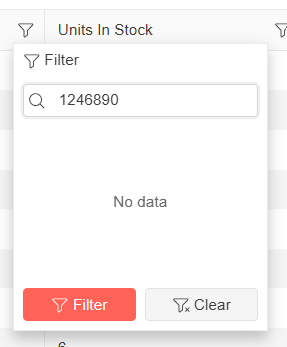
Below is the column definition I am currently using:
<GridColumn Field="@nameof(Tenant.TenantName)" Title="Name" Width="*" FilterMenuType="@FilterMenuType.CheckBoxList">
<FilterMenuTemplate Context="context">
<TelerikCheckBoxListFilter Data="@Model.DistinctTenantNameList"
Field="@(nameof(FilterTenantName.TenantName))"
@bind-FilterDescriptor="@context.FilterDescriptor">
</TelerikCheckBoxListFilter>
</FilterMenuTemplate>
</GridColumn>
Hi Support,
I have an issue with the DragToSelect feature of a Telerik grid in Blazor when this grid is inside a TelerikWindow.
Summary
When a TelerikGrid configured with GridSelectionSettings DragToSelect="true" is rendered inside the <WindowContent> of a <TelerikWindow>, the drag-to-select (rubber-band) behavior is not working properly — the user can only select cells/rows via individual clicks.
Single-click selection continues to work in both cases. The issue is specific to the drag gesture.
Steps to reproduce
Create a page with a TelerikWindow set to Visible="true".
Inside <WindowContent>, place a TelerikGrid with:
SelectionMode="@GridSelectionMode.Multiple"
SelectedCells / SelectedCellsChanged bound
<GridSettings><GridSelectionSettings SelectionType="@GridSelectionType.Cell" DragToSelect="true" /></GridSettings>
Open the window and try to select multiple cells by pressing the mouse button on a cell and dragging over neighboring cells.
Expected behavior
A rubber-band selection rectangle appears and all cells the pointer passes over become selected — same as when the identical grid is placed on a regular page (outside a modal window).
Actual behavior
Drag selection occur rarely. Only the single cell under the initial mousedown gets selected. The rubber-band rectangle rarely appears, and SelectedCellsChanged fires with a single descriptor instead of the full drag range.
Minimal repro (REPL-ready)
<TelerikWindow Visible="true" Width="800px" Height="500px">
<WindowTitle>Repro</WindowTitle>
<WindowContent>
<TelerikGrid Data="@Data" TItem="SampleItem"
SelectionMode="@GridSelectionMode.Multiple"
SelectedCells="@SelectedCells"
SelectedCellsChanged="@((IEnumerable<GridSelectedCellDescriptor> c) => SelectedCells = c)">
<GridSettings>
<GridSelectionSettings SelectionType="@GridSelectionType.Cell" DragToSelect="true" />
</GridSettings>
<GridColumns>
<GridColumn Field="@nameof(SampleItem.Id)" />
<GridColumn Field="@nameof(SampleItem.Name)" />
</GridColumns>
</TelerikGrid>
</WindowContent>
</TelerikWindow>
@code {
public record SampleItem(int Id, string Name);
private List<SampleItem> Data = Enumerable.Range(1, 20).Select(i => new SampleItem(i, $"Item {i}")).ToList();
private IEnumerable<GridSelectedCellDescriptor> SelectedCells = Enumerable.Empty<GridSelectedCellDescriptor>();
}
Now my questions :
- Is this a known limitation of DragToSelect when the grid is inside a modal TelerikWindow?
- Is there an officially supported workaround (CSS pointer-events tweak on .k-overlay, event capture override, grid setting, etc.)?
- If it is a bug, could you open a public issue we can track?
Many thanks you in advance.
Franck Boisdé
The Grid performance worsens progressively with each subsequent edit operation. Please optimize that.
Test page: https://blazorrepl.telerik.com/mJuHFNbb17FpJu9b54
Click on a Price or Quantity cell to start edit mode and tab repetitively to observe the degradation.
The CheckBoxList filter does not work as expected when the Grid is bound to ExpandoObject
===
ADMIN EDIT: A possible workaround is to bind the Grid with OnRead event and populate the MemberType property of the filter descriptors manually:
@using System.Dynamic
@using Telerik.DataSource
@using Telerik.DataSource.Extensions

<TelerikGrid OnRead="@OnGridRead"
             TItem="@ExpandoObject"
             Pageable="true"
             Sortable="true"
             FilterMode="@GridFilterMode.FilterMenu"
             FilterMenuType="@FilterMenuType.CheckBoxList"
             Height="400px">
    <GridToolBarTemplate>
        <GridSearchBox />
    </GridToolBarTemplate>
    <GridColumns>
        @{
            if (GridData != null && GridData.Any())
            {
                <GridColumn Field="PropertyInt" FieldType="@GridPropertyTypes["PropertyInt"]" />
                <GridColumn Field="PropertyString" FieldType="@GridPropertyTypes["PropertyString"]" />
                <GridColumn Field="PropertyGroup" FieldType="@GridPropertyTypes["PropertyString"]" />
                <GridColumn Field="PropertyDate" FieldType="@GridPropertyTypes["PropertyDate"]" />
                <GridColumn Field="PropertyBool" FieldType="@GridPropertyTypes["PropertyBool"]" />
            }
        }
    </GridColumns>
</TelerikGrid>

@code {
    private List<ExpandoObject> GridData { get; set; } = new List<ExpandoObject>();

    private Dictionary<string, Type> GridPropertyTypes { get; set; } = new Dictionary<string, Type>() {
        { "Id", typeof(int) },
        { "PropertyInt", typeof(int) },
        { "PropertyString", typeof(string) },
        { "PropertyGroup", typeof(string) },
        { "PropertyDate", typeof(DateTime) },
        { "PropertyBool", typeof(bool) }
    };

    private async Task OnGridRead(GridReadEventArgs args)
    {
        args.Request.Filters.OfType<CompositeFilterDescriptor>()
        .Each(x =>
        {
            x.FilterDescriptors.OfType<FilterDescriptor>()
                .Each(y => y.MemberType = GridPropertyTypes[y.Member]);
        });

        var result = GridData.ToDataSourceResult(args.Request);

        args.Data = result.Data;
        args.Total = result.Total;
        args.AggregateResults = result.AggregateResults;
    }

    protected override void OnInitialized()
    {
        for (int i = 1; i <= 18; i++)
        {
            dynamic expando = new ExpandoObject();

            expando.Id = i;
            expando.PropertyGroup = $"Group {(i % 3 + 1)}";
            expando.PropertyInt = i;
            expando.PropertyString = $"String {(char)(64 + i)}{(char)(64 + i)}";
            expando.PropertyDate = DateTime.Now.AddMonths(-i);
            expando.PropertyBool = i % 2 != 0;

            GridData.Add(expando);
        }
    }
}
Telerik input components inside EditorTemplate render the whole grid on each keystroke
<AdminEdit>
As a workaround, you can use the standard Input components provided by the framework together with a CSS class that would visually make them like the Telerik Input Components. An example for the TextArea:
<InputTextArea class="k-textarea" @bind-Value="@myValue"></InputTextArea></AdminEdit>