

The data source preview in the web report designer does not show the full shape of the query. It has no horizontal scroll bar to verify the preview data for the entire projection.
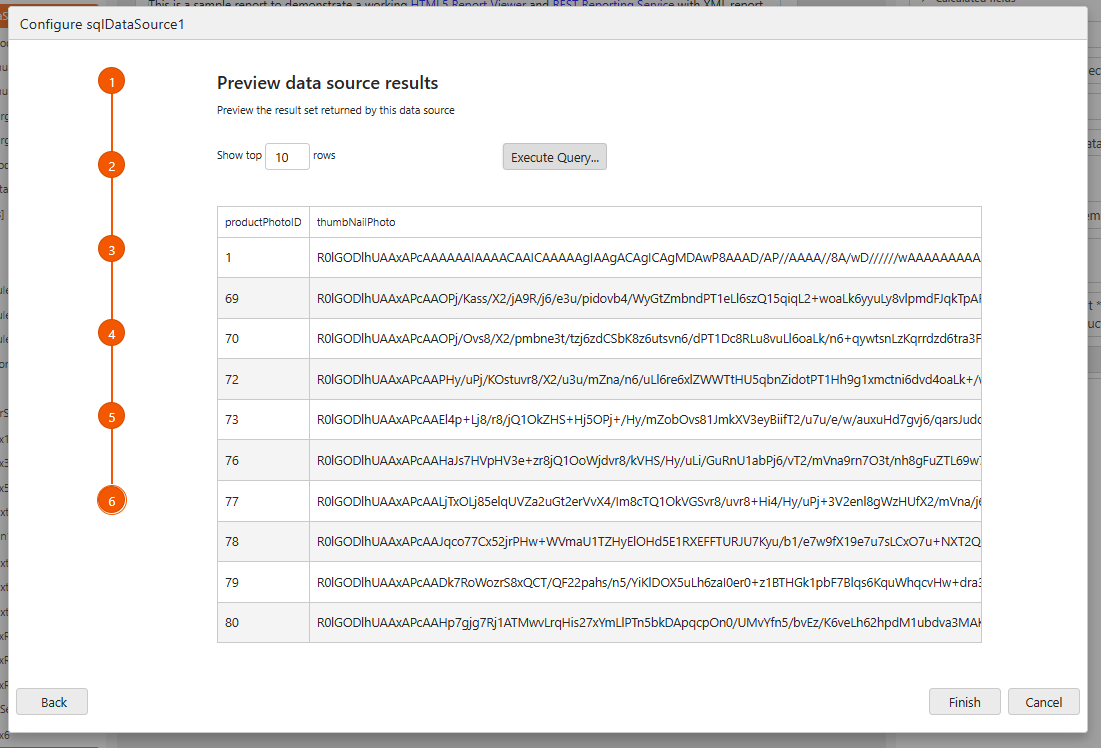
Please consider addressing this.

I have an SVG image that includes text, which uses the "Arial" font-family. On Windows, it renders correctly with GDI and SKIA. However, on Linux, an "Invalid Image Data" exception is thrown, and the image is not rendered. This happens when exporting to PDF and XLSX.
Furthermore, even though there is an exception, it is not caught by the Reporting engine, so RenderingResult.HasErrors returns false. The logic should be modified to catch this error and update the HasErrors flag.
So far, the issue seems to be specific to the Arial font. When I change font-family, the PDF document is created as expected.
When adding localization in CS reports in the VS designer for .NET Framework 4.6.2, the latter adds calls to the ApplyResources function when setting report item values.
After editing and saving such coded reports in SRD.NET, though, they are deserialized differently, replacing the ApplyResources function calls with hardcoded strings. This breaks localization, although the resx files remain.
As we install fonts regularly and don't want to restart/redeploy everytime we install a new font we propose a new api to clear the cache.
A new method Telerik.Reporting.Fonts.RefreshCache would solve this problem and improve the experience of using the Telerik Reporting library.
I have created a report group, and in that group's header, I have added a textbox with a sorting action.
The action can be triggered, but the data does not get sorted, regardless of whether the sorting target is the report itself or the group from which the group section is created.
When the reports are displayed within the WPF Report Viewer, they are rendered in the XAML format, and it does not natively support SVGs.
Currently, the SVGs are always rasterized before being written to the XAML, which results in the images being blurred when zooming in the report viewer.

Currently, the Download Raw Data action is available in the Windows Form Report Viewer. It is hard-coded there, and the download button appears when you hover over the data item.
The developer can cancel the action through the interactive action event handlers. However, the button persists even when the action is cancelled and doesn't do anything, which is misleading and confusing for the report readers.
Please let the developers disable the action/button, for example, through configuration in the viewer.
We get an incorrect “Email format is not valid” validation when sending a report to multiple recipients. We are using the wrapper/HTML5 Angular Report Viewer
Steps to Reproduce
- Open any report in the Telerik Report Viewer.
- Click Send Email.
In the To field, enter multiple valid email addresses, for example:
user1@example.com,user2@example.comor
user1@example.com;user2@example.com- Click Send.
Actual Result
- The validation message "Email format is not valid." is displayed beneath the To field.
- Despite the validation error, the email is sent successfully to all recipients.
Expected Result
- Multiple valid email addresses should be accepted without displaying a validation error.
- Since the email is successfully delivered, no validation message should be shown.


Currently, graph axes do not provide a way to render separator lines between category groups. While this is generally not an issue for simple scenarios, it can make charts with nested categories difficult to read.
For example, when a graph displays multiple subcategories under a parent category (such as revenue ranges grouped by quarter), there is no built-in visual indicator showing where one parent category ends and the next begins.
It would be useful to provide support for category separators on graph axes, allowing report authors to visually separate category groups and improve readability when working with hierarchical data.
We have spotted that PInvoke is now marked as deprecated (this applies even to the latest 0.7.124 version). In the description of the PInvoke.User32 NuGet package, it is mentioned that Microsoft.Windows.CsWin32 should be used instead:

Please consider replacing the deprecated package.
In the Standalone Report Designer File menu, please add the shortcuts next to menu items, like Ctrl + S for Save and Ctrl+Shift+S for Save All.
I changed several reports and then wanted to know how to save all reports at once.
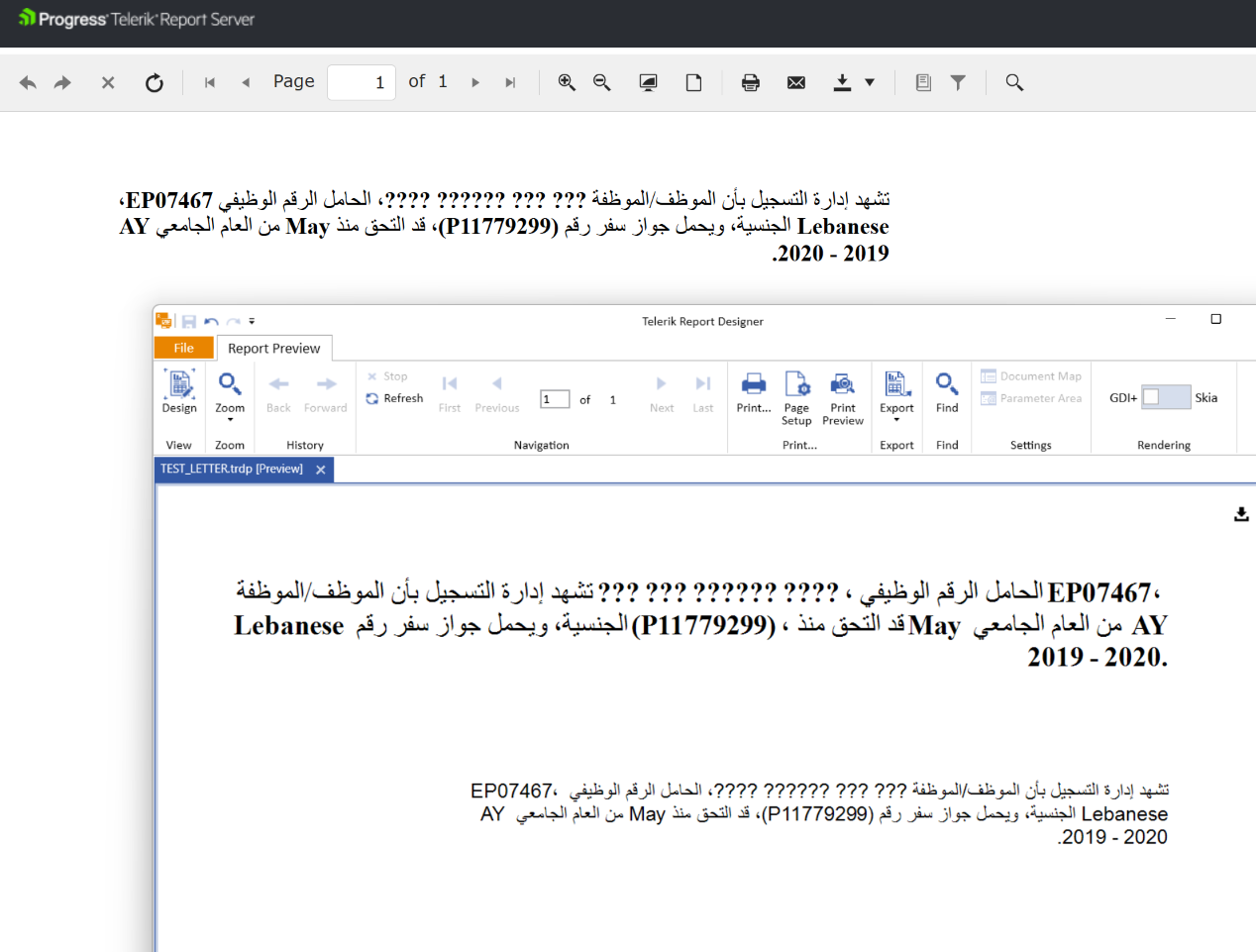
I have a Telerik report designed in the Standalone Report Designer. In the HTML5 Report Viewer, the report seems to be correct, but when I export the report in PDF, the word order changes.
The problem occurs in the HTMLTextBox when rendering in PDF and previewing in the Standalone Designer with both Skia and GDI+.
In the TextBox, the same text is displayed as expected.
When previewing in the HTML Report Viewer, the Arabic text seems fine.
WPF report viewer crashes when launching it the second time. The issue appears to occur only when having a trial license activated.
System.Windows.Data Error: 23 : Cannot convert '<null>' from type '<null>' to type 'System.Uri' for 'en-US' culture with default conversions; consider using Converter property of Binding. NotSupportedException:'System.NotSupportedException: UriTypeConverter cannot convert from (null).
   at System.ComponentModel.TypeConverter.GetConvertFromException(Object value)
   at System.ComponentModel.TypeConverter.ConvertFrom(ITypeDescriptorContext context, CultureInfo culture, Object value)
   at System.UriTypeConverter.ConvertFrom(ITypeDescriptorContext context, CultureInfo culture, Object value)
   at MS.Internal.Data.DefaultValueConverter.ConvertHelper(Object o, Type destinationType, DependencyObject targetElement, CultureInfo culture, Boolean isForward)'
Exception thrown: 'System.NullReferenceException' in Telerik.ReportViewer.Wpf.dll
Object reference not set to an instance of an object.