

In the Q3 2026 release, Telerik Reporting updated the kendo font icons used by the web report viewers. Those icons are loaded alongside the report viewers and are not scoped to them, so they override the icons for elements outside the viewers.
For example, the Telerik UI for AJAX product is currently using kendo font icon subset that is older, so when I load the HTML5/HTML% WebForms report viewer on the page, AJAX's icons are overridden and incorrect.
Migrate the web reports viewers to use Kendo SVG Icons instead of the current font icons implementation, as they allow for better flexibility and render more nicely on the page, and will avoid the issue with overriding font icons when the viewers are used with other Telerik products.

The Telerik.Reporting documentation mentions that the Telerik.Reporting.* libraries should be available on nuget.org with the most recent release. However, when I search for Telerik.Reporting in the NuGet Gallery, I am not able to find any Telerik.Reporting.* package. The other products we use (UI for WPF, Document Processing) seem to be available though.
-----------------------------------------
Staff note: On the Reporting side, our initial goal was indeed to make Telerik Reporting available through nuget.org, alongside the rest of the Telerik product portfolio. However, we are currently investigating an issue that is preventing us from publishing the Telerik.Reporting packages to nuget.org, which has delayed their availability.
Please use this feedback item to subscribe to updates and receive a notification as soon as the Telerik.Reporting packages become available on nuget.org.
When I enable accessibility in my reports, the final PDF document becomes 20+ times bigger than without accessibility. The reports contain large amounts of data and result in 2000+ pages.
I need the images in my reports (usually only one logo) to have alternative text, so the screen readers can describe them. To achieve this, currently I have to enable accessibility for the entire report, hence the huge final documents.
It would be very useful for my scenario to add alternative text to the PictureBox without declaring the entire report as accessible.

I am using the HTML5 report viewer and seeing 4 errors in the WAVE tool, along with multiple alerts. See: https://wave.webaim.org/report#/https://demos.telerik.com/reporting/product-sales
Please consider addressing them.

I use the exportBegin event to prevent the default export logic. However, when I do that, the default viewer notification remains, and I have to hide it manually:
                    exportBegin: function (e, args) {
                        args.handled = true; // Set to true to cancel the default export behavior.
                        //...
                        $(".trv-notification").addClass("k-hidden");
                    },
Double-click selection in the expression editor isn't context-aware. In almost every other application, double-clicking selects a token based on its surrounding context — a single field/identifier when clicking on a field, or the word boundary within a string literal when clicking inside quotes. The expression editor doesn't respect these boundaries, so its double-click behaviour is inconsistent with the standard expression-editor behaviour users expect.
Expected: Double-click selects the relevant token based on context (e.g. an individual field reference, or a word within a string literal).
Actual: Double-click selection ignores context and does not match the token/word-boundary behaviour found in virtually all other expression editors and text inputs.
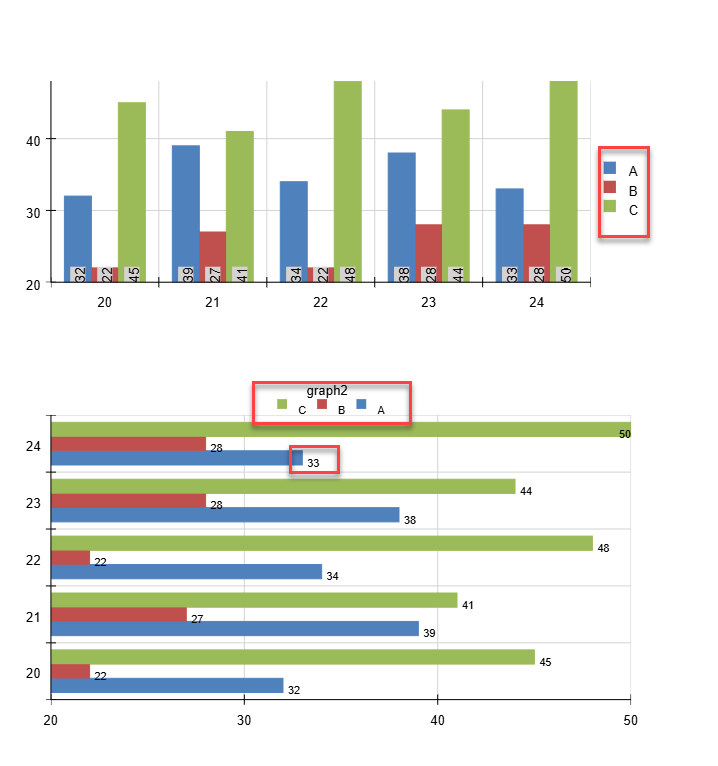
I have graphs in my report. I render them with Skia on Linux. The issue reproduces with Skia on Windows as well.
The legend labels are not aligned well with the color icon, and data labels on a horizontal bar chart (with OutsideEnd) are misaligned as well:



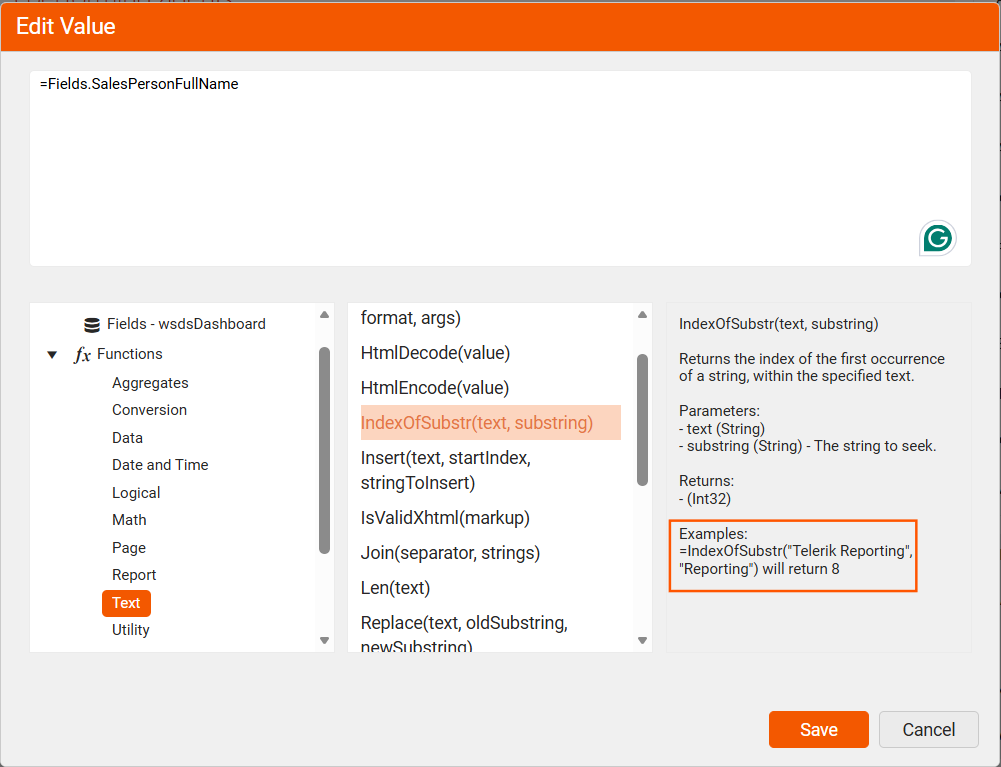
If I open the expression dialog in the Web Report Designer and select one of the available functions, I will see a sample snippet in the third column below the expression area.
This column is not selectable, so I cannot copy the example and test it out. This example should be copyable, so that each function can be easily tested in the report designer.
I have localized a report with a Graph in the 'ar-SA' culture.
When exporting to PDF from the viewer, the report is generated as expected. In the Report Viewer's Preview, though, the Graph Legend and Labels are not correct:
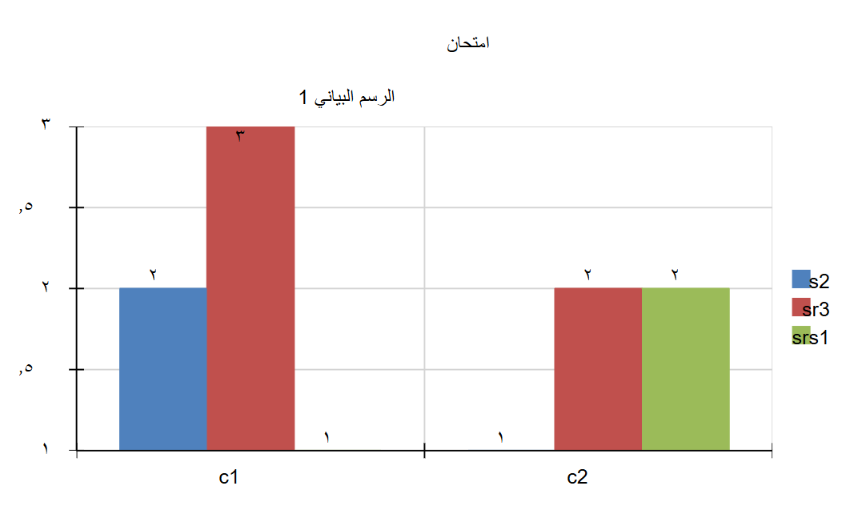
I am using Native Blazor Report Viewer, but the problem also reproduces in the HTML5-based web viewers, with all the themes I have tested.
Request:
Add a RedisStorage constructor overload that accepts StackExchange.Redis.IConnectionMultiplexer rather than only the concrete ConnectionMultiplexer.
Current behavior:
new RedisStorage(ConnectionMultiplexer connectionMultiplexer) requires the concrete type.
Problem:
Modern ASP.NET Core apps manage a single shared multiplexer through DI and expose it as IConnectionMultiplexer — the abstraction recommended by StackExchange.Redis, and the same type
Microsoft.Extensions.Caching.StackExchangeRedis uses via its ConnectionMultiplexerFactory (which returns IConnectionMultiplexer). To call RedisStorage we are forced to downcast our IConnectionMultiplexer back to
ConnectionMultiplexer. This is fragile and it prevents passing test doubles or decorators (e.g. for instrumentation/logging).
Proposed change:
Add RedisStorage(IConnectionMultiplexer connectionMultiplexer), plus a databaseNumber overload (RedisStorage(IConnectionMultiplexer connectionMultiplexer, int databaseNumber)). ConnectionMultiplexer already
implements IConnectionMultiplexer, so this is fully backward-compatible — existing callers that pass a concrete instance keep working unchanged. Everything RedisStorage needs is available on the interface
(GetDatabase for string operations and LockTake/LockRelease, GetSubscriber, GetServer).
Benefits:
- Clean dependency-injection integration with a shared, app-managed multiplexer.
- Unit-testability via a mocked IConnectionMultiplexer.
- Consistency with StackExchange.Redis guidance and Microsoft's own caching abstractions.
Note:
Please target the maintained Telerik.Reporting.Cache.StackExchangeRedis package (the .2 variant appears discontinued after 18.2.24.806 and has no 19.x/20.x release).
I am trying to use the following HTML content for the HtmlTextBox item:
<span style="font-weight:bold">Label 1:</span> <span>Data 1</span> <span style="font-weight:bold"> Label 2:</span> < span>Data 2</span>
However, the non-breaking space between the spans (label 1/data 1 and label 2/data 2) is not preserved.

I have a custom assembly with default 'version', 'culture', and 'publicKeyToken'.
When I reference the assembly in the 'assemblyReferences' element only with its 'name', the Reporting Engine recognizes it.
If I reference it with the full version, '1.0.0.0', it also works.
However, when I set the 'version' to '1.0.0', the Reporting Engine throws, stating that the assembly is not trusted and must be referenced in the 'assemblyReferences' element.
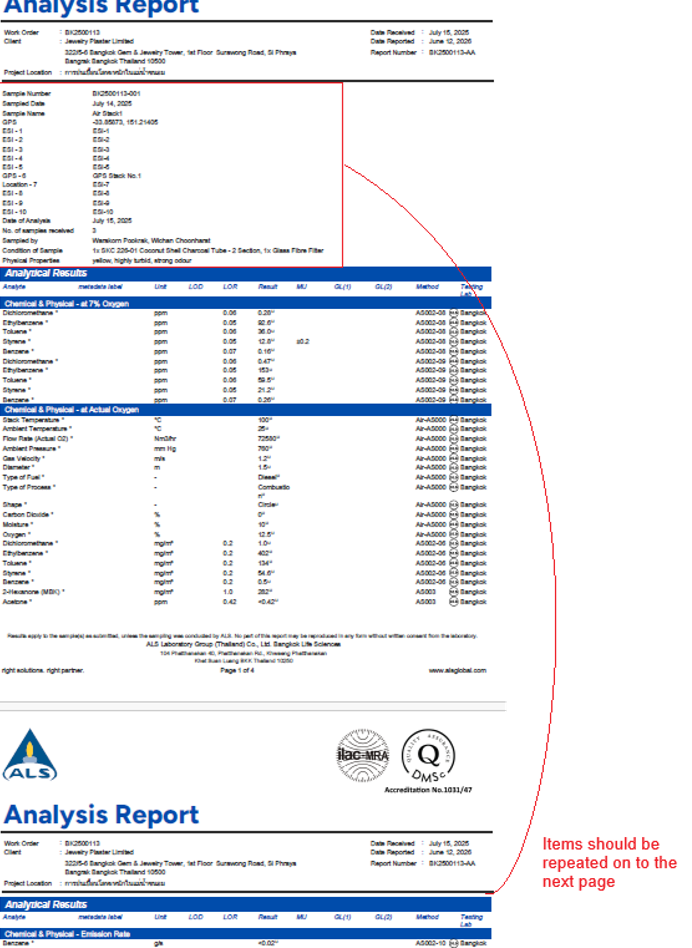
The attached sample has a simple table with two row groups, and "header" rows created via "Insert Row -> Outside Group - above".
The groups have "keep together" set.
But despite this, the header rows render at the bottom of one page, with data rows on the following page. This should never happen, I can't think of any case it would be expected (it would be like having "Chapter 2" at the bottom of a page when the text for it starts on the next page).
I also have a sample with just 1 row group, but with 2 detail rows, and the same thing happens. It only appears to work when there's just 1 row group and 1 detail row.