

The data source preview in the web report designer does not show the full shape of the query. It has no horizontal scroll bar to verify the preview data for the entire projection.
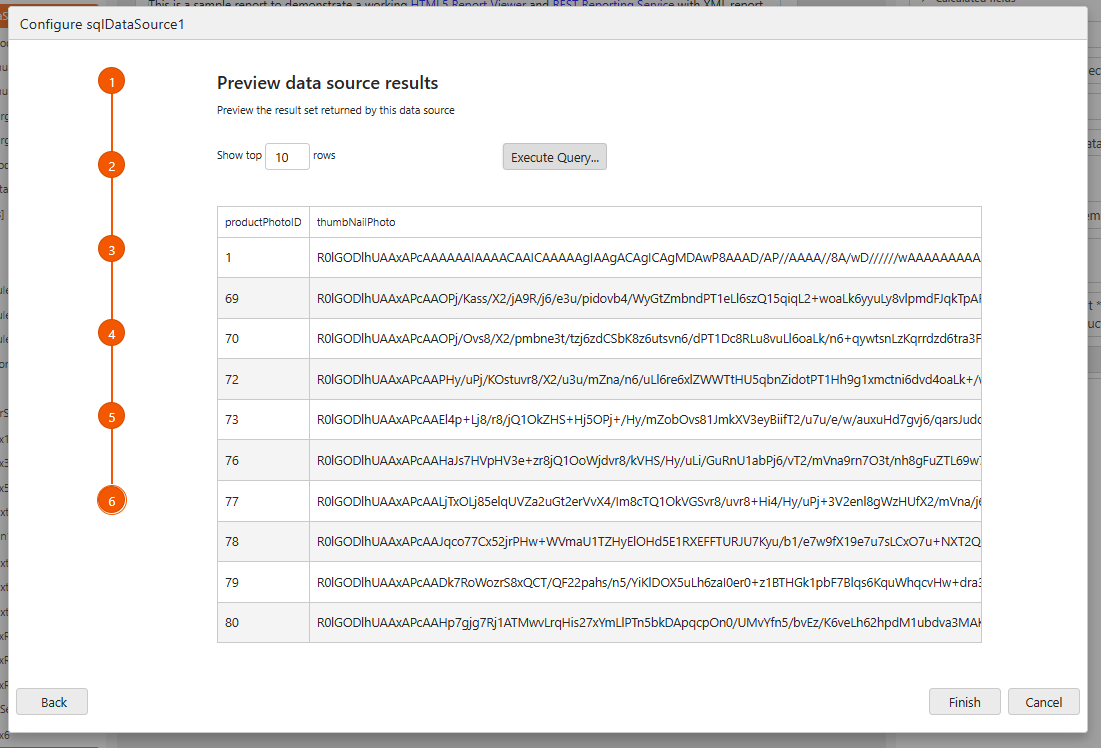
Please consider addressing this.

When a Table has a Group PageBreak that splits the Table into more than one page, the items below the table are rendered after the first part of the Table (after the first page break), rather than under the whole table.
The issue occurs in hard pagination: PrintPreview of the viewers, PDF, etc.
I have an SVG image that includes text, which uses the "Arial" font-family. On Windows, it renders correctly with GDI and SKIA. However, on Linux, an "Invalid Image Data" exception is thrown, and the image is not rendered. This happens when exporting to PDF and XLSX.
Furthermore, even though there is an exception, it is not caught by the Reporting engine, so RenderingResult.HasErrors returns false. The logic should be modified to catch this error and update the HasErrors flag.
So far, the issue seems to be specific to the Arial font. When I change font-family, the PDF document is created as expected.
In the Q3 2026 release, Telerik Reporting updated the kendo font icons used by the web report viewers. Those icons are loaded alongside the report viewers and are not scoped to them, so they override the icons for elements outside the viewers.
For example, the Telerik UI for AJAX product is currently using kendo font icon subset that is older, so when I load the HTML5/HTML% WebForms report viewer on the page, AJAX's icons are overridden and incorrect.
Migrate the web reports viewers to use Kendo SVG Icons instead of the current font icons implementation, as they allow for better flexibility and render more nicely on the page, and will avoid the issue with overriding font icons when the viewers are used with other Telerik products.
I have a CS report that contains a SubReport with InstanceReportSource. I have it in a .NET 10 Classlibrary project.
I tried to edit this report as a coded report in SRD.NET. However, when I saved the report, in the 'designer.cs' file, the value assigned to the ReportSource of the SubReport was set to 'userreport1' that is not instantiated and throws.
When adding localization in CS reports in the VS designer for .NET Framework 4.6.2, the latter adds calls to the ApplyResources function when setting report item values.
After editing and saving such coded reports in SRD.NET, though, they are deserialized differently, replacing the ApplyResources function calls with hardcoded strings. This breaks localization, although the resx files remain.

The Telerik.Reporting documentation mentions that the Telerik.Reporting.* libraries should be available on nuget.org with the most recent release. However, when I search for Telerik.Reporting in the NuGet Gallery, I am not able to find any Telerik.Reporting.* package. The other products we use (UI for WPF, Document Processing) seem to be available though.
-----------------------------------------
Staff note: On the Reporting side, our initial goal was indeed to make Telerik Reporting available through nuget.org, alongside the rest of the Telerik product portfolio. However, we are currently investigating an issue that is preventing us from publishing the Telerik.Reporting packages to nuget.org, which has delayed their availability.
Please use this feedback item to subscribe to updates and receive a notification as soon as the Telerik.Reporting packages become available on nuget.org.
As we install fonts regularly and don't want to restart/redeploy everytime we install a new font we propose a new api to clear the cache.
A new method Telerik.Reporting.Fonts.RefreshCache would solve this problem and improve the experience of using the Telerik Reporting library.
I have created a report group, and in that group's header, I have added a textbox with a sorting action.
The action can be triggered, but the data does not get sorted, regardless of whether the sorting target is the report itself or the group from which the group section is created.
When the reports are displayed within the WPF Report Viewer, they are rendered in the XAML format, and it does not natively support SVGs.
Currently, the SVGs are always rasterized before being written to the XAML, which results in the images being blurred when zooming in the report viewer.
When I enable accessibility in my reports, the final PDF document becomes 20+ times bigger than without accessibility. The reports contain large amounts of data and result in 2000+ pages.
I need the images in my reports (usually only one logo) to have alternative text, so the screen readers can describe them. To achieve this, currently I have to enable accessibility for the entire report, hence the huge final documents.
It would be very useful for my scenario to add alternative text to the PictureBox without declaring the entire report as accessible.

I am using the HTML5 report viewer and seeing 4 errors in the WAVE tool, along with multiple alerts. See: https://wave.webaim.org/report#/https://demos.telerik.com/reporting/product-sales
Please consider addressing them.

Currently, the Download Raw Data action is available in the Windows Form Report Viewer. It is hard-coded there, and the download button appears when you hover over the data item.
The developer can cancel the action through the interactive action event handlers. However, the button persists even when the action is cancelled and doesn't do anything, which is misleading and confusing for the report readers.
Please let the developers disable the action/button, for example, through configuration in the viewer.
We get an incorrect “Email format is not valid” validation when sending a report to multiple recipients. We are using the wrapper/HTML5 Angular Report Viewer
Steps to Reproduce
- Open any report in the Telerik Report Viewer.
- Click Send Email.
In the To field, enter multiple valid email addresses, for example:
user1@example.com,user2@example.comor
user1@example.com;user2@example.com- Click Send.
Actual Result
- The validation message "Email format is not valid." is displayed beneath the To field.
- Despite the validation error, the email is sent successfully to all recipients.
Expected Result
- Multiple valid email addresses should be accepted without displaying a validation error.
- Since the email is successfully delivered, no validation message should be shown.