

Using the Editor component with Form Support, if I choose the style Heading 1 and type some letter.
I clean the value using only backspace key on the keyboard and the value of the form control is <h1></h1>.
This is reproductible on the demo : https://www.telerik.com/kendo-angular-ui/components/editor/forms/#toc-template-driven-forms
- Choose Heading 1 style
- Type AAA
- The form value = <h1>AAA</h1>
- Clean the value using backspace
- The form value = <h1></h1>
Expected result
- The form value should be empty
It will be a good addition to the date formatting options if the week of year format is supported.
Current supported formats:
https://github.com/telerik/kendo-intl/blob/master/docs/date-formatting/index.md
Severity: Sev2 (High)
Test Environment: OS: Windows 11 22H2
OS Build: 23620.1000
Pre-Requisite: Turn on NVDA/Narrator.
Repro steps:
1.Now turn on NVDA/Narrator
2.Open this url "app.component.ts - nodebox - CodeSandbox".
3.Tab till preview tab which is present at right down corner.
4.Tab till quick filter input box and press enter.
5.Observe that NVDA/Narrator is not announcing Search results whether result is found or not.
Actual Result:
Narrator/NVDA is not announcing Search results whether result is found or not.
Expected Result:
Narrator/NVDA should announce Search results whether result is found or not.

1. Start using the Kendo Tree View in Angular.
2. Load a large dataset for the Kendo Tree View, observe the time taken to render the Tree View.
3. The timing will increase if the dataset keeps on increasing.
4. Suggest some ways to reduce or optimize it.
This is how I am using the Kendo TreeView in Angular,
Hello,
I want to request a new control (Powerpoint Viewer) that we can use to slide show Powerpoint (ppt or pptx) files.
the main purpose is to handle the previous and next clicks of slides.
Thanks,
Chakshuta Desai
I need access to Sketch support files containing the existing UI elements for Kendo for Angular so that I can create comps for my design.

Ideally this would be a collection of sketch symbols that match the current Kendo UI design.
It is really hard to check change log for every component you have. Why not implement common change log for all components.
I already talk to Carl Bergenhem (Product Manager for Kendo UI) about that, and he reply:
"
Great suggestion! I’ll sync this with our web site team and try to see if we can create something like this!
"
As picture says more then 1000 words, I attach propose solution.
https://stackblitz.com/edit/angular-5elhtu?file=src%2Fapp%2Fapp.component.ts
When a detail row is used, the moment you expand one row and scroll, it automatically loads the last items from the dataset.
Ex expand row 1 - start scrolling, and it suddenly loads 5xx th row+;
When grouping is also enabled - expanding the detail row under one group, expands it under all groups.
The stackbliz is from the kendo demo page for virtualscroll (with the added detail row).
minimized the last column to smallest and it's difficult to expand this column. Could you please help how to expand this column . Thanks.
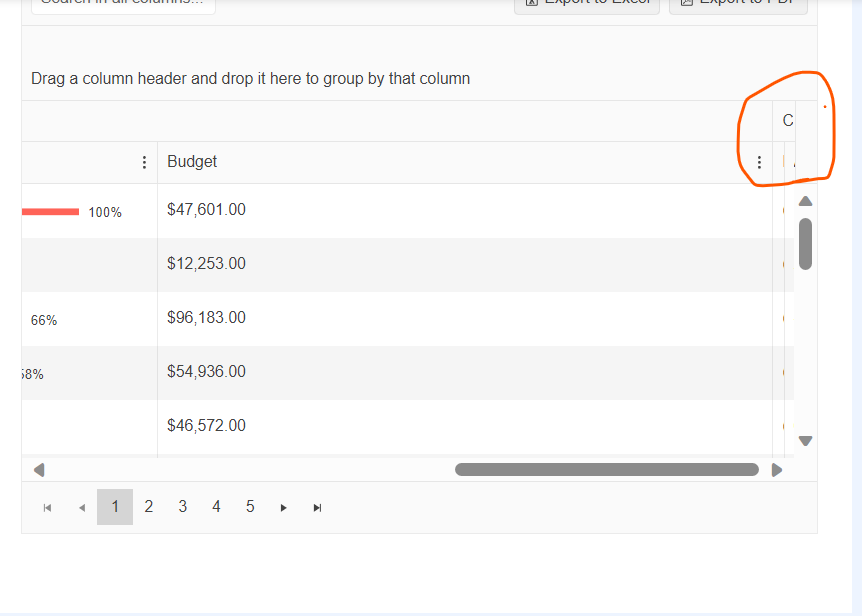
https://stackblitz.com/edit/angular-botsaf?file=src/app/app.component.ts
The internal element has a calculated width - but it only grows in value if slider width changes (responsive or even in CSS with media queries etc).
It permanently stays at the largest size.
These are the numeric symbols returned for a locale and so far the decimal, group and percentSign are the only properties that can be overwritten:
numbers: {
        symbols: {
            decimal: ",",
            group: " ",
            list: ";",
            percentSign: "%",
            plusSign: "+",
            minusSign: "-",
            exponential: "E",
            superscriptingExponent: "×",
            perMille: "‰",
            infinity: "∞",
            nan: "NaN",
            timeSeparator: ":"
}
Please allow customizing the rest of the properties (minusSign, nan, timeSeparator, etc). There are certain projects, where those symbols need to be customized.
Current behavior
Currently when calling toDataSourceRequest with a date filter, the following is observed:
- Set a filter with the Date object of Wed Sep 19 2018 00:00:00 GMT+0530 (India Standard Time)
- Call toDataSourceRequest or toDataSourceRequestString with the grid state
- The resulting query string contains datetime'2018-09-19T00-00-00'
- On the backend, MVC can bind the DataSourceRequest with DateTime of {2018/9/19 00:00:00} and an offset of ???
As you can see, the browser's UTC offset is discarded when constructing the query. This presents an issue when the backend server is running in a time zone that is different than the browser or is invariant. Internally toDataSourceRequest calls formatDateValue which calls toUTC. I propose adding an optional argument that allows us to skip this operation so that the offset can be kept as is, the reason being so that it can later be normalized to UTC without losing the information.
Expected behavior
Calling toDataSourceRequest with the option should produce the following:
- Set a filter with the Date object of Wed Sep 19 2018 00:00:00 GMT+0530 (India Standard Time)
- The resulting query string contains datetime'2018-09-18T18-30-00' (append Z if possible)
- On the backend, MVC can bind the DataSourceRequest with DateTime of {2018/9/18 18:30:00} and an offset of 0
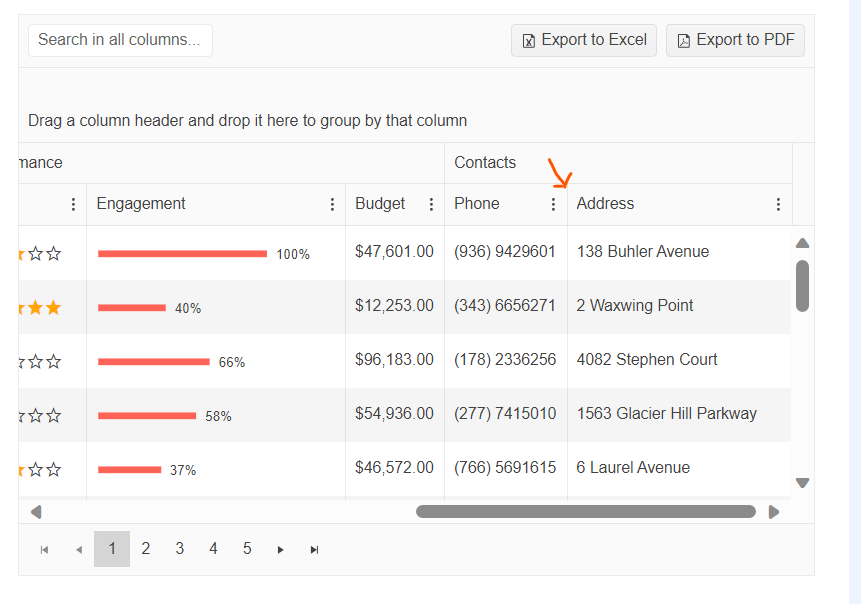
first double click on this column line .
scroll move to first column
Could you please help to solve this?
Test Environment:
Windows 11 Enterprise 22H2 22621.1848.
Narrator
Microsoft Edge Version 114.0.1823.79
Repro steps:
- Open link https://www.telerik.com/kendo-angular-ui/components/grid/examples/filter-all-columns/?theme=default-main&themeVersion=6.4.0
- Run Narrator
- Tab to the table present.
- Tab to the column header "Contact Name" and move to the column menu present and press enter
- check if the screen reader is announcing the column menu is expanded.
Actual Result:
When pressing enter on the column menu present beside the "Contact name" column header of the table, Screen reader is no announcing the state of the the column as it is expanded or collapsed because of the role set as link.
Expected Result:
When pressing enter on the column menu present beside the "Contact name" column header of the table, screen reader should be announcing the state of the column menu as it is expanded or collapsed, role should be set as button with expand collapse functionality.
Spreadsheet control as a separate component, or Grid control updated for AutoCOmplete and drag fill capabilities
Provide a built-in Image Editor component such as Kendo UI ASP.NET AJAX:
https://demos.telerik.com/aspnet-ajax/imageeditor/examples/imageupload/defaultcs.aspx
If you have a kendo grid table with some data over multiple pages and you go e.g. to the last page and then reload the data, resulting with less pages - the table is empty and you have to manually click on the first page to see the data. Here is a working example:
https://codesandbox.io/s/upbeat-lamarr-d67m8k?file=/src/app/app.component.ts
Step 1. Go to the last page
Step 2. Click on the button "'Reset data" <- you see no data
Step 3. Click on the first page <- You see the data
Hi, Team!
I would like to have a designated component in the Kendo UI for Angular suite that would provide built-in syntax highlighting and code editing experience for popular programming languages.
Similar to the WPF SyntaxEditor: https://www.telerik.com/products/wpf/syntaxeditor.aspx
We are exporting an Excel from a treelist -> there are merged cells, and the table has lots of rows (~20k).
It's taking forever (it's unusable) and the reason is that there is an O(N^2) bug in the toXML function: each row adds a merged cell range, and the mergedCells array is scanned linearly for every new row.
I was able to fix this by adding a mergedCells hash (I would be happy to create a pull request).
Also, as a related issue, it would be nice to be able to change the compression level on the generated zip file, because the default again takes forever for large enough files.