


foreach (ImageInline image in document.EnumerateChildrenOfType<ImageInline>().ToList())
{
	UriImageSource uriImageSource = (UriImageSource)image.Image.ImageSource;
	if (uriImageSource != null && !IsValid(uriImageSource.Uri.OriginalString))
	{
		image.Paragraph.Inlines.Remove(image);
	}
}
private static bool IsValid(string uri)
{
try
{
Path.GetExtension(uri);
}
catch (ArgumentException)
{
return false;
}
return true;
}
<w:pict ...>
  <v:shape ...>
	<v:fill opacity="39151f"/>
	<v:path .../>
	<w10:wrap anchorx="page" anchory="page"/>
  </v:shape>
</w:pict>

Wrongly imported/exported table cells from nested tables (see the picture below).
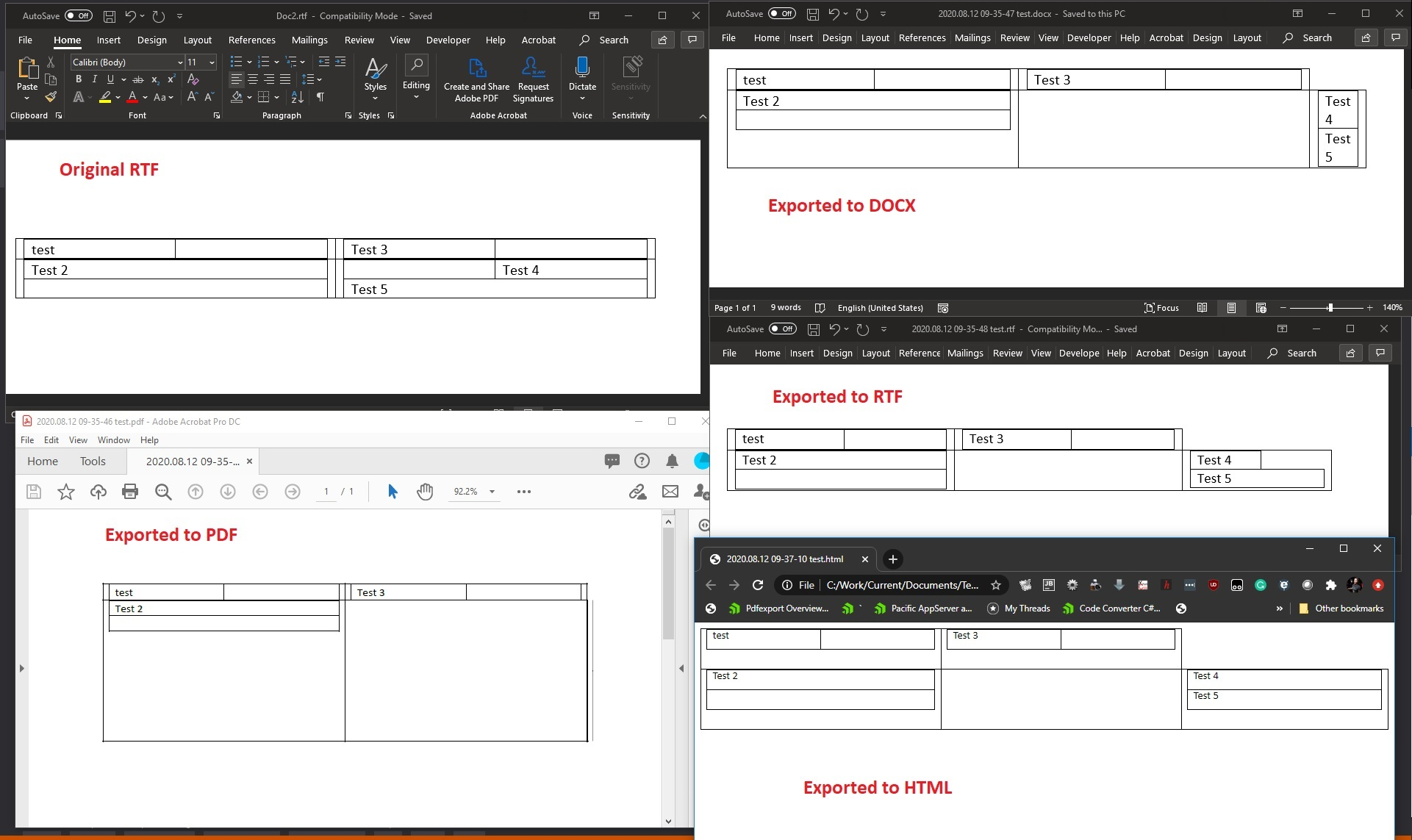
Tables should ignore fixed proffered width with the value of 0, this is the default behavior in Word as well.
Workaround (when converting Flow to PDF documents):
foreach (var item in tables)
{
    if (item.PreferredWidth.Type == Telerik.Windows.Documents.Flow.Model.Styles.TableWidthUnitType.Fixed &&
        item.PreferredWidth.Value == 0)
    {
        item.PreferredWidth = new Telerik.Windows.Documents.Flow.Model.Styles.TableWidthUnit(Telerik.Windows.Documents.Flow.Model.Styles.TableWidthUnitType.Percent, 100);
    }


}



Currently, the hyperlink is exported not as hyperlink text only but additionally, all the field data is included.
Steps to reproduce:
- Insert a hyperlink to the RadFlowDocument:
editor.InsertHyperlink(text:"telerik", uri:"http://www.telerik.com", isAnchor:false, toolTip:"Telerik site"); - Export to plain text using the TxtFormatProvider.
Actual: HYPERLINK "http://www.telerik.com" \o "Telerik site" Telerik
Expected: Telerik
Workaround:
IEnumerable<Run> runs = document.EnumerateChildrenOfType<Run>();
foreach (Run run in runs.ToList())
{
	if (run.Text.Trim().StartsWith("HYPERLINK"))
	{
		run.Paragraph.Inlines.Remove(run);
	}
}
From the Office Open XML specification:
gridAfter (Grid Columns After Last Cell):
This element specifies the number of grid columns in the parent table's table grid which shall be left after the last cell in the table row.
gridBefore (Grid Columns Before First Cell):
This element specifies the number of grid columns in the parent table's table grid which must be skipped before the contents of this table row (its table cells) are added to the parent table. [This property is used to specify tables whose leading edge (left for left-to-right tables, right for right-to-left tables) does not start at the first grid column (the same shared edge)]
Add support for inline lists.
When the display attribute is set to inline all items should be on the same row (see attached)
When a watermark needs more space than the available on the page, it should be resized. At this point, part of its content can be cut off as it falls outside of the page bounds.
Workaround: Decrease the size of the watermark prior to exporting it to PDF:
foreach (var section in this.document.Sections)
{
    Header header = section.Headers.Default;
    if (header != null)
    {
        foreach (Watermark watermark in header.Watermarks)
        {
            if (watermark.TextSettings != null && watermark.TextSettings.Width > section.PageSize.Width)
            {
                watermark.TextSettings.Width = section.PageSize.Width;
            }
        }
    }
}
The missing feature leads to this unwanted behavior:
- When there is content control, which generates content on interaction, and it has some custom run properties set to it, they are lost when the user modifies it.
As a workaround, you need to apply a custom style (with the desired run properties) and apply it to the content control.