

When using Telerik Document Processing (PdfProcessing) for embedding Factur-X invoices, the produced PDF document is Non‑compliant with PDF-AF / Factur‑X according to the following validator:
https://www.superpdp.tech/outils/validateur-facture-electronique/

After merging several PDF documents, some pages are blank indicating the following error:



https://loc.gov/preservation/digital/formats/fdd/fdd000532.shtml
PDF/A‑4f is a version of PDF/A designed for archival storage that:
- Ensures long‑term visual and structural preservation
- Is based on modern PDF 2.0
- Allows embedded files (attachments) that are also archival‑compliant

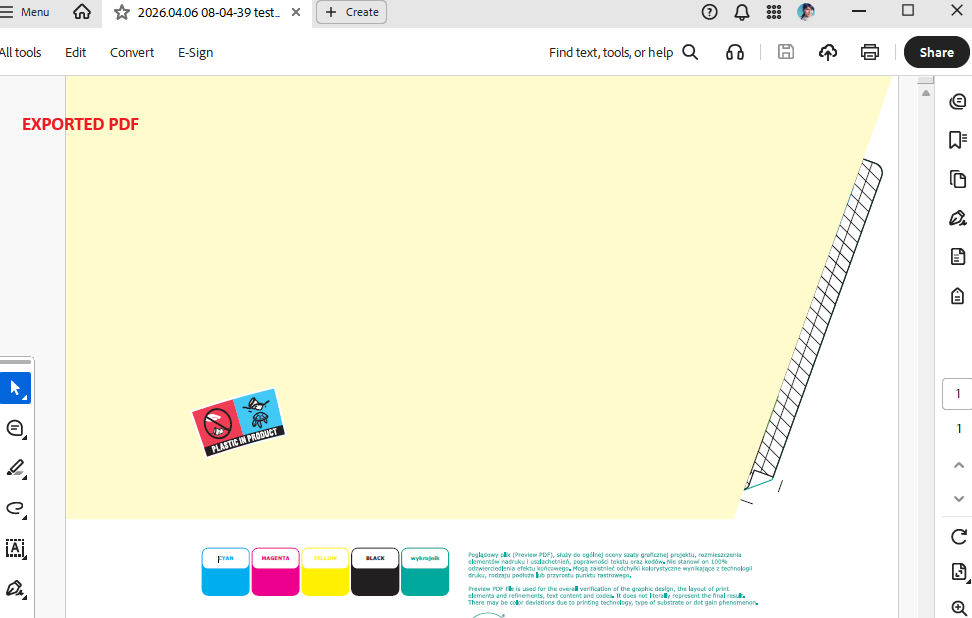
NetStandard: Missing content due to empty glyph outlines in embedded TrueType font subsets.
Workaround 1
Fully embed the fonts in the result PDF document:
PdfFormatProvider pdfFormatProvider = new PdfFormatProvider();
pdfFormatProvider.ExportSettings.FontEmbeddingType = FontEmbeddingType.Full;
Workaround 2
Switch to a .NET Framework project environment and use the .NET Framework PdfProcessing packages.

Here is a sample structure of the signature:
/Type /Sig
/SubFilter /adbe.x509.rsa_sha1
/Filter /Adobe.PPKMS


InvalidOperationException is thrown when exporting a PDF document with a set compliance that processes Type3 font glyphs.
Workaround: Before export, set compliance to None.
var provider = new PdfFormatProvider();
provider.ExportSettings.ComplianceLevel = PdfComplianceLevel.None;
Endless loop on PDF export when an empty string is assigned to text fields with no source /V and auto-sized default appearance (/DA with 0 Tf).
Workaround: Instead of an empty string (""), set the value to null. Or don't set it at all and leave it unmodified.
The widgets then contain valid "/Off" appearance states, but their model Option property is null. During export, FieldPropertiesExporter accesses widget.Option.Value, causing a "NullReferenceException: Object reference not set to an instance of an object."
The issue is reproducible by merging the same four-page form twice. The resulting PDF contains all widget annotations, but PDF viewers do not resolve the second form’s interactive fields correctly.
Wrapped table cell text is incorrectly split by hyphens ("-").
This is a regression introduced in version 2026.3.826. Use an older version to avoid this issue.
HTML importer creates hyperlink field markers for <a name="...">. During block replacement, cloned FieldCharacter instances lose FieldInfo, leaving orphan field markers. PDF exporter later dereferences FieldInfo and throws a NullReferenceException.