

Bug report
When a Grid's row is reordered and then the changes are saved - a Destroy request is sent to the server for the dataItem of the reordered row. This happens even though no changes are applied to dataItem of the reordered row.
Reproduction of the problem
- Run this Telerik REPL or this Dojo
- Reorder a row
- Open the browser's Network Tab
- Click the Save Changes button
Expected/desired behavior
The Grid should request the reordered item to be perished from the backend.
Environment
- Kendo UI version: 2023.2.718

Is it possible to add an option to enable/disable the valuePrimitive of the DropDownList editor of a Foreign Key column in the Grid? This way, the ForeignKey column can be configured to allow null values.

Currently, calling the ClientTemplate method of the Grid's ToolBar overrides any previously defined commands.
It would be really useful to expose an option to use the Template component to define a custom command for the Grid's ToolBar, instead of having to rewrite the entire TollBar in the ClientTemplate configuration.

In the latest version (2023.2.718), the Column Menu in the Grid faild to open if you set the Groupable option to false.
To reproduce the issue simply change the line below in the Grid Overview Demo
.Groupable(g=>g.ShowFooter(false))to the following:
.Groupable(false)
https://netcorerepl.telerik.com/cxkhGOvU52pBO4NK33
The error you get when clicking on the Column Menu is:
Uncaught TypeError: Cannot read properties of undefined (reading '_canDrag')
    at init._updateGroupColumns (kendo.all.js:321370:19)
    at init._open (kendo.all.js:321370:19)
    at init.trigger (kendo.all.js:321370:19)
    at init._trigger (kendo.all.js:321370:19)
    at init.open (kendo.all.js:321370:19)
    at init.toggle (kendo.all.js:321370:19)
    at init._click (kendo.all.js:321370:19)
    at HTMLAnchorElement.dispatch (jquery.min.js:3:12445)
    at r.handle (jquery.min.js:3:9174)
### Bug report
When dragging and dropping a row within the Grid, the DOM element of the drag handle receives duplicated classes and styles.
### Reproduction of the problem
1) Enable the Drag & Drop functionality of the Grid.
2) Drag and drop a row within the Grid.
3) Inspect the DOM element of the drag handle - it has multiple duplicated classes and styles:
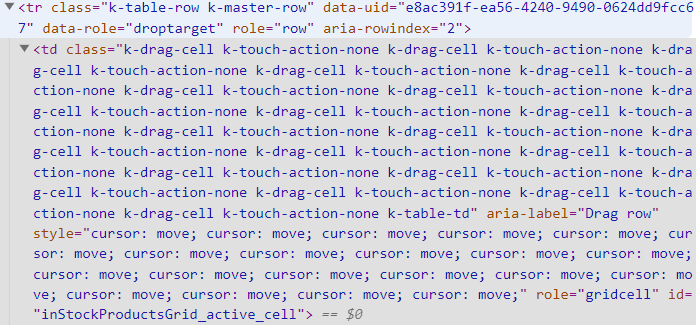
A Dojo sample for reproduction: https://dojo.telerik.com/IRotEKEX
### Environment
* **Kendo UI version: 2023.2.606
* **jQuery version: 1.12.4
* **Browser: [all]
Bug report
When tabbing in a batch editable Grid cells do not enter edit mode.
This is a regression introduced with v 2023.2.606.
Reproduction of the problem
- Run this dojo
- Click on a cell in Product Name column - an editor is generated
- Press the Tab key
Current behavior
The corresponding Unit Price is focused, but an editor is not generated
Expected/desired behavior
The cell should enter edit mode, as with v2023.1.425 - dojo
Environment
- Kendo UI version: 2023.2.606
- Browser: [all]
Bug report
Group Paging is not working as expected when the Kendo UI Grid is populated from data deserialized from a file and multiple groups are defined.
Reproduction of the problem
Using the UI for ASP.NET Core Grid, populate it with a file, set GroupPaging to true, add more than one group, and set the default serialization:
 builder.Services.AddControllersWithViews()
            .AddJsonOptions(options =>
                options.JsonSerializerOptions.PropertyNamingPolicy = null);@(Html.Kendo().Grid<MyViewModel>()
        .Name("grid")
        .Groupable()
        .Scrollable(s=>s.Virtual(true))
        .DataSource(dataSource=>dataSource
            .Ajax()
            .GroupPaging(true)
            .PageSize(50)
            .Read("ReadFromFile", "HomeController")
            .Group(x=>
            {
               x.Add(y=>y.Group1);
               x.Add(y=>y.Group2);
            })
        )
        //...)
Current behavior
With multiple groups, the follow error message will appear:
System.ArgumentNullException: Value cannot be null. (Parameter 'source')
   at System.Linq.ThrowHelper.ThrowArgumentNullException(ExceptionArgument argument)
   at Kendo.Mvc.Infrastructure.Group.InitializeSubgroups()
   at SubgroupsGetter(Object )
   at System.Text.Json.Serialization.Metadata.JsonPropertyInfo`1.GetMemberAndWriteJson(Object obj, WriteStack& state, Utf8JsonWriter writer)
   at System.Text.Json.Serialization.Converters.ObjectDefaultConverter`1.OnTryWrite(Utf8JsonWriter writer, T value, JsonSerializerOptions options, WriteStack& state)
   at System.Text.Json.Serialization.JsonConverter`1.TryWrite(Utf8JsonWriter writer, T& value, JsonSerializerOptions options, WriteStack& state)
   at System.Text.Json.Serialization.JsonConverter`1.TryWriteAsObject(Utf8JsonWriter writer, Object value, JsonSerializerOptions options, WriteStack& state)
   at System.Text.Json.Serialization.JsonConverter`1.TryWrite(Utf8JsonWriter writer, T& value, JsonSerializerOptions options, WriteStack& state)
   at System.Text.Json.Serialization.Converters.IEnumerableConverter`1.OnWriteResume(Utf8JsonWriter writer, TCollection value, JsonSerializerOptions options, WriteStack& state)
   at System.Text.Json.Serialization.JsonCollectionConverter`2.OnTryWrite(Utf8JsonWriter writer, TCollection value, JsonSerializerOptions options, WriteStack& state)
   at System.Text.Json.Serialization.JsonConverter`1.TryWrite(Utf8JsonWriter writer, T& value, JsonSerializerOptions options, WriteStack& state)
   at System.Text.Json.Serialization.Metadata.JsonPropertyInfo`1.GetMemberAndWriteJson(Object obj, WriteStack& state, Utf8JsonWriter writer)
   at System.Text.Json.Serialization.Converters.ObjectDefaultConverter`1.OnTryWrite(Utf8JsonWriter writer, T value, JsonSerializerOptions options, WriteStack& state)
   at System.Text.Json.Serialization.JsonConverter`1.TryWrite(Utf8JsonWriter writer, T& value, JsonSerializerOptions options, WriteStack& state)
   at System.Text.Json.Serialization.JsonConverter`1.WriteCore(Utf8JsonWriter writer, T& value, JsonSerializerOptions options, WriteStack& state)
   at System.Text.Json.Serialization.JsonConverter`1.WriteCoreAsObject(Utf8JsonWriter writer, Object value, JsonSerializerOptions options, WriteStack& state)
   at System.Text.Json.JsonSerializer.WriteCore[TValue](JsonConverter jsonConverter, Utf8JsonWriter writer, TValue& value, JsonSerializerOptions options, WriteStack& state)
   at System.Text.Json.JsonSerializer.WriteStreamAsync[TValue](Stream utf8Json, TValue value, JsonTypeInfo jsonTypeInfo, CancellationToken cancellationToken)
   at System.Text.Json.JsonSerializer.WriteStreamAsync[TValue](Stream utf8Json, TValue value, JsonTypeInfo jsonTypeInfo, CancellationToken cancellationToken)
   at System.Text.Json.JsonSerializer.WriteStreamAsync[TValue](Stream utf8Json, TValue value, JsonTypeInfo jsonTypeInfo, CancellationToken cancellationToken)
   at Microsoft.AspNetCore.Mvc.Infrastructure.SystemTextJsonResultExecutor.ExecuteAsync(ActionContext context, JsonResult result)
   at Microsoft.AspNetCore.Mvc.Infrastructure.ResourceInvoker.<InvokeNextResultFilterAsync>g__Awaited|30_0[TFilter,TFilterAsync](ResourceInvoker invoker, Task lastTask, State next, Scope scope, Object state, Boolean isCompleted)
   at Microsoft.AspNetCore.Mvc.Infrastructure.ResourceInvoker.Rethrow(ResultExecutedContextSealed context)
   at Microsoft.AspNetCore.Mvc.Infrastructure.ResourceInvoker.ResultNext[TFilter,TFilterAsync](State& next, Scope& scope, Object& state, Boolean& isCompleted)
   at Microsoft.AspNetCore.Mvc.Infrastructure.ResourceInvoker.InvokeResultFilters()
--- End of stack trace from previous location ---
   at Microsoft.AspNetCore.Mvc.Infrastructure.ResourceInvoker.<InvokeNextResourceFilter>g__Awaited|25_0(ResourceInvoker invoker, Task lastTask, State next, Scope scope, Object state, Boolean isCompleted)
   at Microsoft.AspNetCore.Mvc.Infrastructure.ResourceInvoker.Rethrow(ResourceExecutedContextSealed context)
   at Microsoft.AspNetCore.Mvc.Infrastructure.ResourceInvoker.Next(State& next, Scope& scope, Object& state, Boolean& isCompleted)
   at Microsoft.AspNetCore.Mvc.Infrastructure.ResourceInvoker.InvokeFilterPipelineAsync()
--- End of stack trace from previous location ---
   at Microsoft.AspNetCore.Mvc.Infrastructure.ResourceInvoker.<InvokeAsync>g__Logged|17_1(ResourceInvoker invoker)
   at Microsoft.AspNetCore.Mvc.Infrastructure.ResourceInvoker.<InvokeAsync>g__Logged|17_1(ResourceInvoker invoker)
   at Microsoft.AspNetCore.Routing.EndpointMiddleware.<Invoke>g__AwaitRequestTask|6_0(Endpoint endpoint, Task requestTask, ILogger logger)
   at Microsoft.AspNetCore.Authorization.AuthorizationMiddleware.Invoke(HttpContext context)
   at Microsoft.AspNetCore.Diagnostics.DeveloperExceptionPageMiddleware.Invoke(HttpContext context)
Expected/desired behavior
Server GroupPaging should work as expected with multiple groups and the default serialization that is delivered with ASP.NET Core. An example would be this live demo.
Workaround
Use the Newtonsoft library to set the serialization options for the application:
builder.Services.AddControllersWithViews()
  .AddNewtonsoftJson(options => options.SerializerSettings.ContractResolver = new Newtonsoft.Json.Serialization.DefaultContractResolver());
Environment
- Kendo UI version: 2023.2.606
- jQuery version: All Supported Versions
- Browser: all
Bug report
Reproduction of the problem
- Open the following dojo.
- Open the filter menu for the "category" field.
- Interact with the second DropDownList with the "-Select Value-" option label.
Current behavior
The second criterion DropDownList in the Filter Menu does not show records upon interaction:

Expected/desired behavior
The second criterion DropDownList in the Filter Menu should show records upon interaction:

Environment
- Kendo UI version: 2023.2.606
- Browser: [all]
If I put the Grid into a kendo-template for the TileLayout control, the ClientTemplate does not work properly. It only gets called once regardless of the number of items in the grid and the data is not being passed in.
This is my column definition:
columns.Bound(c => c.DocumentKey).Title(" ").ClientTemplate("#=CommandTemplate(data)#").Width(70);
And I am calling the .ToClientTemplate() on the Grid. Everything else work great except for this one issue.
I have not been able to find any other info, so what am I missing?
Bug report
Tooltip produces inconsistent behavior upon hovering when the content is configured through the content client-side configuration.
Reproduction of the problem
- Navigate to the Loading Content with AJAX or the Content Template demos.
- Hover over the first element.
- Hover over the second element and notice that the content is not shown.
Current behavior
For every second hover, the Tooltip does not display the element's content.
Expected/desired behavior
For every second hover, the Tooltip should display the element's content.
Environment
- Kendo UI version: 2023.1.314
- Browser: [all]
I have a model with configured Display and Required DataAnnotation.
However the TagHelper Grid doesn't serialize them because it is lacking a configuration property to bind to a Model like the HtmlHelper does:
@(Html.Kendo().Grid<Kendo.Mvc.Examples.Models.CustomValidationProductViewModel>()
        .Name("grid")
        ...
 )
Can this capability be implemented for the TagHelper as well?
Expose the ability to specify an Edit Form Type mode for the Grid similar to the Telerik UI for ASP.NET AJAX control:
https://demos.telerik.com/aspnet-ajax/grid/examples/data-editing/edit-form-types/defaultcs.aspx
### Bug report
When the Grid group paging is enabled, and the Grid is grouped, when the user search through the built-in search panel, and expand a specified group, an infinite loop appears. The Grid sends Read requests, and the server returns empty "data" property.
### Reproduction of the problem
1) Create a Grid bound to remote data and enable the group paging feature.
2) Group the Grid by a specified column.
3) Enter a value in the Grid search panel (the grouped data is filtered).
4) Expand a specified group --> it causes an infinite loop.
5) Open the browser Network tab to review the Read requests.
A Dojo sample for reproduction: https://dojo.telerik.com/EsuQoQiP
### Expected/desired behavior
The grouped Grid data should be filtered through the search panel as expected.
### Environment
* **Kendo UI version: 2023.1.117
* **jQuery version: 1.12.4
* **Browser: [all]
Bug report
Filtering a column bound to a complex object throws a JavaScript error.
This is a regression introduced with v 2023.1.117
Uncaught TypeError: Cannot convert undefined or null to object
    at Function.keys (<anonymous>)
    at x (kendo.all.js:313050:21)
    at init._createForm (kendo.all.js:313050:21)
    at init._init (kendo.all.js:313050:21)
    at init._click (kendo.all.js:313050:21)
    at HTMLAnchorElement.dispatch (jquery.min.js:3:12445)
    at r.handle (jquery.min.js:3:9174)
Reproduction of the problem
Current behavior
JavaScript error is thrown and the filter menu is not generated.
Expected/desired behavior
Filtering should work as expected.
Environment
- Kendo UI version: 2023.1.117
- Browser: [all]