

I understand that the ReportViewer has a very different paradigm from, say, the RadGridView. However, I believe they should and could be much more similar. With some fairly minor tweaks ReportViewer could be made to be a proper member of the C#/XAML/MVVM environment. Particularly what is needed is a binding to the data source, just like RadGridView's "ItemsSource".
I've begun a discussion in the forum about this topic at https://www.telerik.com/forums/reporting-and-mvvm. With Momchil's help I was able to create a workable solution for my scenario, but it required code that, in my opinion, I shouldn't have to write.
I'd be more that willing to chat about this further and provide more thoughts and details, but since we've made it all the way to 2024 without this being raised, I tend to assume the needs I've expressed may not be as universal as I'd assumed they would be.
Thanks!
In my report, I show a tiny goat symbol with the font 'Segoe UI Emoji'. It looks good in the Standalone Designer for .NET Framework, but it is not shown in the PDF export from my .NET application, although the font is correctly embedded.
In the Standalone Report Designer for .NET 8, the goat is not displayed when previewing or exporting either.
When the end-user closes the browser or the window where the web report viewer is rendering the report, the report rendering is not automatically cancelled on the server.
The report rendering should stop when the browser/window is closed.
When I render a report with Gujarati language text to PDF on Windows, the GDI graphics engine is used and the text is displayed properly.
When I render the same report with the Skia graphics engine, on Windows or Linux, the characters are misplaced or incorrectly drawn.
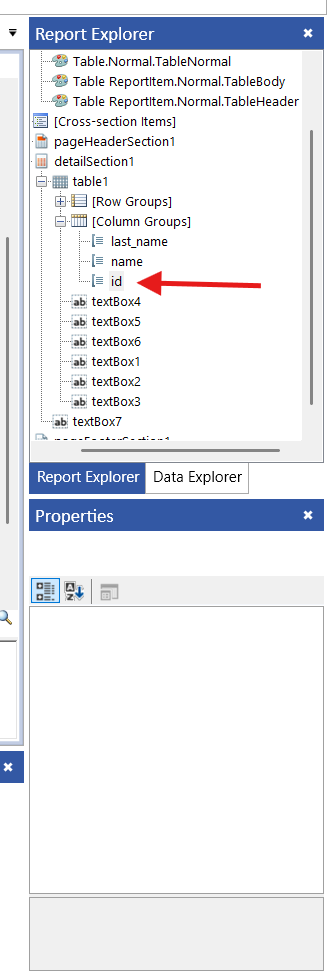
Group properties are not visible in the item tree of the Telerik Report Designer for .NET.
The report items that have explicitly set background in the report definition are not highlighted by the Search functionality of the viewer when their content matches the search.
Reproducible with Blazor Native Report Viewer.
Partially reproducible with HTML5 Viewer - the highlighted (when selecting the item in the Search list) class is applied but the shaded is not.
The workaround is to use the following styles on the page with the viewer:
<style>
    .trv-report-viewer-wrapper .trv-search-dialog-highlighted-result {
        background-color: rgba(0, 35, 102, 0.3);
        color: #fff;
        background-image: none;
    }

    .trv-report-viewer-wrapper .trv-search-dialog-shaded-result {
        background-color: rgba(255, 140, 0, 0.3);
    }
</style>
In the WebReportDesigner, when resizing a table cell on the designer-Element (NOT through the properties area), the Units of width and height are always reset to pixel.
The selected unit should not change when resizing the table cell/column/row.

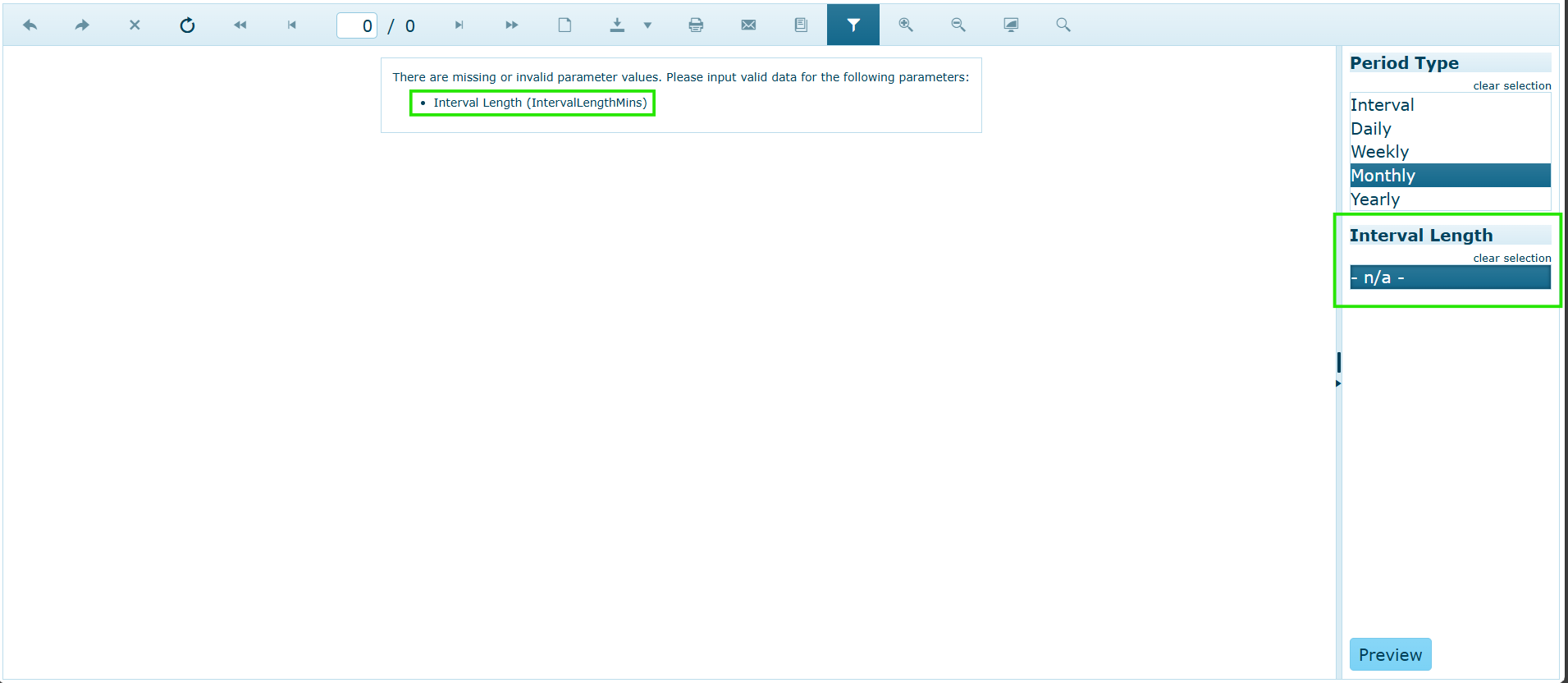
We use some cascading/dependant parameters and, in some cases, these have their "value" property (initial/default) value unset, generally to prevent the viewer auto-run as well as to give the user a chance to select first.
The dependant parameters have their Value properties set to the ValueMember field(e.g. =Fields.value) so when the cascading parameter is selected, the dependant will have a valid value set.
However, the "missing or invalid parameter" still shows that the dependant parameter has an invalid value.For example:
In some cases, the engine will not render the graph and will instead display the message
The current NumericalScale settings would result in more than 1000 labels which will make the scale unreadable. Please set the axis/ grid lines visibility to False or change the corresponding property.
The reason to see this or similar messages is that the selected LabelStep, MajorStep, or MinorStep scale property has a value that is too small and the processing engine will violate the previously mentioned constraint numbers.
The issue is fixed by manually correcting the values for those properties but I wish that the automatic configuration would be better.
Currently, there is design-time support for the WinFoms Report Viewer in the VS Designer only when the project targets .NET Framework. I need this functionality to be supported in .NET WinForms projects as well.
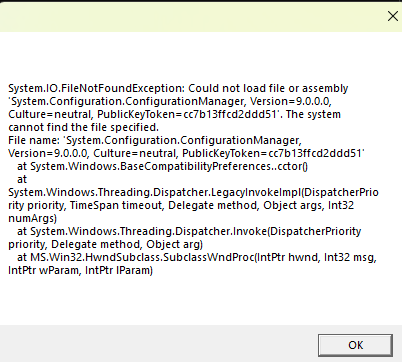
I followed the instructions from the Loading .NET 9 assemblies in the Standalone Report Designer for .NET - Telerik Reporting article to use the Standalone Report Designer for .NET with the .NET 9 runtime so that I can load .NET 9 assemblies in it but it crashes on startup:

When trying to open reports from an assembly in the Standalone Report Designer so that they can be imported, if there are types that inherit from Telerik.Reporting.Report that do not have a parameterless constructor, this will cause an exception as it is required for the report types to have such a constructor, otherwise, the wizard cannot import them into TRDP.
In this scenario, the report types that do not have a parameterless constructor should be written to the trace or in the exception message dialog so that the user can see which are the problematic types and correct them.
I have created an abstract class in my report library that inherits from Telerik.Reporting.Report. When I try to load the project's assembly in the Standalone Report Designer to import those reports as TRDP, an exception is thrown while the application tries to load the assembly that there are report types that do not have a parameterless constructor.
To resolve the issue, I had to remove the 'abstract' modifier. However, that should not be necessary. The wizard should ignore abstract classes or at the very least, let me import the other report types while displaying a message that there are report types with parameterless constructors.
2. Toolbar Button Properties: Along with this, since IReportViewerTool exposes the Icon and CommandName, request it also expose an Enabled property. At a bare minimum, it would be helpful if, while rendering, all but the 'Stop Rendering' (Cancel) and Pager buttons are disabled by default or by setting a new viewer property.
Currently we must use JSInterop to accomplish these things.
The reason we are managing these things in the first place is because we are using Custom Parameter Editors (CPEs). When a long-running report is in the process of rendering, and a user changes a parameter and re-requests the report (either via our 'Retrieve' button or a viewer toolbar button), an unhandled exception occurs in _content/Telerik.ReportViewer.BlazorNative/js/reporting-blazor-viewer.js. So we make use of the OnRenderingBegin and OnRenderingEnd events to disable/enable the CPEs. The problem arises when the 'Stop Rendering' (Cancel) button is clicked. Since we cannot detect the button click, our CPEs remain disabled.
Hello,
the search results in a PDF generated with report is not correct. Again...
Please fix this bug and add this scenario to your tests.
Steps: Search for a text in a pdf.
When exporting an SVG image to PDF, polylines with stroke-dasharray are rendered incorrectly — the dash pattern is not applied.
Additionally, polylines with a stroke-width exhibit visual artifacts such as pixelation or inconsistent thickness.
Step by step instructions or code snippets how to reproduce the problem
- Save svg content (see below) as a file c:\test_svg_line_stroke.svg
- Create an empty report
- Add a picture box
- Select a value for the picture box - use file c:\test_svg_line_stroke.svg
- Go to preview - SVG is correct
- Click Export->Acrobat (PDF) file and export a PDF file
- Open PDF file to verify that the red line in a bottob does not have stroke-dasharray applied
If there's no black line with no stroke-dasharray - the red line in a bottom looks correct
test_svg_line_stroke.svg
<svg version="1.1" xmlns="http://www.w3.org/2000/svg" xmlns:xlink="http://www.w3.org/1999/xlink" xmlns:xml="http://www.w3.org/XML/1998/namespace" width="500" height="400" viewBox="0, 0, 500, 400" preserveAspectRatio="xMinYMin" transform="scale(1)">
  <polyline points="100, 100 400, 100" stroke-width="7" stroke-dasharray="40 40" style="fill:none;stroke:#FF0000;" />
  <polyline points="100, 200 400, 200" stroke-width="5" style="fill:none;stroke:#000000;" />
  <polyline points="100, 300 400, 300" stroke-width="7" stroke-dasharray="40 40" style="fill:none;stroke:#FF0000;" />
</svg>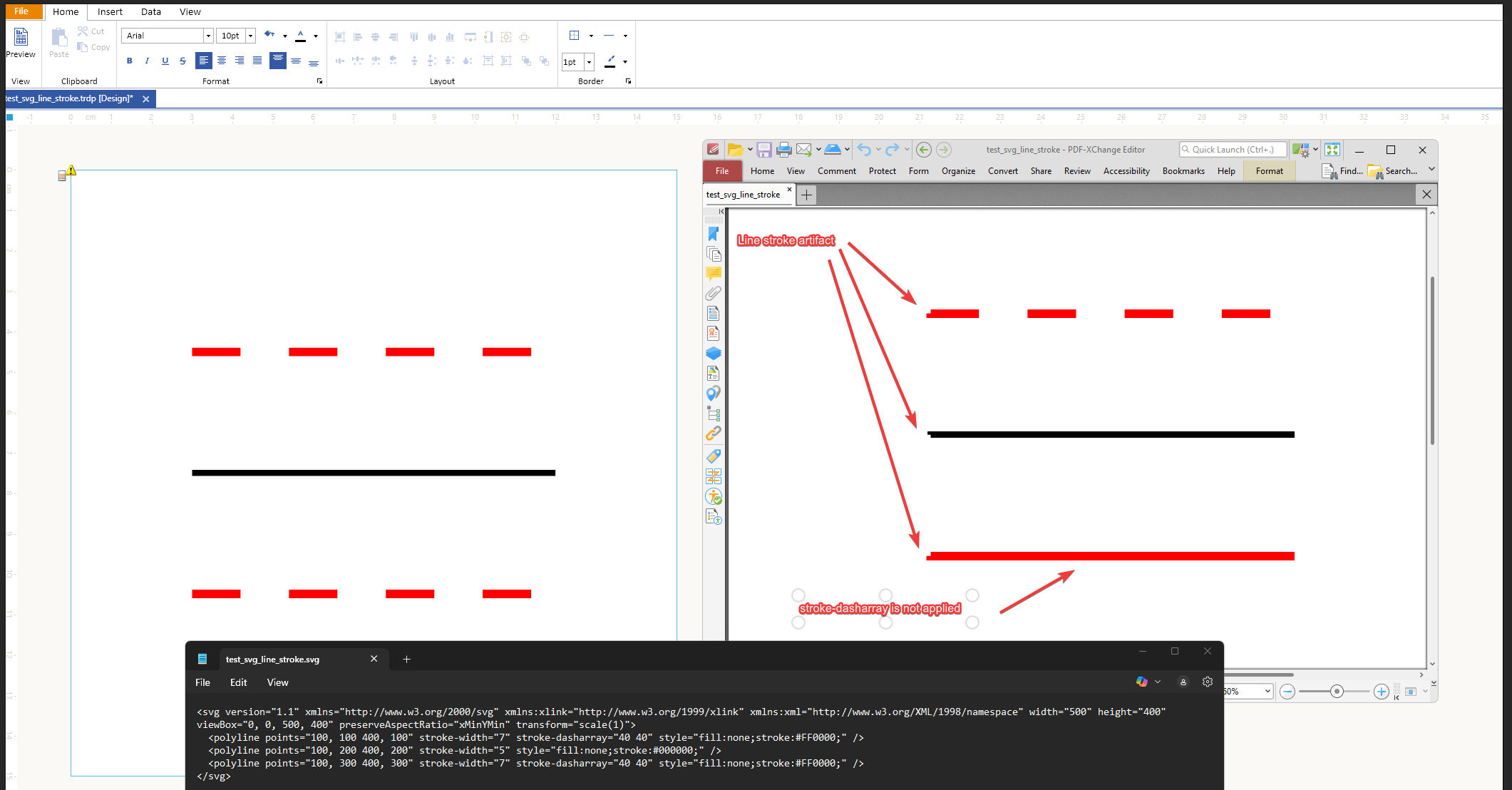
test_svg_line_stroke.svg - svg source file
test_svg_line_stroke.trdp - report with a picture box with SVG image
test_svg_line_stroke.pdf - generated PDF file