When using A4 paper or narrow-edge leading media the Web Viewer prints everything perfectly.
When using a 60mm x 30mm label, therefore "wide-edge" leading media, the web viewer prints the label in landscape, even though the print is in portrait!
Just because the media is "landscape" surely it is the print on the media that determines the orientation?
When using the Windows System Print Dialogue this does not occur, on the using the print from the Web Viewer. This is because the Web Viewer converts it to PDF first to print (I believe). Surely, in the code you can state NOT to rotate, OR rotate it back to the correct orientation for wide edge leading media.
The label design is portrait so all the "print / pdf" code needs to do is to query this and not assume that wide edge leading media automatically prints in landscape.

After updating to the Q1 2026 release of Reporting, I get the following error when passing the value of a DateTime parameter from the main report to a DateTime parameter of a report that I open via the Navigate To Report action:
CSharp.Net10.ReportingRestServiceCorsDemo Error: 0 : Parameter /Date(1771253073461)/ does not match Epoch regex format!
CSharp.Net10.ReportingRestServiceCorsDemo Error: 0 : Parameter /Date(1771253073461)/ does not match Epoch regex format!
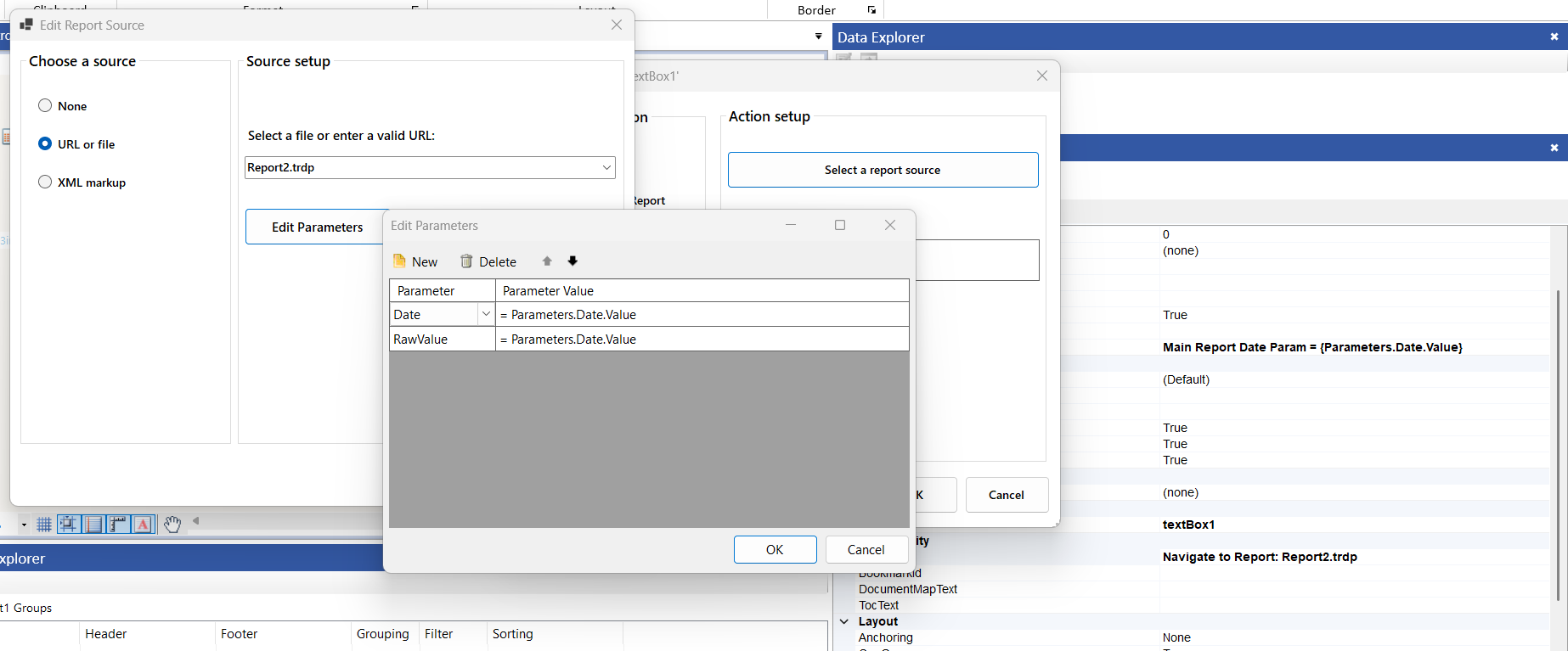
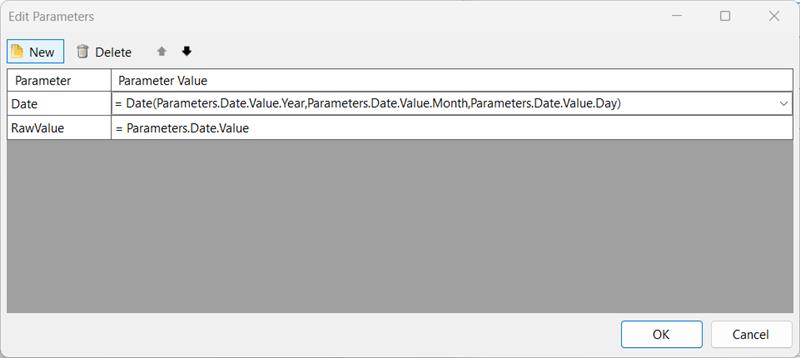
The issue seems to occur only when directly passing the value of the DateTime report parameter, so as a workaround, I decided to create a new date using the Date() function. For example:

When I invoke a cancellation before the report processing starts, the expected behavior is that the report should really not even begin processing, but it runs to completion.
When I export to XLSX, RTF, and CSV formats, and try to cancel the report a few seconds later, so that cancellation is signaled while report processing is already occurring, it doesn't stop. The expected behavior is that a TaskCanceledException should be raised, and the report processing should stop, but the report runs to completion. In PDF, DOCX, and PPTX, this works as expected.

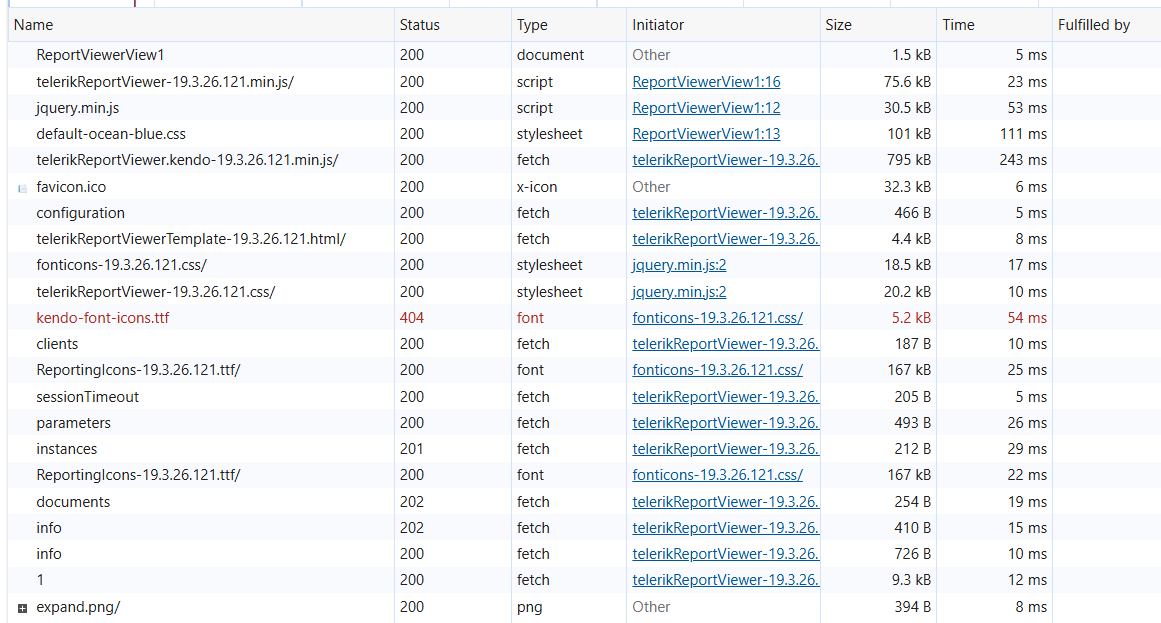
The HTML5-based report viewers send 404 request to `/sass/fonts/kendo-font-icons.ttf` when font icons are being used:
Description
Even though there is no map wizard for the WRD, it is possible to create a map item and try to set it. However, it is not possible to select an ESRI Shapefile for the spatial data or inspect the already existing one in the report:

Steps To Reproduce
- Use the PopulationDensity report
- Open the ShapeMapSeries:

- The Source type can't be configured:

Expected behavior
Even with no map wizard in the WRD, the map item should be created from scratch, and all properties should be editable.
Actual behavior
The Source Type doesn't show any option for selecting shape files.
The attached report generates different PDF documents when rendered by the Standalone Designer and REST Service, both targeting the .NET Framework 4.6.2:
- The PDFs have different sizes
- When using the 'Read out loud' functionality of the Adobe Reader, the items are read in a different order. The order in the PDF generated by the designer is correct, and the one in the service-generated PDF is wrong.
Hi, our project uses the Telerik Report Service with Asp .NET Core with Keycloak as Session Provider, every time the user tries to use an Report, after some time, he gets Unauthorized error.
To solve this I've implemented a way to specify the login promise (that is called before each request) when starting the HTML5 Report Viewer.
What if it becomes an native feature?

My report has a Text Watermark as part of the PageSettings, and is configured for Accessibility. The report contains a Page Header and Page Footer. In the Page Footer, there are two TextBoxes.
When I generate an accessible PDF with Telerik Reporting and use the Adobe Reader > Read Out Loud functionality, it doesn't read the content of the second TextBox in the Page Footer.
Currently, Telerik Reporting has a dependency on Microsoft.Data.SqlClient version="5.2.2".
This version may cause build failure when restoring packages due to locked package files.
See the following dotnet issue for more information about the problem: dotnet/SqlClient#2464

Some of the Web Report Designer pop-up messages are not localizable. For example, the message about trying to access a report that does not exist on the server:

Related to:
Also affects Telerik.Reporting.Processing and Configuration: Attempt by security transparent method 'Telerik.Reporting.Processing.AssemblyRefManager.LoadAssembliesCore()' to access security critical method 'Telerik.Reporting.Configuration.ReportingConfiguration.get_Current()' failed.
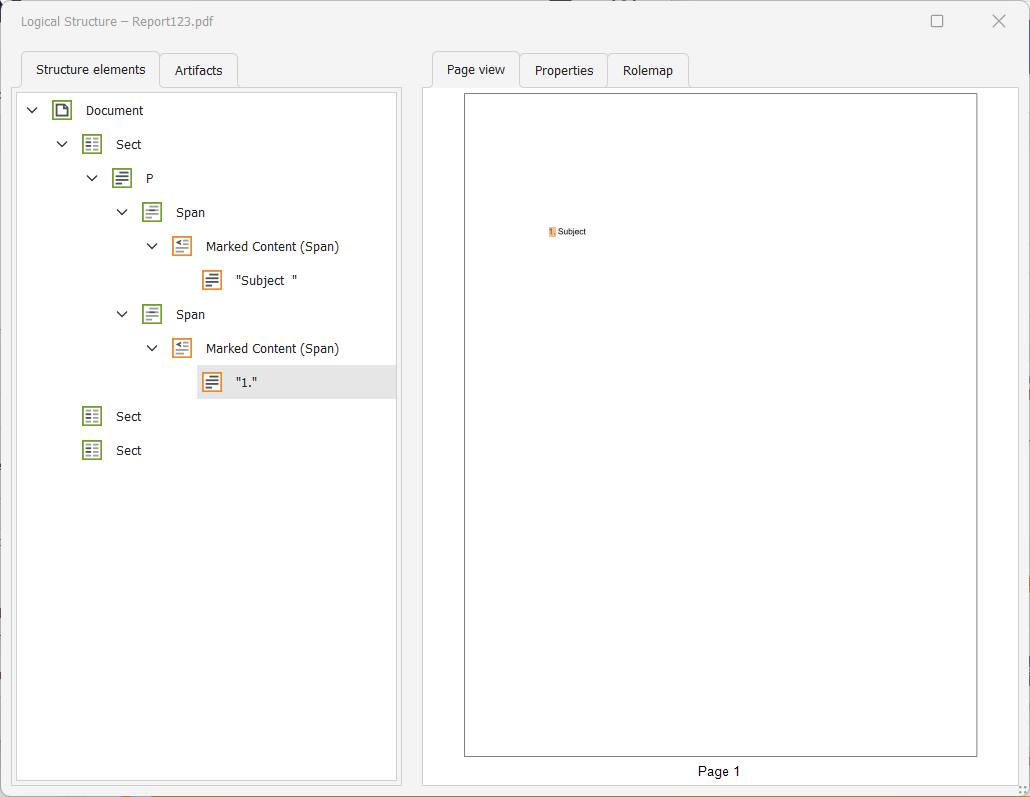
I have a report with an HtmlTextBox item, which contains an ordered list(<ol>). When I export this report to PDF, and inspect the logical tree of the document with a tool like the PDF Accessibility Checker, I can see that the span with the text is inserted above the number.
As a result, when I read the document with a screen-reading tool like Adobe's "Read Out Loud" feature or NVDA, the text is read before the current number in the list, which I find unexpected.
Currently, the GetDesignerResource endpoint of the Web Report Designer service is case-insensitive, which can lead to issues if the URL is made lowercase at some point, such as by a URL rewrite rule, or similar scenarios.
For example, the following reference to the Web Report Designer script will load return the file:
<script src="api/reportdesigner/designerresources/js/webReportDesigner"></script>But if lowercase is used, for example, like this:
<script src="api/reportdesigner/designerresources/js/webreportdesigner"></script>The request will return a 404(Not Found) response.
Using Blazor native reporting component. Our underlying email sending service requires that Subject is not blank, however the UI does not validate the Subject field.
Need to be able to validate that Subject is not blank when user attempts to submit email form.
We are experiencing issues with Telerik Reporting related to RTL text (culture 'ar-JO') rendering, as outlined below:
- Text wrapping is not working correctly within the HTML5 Report Viewer. The text seems to overflow the TextBox.
- When exporting to PDF, the text exceeds its boundaries, does not wrap as expected, and in some cases is cut off.
This also triggers multiple requests without an instance ID and document ID, resulting in 404 Not Found responses.
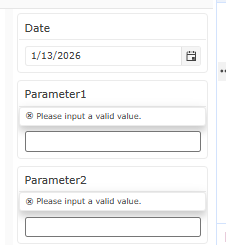
Please note the spelling error in the k-notificaiton-error class name. Should be k-notification-error:
<div class="trv-parameter-error k-notification k-notificaiton-error" style="">
<span class="k-notification-status k-icon k-i-x-outline"></span>
<span class="trv-parameter-error-message k-notification-content">Parameter value cannot be empty.</span>
</div>
Because of this, error messages are rendered with incorrect color (should be red):
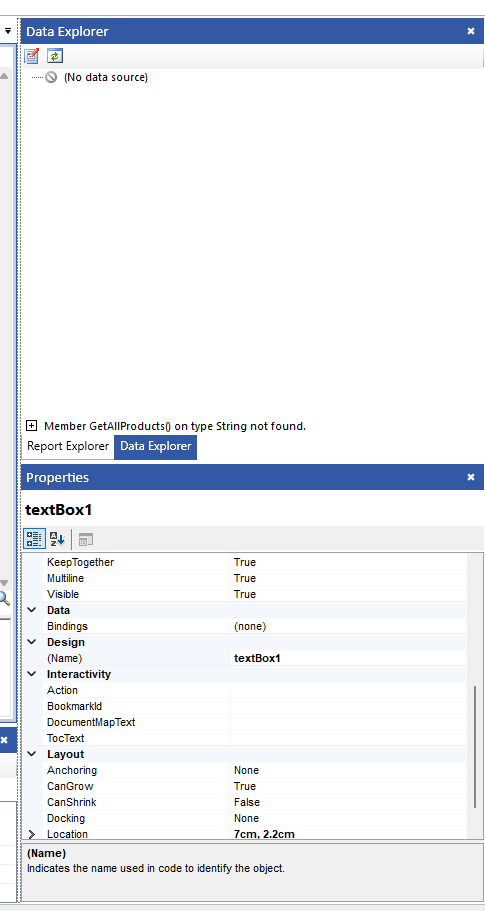
I'm getting an error in Telerik Report Designer (Data Explorer): "Member x on type String not found"
The version is: 19.3.25.1119
Steps to Reproduce:
- Open SRD.NET.
- Configure the Assembly References through the SRD.NET UI to include a DLL.
- Open an existing report file.
- Observation: The Data Explorer tool window is populated correctly, showing all fields and methods as expected.
- Close Telerik Report Designer.
- Re-open Telerik Report Designer.
- Verify that the Assembly References are still correctly configured (they are).
- Open the same report file.
- The Data Explorer is not populated. Instead, it throws an error: