

Hi Team,
I'd like to request the functionality to sync the Kendo UI Scheduler's events with Google Calendar. This would be preferably one way from Kendo UI to Google.
Thank you!

I just upgraded to the latest version today.
kendoScheduler doesn't fire change event when in "Year" view.
This is really easy to duplicate. Select Year and it doesn't fire.
<!DOCTYPE html>
<html><head>
<meta charset="utf-8"/>
<title>Kendo UI Snippet</title>
<link rel="stylesheet" href="https://kendo.cdn.telerik.com/2022.3.1109/styles/kendo.default-v2.min.css"/>
<script src="https://code.jquery.com/jquery-1.12.4.min.js"></script>
<script src="https://kendo.cdn.telerik.com/2022.3.1109/js/kendo.all.min.js"></script>
</head>
<body>
<div id="scheduler"></div>
<script>
$("#scheduler").kendoScheduler({
date: new Date("2013/6/6"),
views: [ "day", "month", "year" ],
selectable:true,
dataSource: [
{
id: 1,
start: new Date("2013/6/6 08:00 AM"),
end: new Date("2013/6/6 09:00 AM"),
title: "Interview"
}
],
change: function(e) {
var start = e.start;
var end = e.end;
/* The result can be observed in the DevTools(F12) console of the browser. */
console.log(kendo.format("Selection between {0:g} and {1:g}", start, end));
}
});
</script>
</body>
</html>

Hi Team,
Can you adjust the culture of de-DE and de-CH? Month/Day looks incorrect for these regions, it should be Day/Month.

Thank you!

Hi,

We have a requirement where in, we would like to have rolling view for the standard timeline views (timelineweek & timelineMonth).

What i mean by that is, the start-date of the view starts from the current date and the end date is based on whether its a week or a month.
For instance, if its the timeline week, if the current day is Wednesday, the start day of the week must be the current Wednesday and the end should be the next week's Tuesday.
The navigation from there should be the next Wednesday to the next corresponding Tuesday.

Now if the user navigates to a day via the calendar, for instance a Thursday. The view must start from a Thursday and end on a Wednesday.
The same applies for the timelinemonth view as well. Only change would be, in the case of the month, its the date and not the day.

Currently this can be achieved by creating a custom-view by extending the standard views.
It would be really helpful if this is available as toggle/setting in the standard view.

Thanks,
Shashank
Refer to : http://www.telerik.com/forums/setting-recurrance-messages-from-variable

To allow multiple language support it should be possible to define the  recurrenceeditor messages in the template to use an external source rather than having to hard code 1 set of messages.

Bug report
When the Scheduler is grouped, selecting a cell from the last row does not mark it as selected in IE 11 in TimelineView.
Reproduction of the problem
- Open https://dojo.telerik.com/UxetITah/3 in IE 11.
- Click on any of the cells in the last row('Charlie').
You will notice that the same cell in the previous row is marked as selected.
Current behavior
Selection does not mark the correct cell as selected in TimeLine View with grouping.
Expected/desired behavior
Selection should mark the correct cell as selected in TimeLine View with grouping.
Environment
- Kendo UI version: 2019.2.516
- Browser: [all]
This one is reproducible on the demo site today and that’s where this screenshot is from. Begin to create a new event. Set to recurring Monthly. Note that below “Never” is checked and the “10/11/2020” box is disabled. Now go and change your start date to any other date above. This box enables itself. It should not do this because the ending date option is not actually selected.
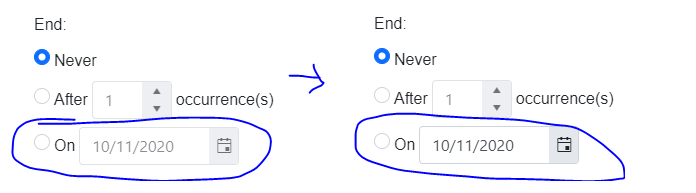
I fixed this in JavaScript by hooking into some events rather than modifying the Kendo.all.js file.
Bug report
Editing a recurrent event in the Scheduler with End options set to Never triggers validation on the DatePicker.
This is a regression introduced with R1 of 2022
Reproduction of the problem
- Run this dojo.
- Create a recurring event, for example weekly, each Monday, starting on 6/3/2013, and set End to
Never. - Save event.
- Edit the series.
- Change the start and end date to 6/4/2013.
Current behavior
Validation error is displayed.
screencast
Expected/desired behavior
Validation error should not be present in this scenario.
Environment
- Kendo UI version: 2022.3.1109
- Browser: [all]
Your recent feature to allow the start and end times to be altered in a timeline view so that you can configure an overnight view is very useful. Could the same facility be provided for the Day, Week and WorkWeek views.
Having the ability to setup a recurrence outside of the scheduler would be nice. The ability to use recurrences for other things that don't make sense showing up on a scheduler. An example would be setting up a an email subscription. I want it to recur, but I don't need to see it on a calendar.
The RecurrenceEditor is a great feature for the scheduler widget. I would also like to use it in other scenarios like a task planer. However such an isolated scenario is currently not supported (ticket answer).

In combination with angularJS i.e. I do not have the datepicker correctly displayed.
Bug report
The recurring events are not rendered as expected in some scenarios depending on the start time set.
Reproduction of the problem
- Open the Dojo
The difference between the first and the second event is the start time.
Current behavior
The first event is not rendered for every week, but it is rendered for every second week.
Expected/desired behavior
When the recurring rule is 'FREQ=WEEKLY' the event should be displayed every week, despite of its starting time.
The issue is a regression. The last working version is 2020 R1 SP1 (2020.1.219).
In 2020 R1 SP2 (2020.1.406) there is a bug related to missing events fixed with 2020.2.513. - Dojo with 2020.1.406
Starting with 2020 R2 (2020.2.513) the current behavior is introduced.
The issue might be related also to: #5978
Environment
- Kendo UI version: 2022.2.802
- Browser: [all ]
Bug report
When the dataSource for the resources is empty and the Month view is selected the 'Cannot read property 'firstChild' of undefined error is thrown in Scheduler.
Reproduction of the problem
- Open the Dojo and observe the browser console https://dojo.telerik.com/@NeliKondova/IvIJeLAw
Current behavior
'Cannot read property 'firstChild' of undefined error is thrown in Scheduler when the Month view is selected.
Expected/desired behavior
No error should be thrown with an empty resources dataSource in Scheduler.
The issue is a regression starting with 2020 R1 (2020.1.114) release
Environment
- Kendo UI version: 2022.2.510
- Browser: [all ]
Bug report
When you right click on an event to open a ContextMenu in the Scheduler, the first row is selected.
Regression introduced with 2022.1.301
Reproduction of the problem
- Open this Dojo example - https://dojo.telerik.com/aCEtARaH/22
- Right-click on a event cell
Current behavior
The first row is selected
Expected/desired behavior
The targeted row should be selected
Environment
- Kendo UI version: 2022.2.802
- Browser: [all]
Hi Team,
I'd like to request the Kendo UI Scheduler contain a clearSelection() method within the built-in API.
Thank you!
Currently, the Scheduler widget does not provide the possibility to have different start and end times for its resources. We would like to have the possibility to indicate business hours and timezone per resource.
For example, in the demo linked here we would like Alex and Bob to have different business hours, and also to be able to mark that they are in different timezones.

Is it possible to implement an option to show only the workdays in the Scheduler Month View?

Currently, the default start and end dates in the Agenda view can be edited only if we use a custom view.
It will be very easy for the users if we can just pass these dates as a property.
When setting a timeline view to display as an overnight view have an option to highlight the midnight timeline. This is currently only possible via a complex set of css rules...

you could have something like...

highlightTime: {time: 0, color:#ff0000}

where time is the timeline that needs to be highlighted and color is the color the line should be.