

I would like the ability to flag elements in a data bound combo that are no longer available as disabled and not selectable. Had they been previously selected, they still need to show, but should not allow a user to select it again.
I would like a property that can be set when databinding a combo.
For instance when you set the Data, TextField, & ValueField properties, can there also be one for SelectableField (or something) - this could be mapped to a Boolean in the dataset.
If this property isn't used then it defaults to yes (ie they are all selectable), but if it is used, then any items which have this field set to 'no' then they show as a different color (could just be grey) but are not selectable by the user.
If they had previously been selected (prior to being marked as no longer available) then they should show when the record is loaded, but otherwise they are not selectable.
I don't particularly want to write code on click to see if its enabled and then unselect it, I would prefer it to simply be built into the base control.
Is this possible? Or is there another property already there that does this?
I would like to change the text in the ComboBox dropdown when there is no data in the source collection.
At the moment the only option is through localization for all instances like here.

We are needing a way to display a hierarchy inside the ComboBox. I don't see any examples on this particular feature, I had found a similar request, but not identical.
Our use case:
We have administrators that manage multiple tenants within our system. The tenants are part of a hierarchy, the user needs to be able to select a tenant or tenant parent.
I will use hotels as an example:
-Chain 1
--Brand 1
---Property 1
---Property 2
--Brand 2
---Property 3
Our current system that we are migrating controls from has this feature, so I would like to stick as close to this functionality as possible, however; if it is not an option, what control would you suggest as an alternative.
See example (sorry for the redactions)
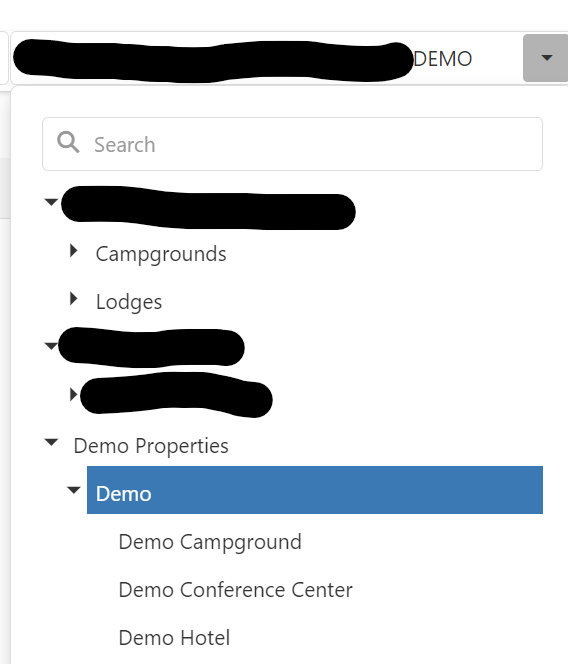
The core concept is providing a user a choice as part of a form, but layout needs to be organized so that a user can easily navigate. Top level names are unique, all other names can duplicate since they may share similar naming conventions across different organizations.
An option that may work as an alternative, is invoking a dialog popup and within it having a tree list of the information I need. I think it could work, but it would certainly break the flow of the form.

If my browser culture is set to Swedish, I can no longer tab through multiple ComboBoxes.
<AdminEdit>
You can manually add the TabIndex parameter to each ComboBox and set their values to non-negative integers.
</AdminEdit>

If the AllowCustom parameter is set to true and the OnChange fires during the data load, the value in the OnChange handler is null. Press Enter before the data load ends and the OnChange handler will give null instead of the current input value.
If I enter a text and press enter when there are no items (yet), I expect it to call the OnChange with that text. Even with a static list of zero items (replace 'Read=' with 'Data=' en provide a new List<>()), the OnChange is passed a null value.
If the OnChange fires before the empty dropdown get opened, it passes a null value, if it fires after the empty dropdown opens, it passes the entered text. That doesn't sound logical to me. Why needs the (empty) dropdown to be open before the data gets passed? And if that is necessary, why gets the OnChange fired before the dropdown is opened, and doesn't wait till it is open and then fire with the entered data?
I would like to use an event that fires only when the user clicks on an item from the dropdown.
=====
ADMIT EDIT:
Here is a possible way to achieve this now:
<TelerikComboBox @bind-Value=@SelectedValue
                 Data="@ComboBoxData"
                 ValueField="ProductId"
                 TextField="ProductName">
    <ItemTemplate>
        @{
            var currentItem = context as Product;

            <div onclick="@(() => OnClickHandler(currentItem))" style="width:100%">
                @currentItem.ProductName
            </div>
        }
    </ItemTemplate>
</TelerikComboBox>

@code {
    private void OnClickHandler(Product item)
    {
        //the application logic here
    }

    public IEnumerable<Product> ComboBoxData { get; set; }
    public int SelectedValue { get; set; } = 2;

    protected override void OnInitialized()
    {
        List<Product> products = new List<Product>();
        for (int i = 1; i < 10; i++)
        {
            products.Add(new Product()
                {
                    ProductId = i,
                    ProductName = $"Product {i}",
                    UnitPrice = (decimal)(i * 3.14)
                });
        }

        ComboBoxData = products;
        base.OnInitialized();
    }

    public class Product
    {
        public int ProductId { get; set; }
        public string ProductName { get; set; }
        public decimal UnitPrice { get; set; }
    }
}
In my data, I have multiple identical values for the TextField of the ComboBox. When the user selects one of them and focuses away from the component the selected value changes to the first instance of the items with the same TextFields, although they have different ValueFields.
Reproduction:
<TelerikComboBox Data="@myDdlData"
                 TextField="MyTextField"
                 ValueField="MyValueField"
                 Value="selectedValue"
                 ValueChanged="@((int? id) => ValueChangedHandler(id))"
                 FilterOperator="StringFilterOperator.Contains"
                 Filterable="true">
</TelerikComboBox>

@code {
    private List<MyDdlModel> myDdlData { get; set; }

    private void ValueChangedHandler(int? id)
    {
        selectedValue = id;
    }

    public class MyDdlModel
    {
        public int? MyValueField { get; set; }
        public string MyTextField { get; set; }
    }

    int? selectedValue { get; set; }

    protected override void OnInitialized()
    {
        myDdlData = new List<MyDdlModel>()
        {
            new MyDdlModel()
            {
                MyValueField = 1,
                MyTextField = "John Smith"
            },
            new MyDdlModel()
            {
                MyValueField = 2,
                MyTextField = "John Smith"
            },
            new MyDdlModel()
            {
                MyValueField = 3,
                MyTextField = "John Smith"
            },
            new MyDdlModel()
            {
                MyValueField = 4,
                MyTextField = "Alice Jones"
            },
            new MyDdlModel()
            {
                MyValueField = 5,
                MyTextField = "Alice Jones"
            },
        };
    }
}
Description
When the user types a value in the input and wishes to navigate to the beginning or end (by pressing Home/End buttons) of the input to make a correction, a value from the popup is actually selected and the value in the input is overridden.
Reproduction
1. Create a ComboBox and enable filtering.
2. Start typing in the input. Popup is opened.
3 Try to navigate in the input via the Home/End buttons. A value from the popup is selected that overrides the value in the input.
A ComboBox is databound via OnRead. It has an initial value, but no data arrives after the first OnRead call. We call Rebind() to fetch data and then it populates, but the component value doesn't show.
Click the button. The ComboBox should show its initial value, but doesn't. A similar scenario worked until version 2.30, when there was no Rebind(), but we set Data directly.
The workaround is to set raise a flag in OnRead and set the value in OnAfterRenderAsync.
@using Telerik.DataSource.Extensions

<TelerikButton OnClick="@BindCombo">Rebind Combo</TelerikButton>

<TelerikComboBox TItem="@ComboItem"
                 TValue="int"
                 @ref="@ComboRef"
                 TextField="Text"
                 ValueField="Id"
                 OnRead="OnComboRead"
                 Width="200px"
                 @bind-Value="@ComboValue">
</TelerikComboBox>

@code {
    string FilterValue { get; set; } = "A";
    int ComboValue { get; set; } = 2;
    bool BindFlag { get; set; }
    bool ShouldResetValue { get; set; }
    IEnumerable<ComboItem> LegacyComboData { get; set; }

    TelerikComboBox<ComboItem, int> ComboRef { get; set; }

    void BindCombo()
    {
        BindFlag = true;
        ComboRef.Rebind();
    }

    protected override async Task OnAfterRenderAsync(bool firstRender)
    {
        if (ShouldResetValue)
        {
            // comment out the initially set value above to make the following line work
            ComboValue = 2;
            StateHasChanged();
        }

        await base.OnAfterRenderAsync(firstRender);
    }

    async Task OnComboRead(ComboBoxReadEventArgs args)
    {
        if (BindFlag)
        {
            var service = new MyService();

            var data = await service.GetComboItem(FilterValue);
            var result = await data.ToDataSourceResultAsync(args.Request);

            args.Data = result.Data;

            //ShouldResetValue = true;
        }
    }

    public class ComboItem
    {
        public int Id { get; set; }
        public string Code { get; set; }
        public string Text { get; set; }
    }

    public class MyService
    {
        public async Task<IEnumerable<ComboItem>> GetComboItem(string code)
        {
            await Task.Delay(300);

            var data = new[]
            {
                    new ComboItem{ Id = 1, Code = "A", Text = "ValueA1" },
                    new ComboItem{ Id = 2, Code = "A", Text = "ValueA2" },
                    new ComboItem{ Id = 3, Code = "A", Text = "ValueA3" },
                    new ComboItem{ Id = 4, Code = "B", Text = "ValueB4" },
                    new ComboItem{ Id = 5, Code = "B", Text = "ValueB5" },
                    new ComboItem{ Id = 6, Code = "B", Text = "ValueB6" },
                    new ComboItem{ Id = 7, Code = "C", Text = "ValueC7" },
                    new ComboItem{ Id = 8, Code = "C", Text = "ValueC8" },
                    new ComboItem{ Id = 9, Code = "C", Text = "ValueC9" },
                };

            return data.Where(x => x.Code == code).ToList();
        }
    }
}
The ComboBox will not display an initial selected item, if the value is equal to the type's default. Applies to integers, guids, etc.
This used to work until version 2.30.
Here is a REPL test page.
If the value type is nullable, a zero int value will work for initial item selection.
See this REPL:
https://blazorrepl.telerik.com/QmOFQTbW46QegjwX11
Run the program and scroll so that new data will be requested. The page variable does not change, so I'm not able to request new data from my datasource.
GitHub Repo - https://github.com/benhysell/BlazorGridPagingIssue
Expected Behavior - In the ComboBox ItemTemplate show the user's email address along with user name
Actual Behavior - Works fine debugging in Visual Studio, however in a published application the browser throws exception and will not display user's email address in the ItemTemplate.
Steps To Reproduce
- Clone and start debugging application
- Navigate to https://localhost:5001/createWeather
- This is a simple form with two ComboBoxes, one for weather data and one for user data
- In debug the ComboBoxes work as expected, each has an ItemTemplate that shows the desired data.
- Stop debugging and publish the applicaiton
- ie -- dotnet publish -o "YOUR DESIRED OUPUT DIRECTORY" -r win-x64 --self-contained
- Navigate to the output directory and run .\BlazorGrid.Server.exe
- In the browser navigate to https://localhost:5001/createWeather
- The page now throws an exception
- Also notice how the user's email address is no longer shown for the User in the comobobox drop down.
Details
Ran across this in a larger application...I have a class that inherits from Microsoft.AspNetCore.Identity.IdentityUser<Guid> and wanted to display all of my users in a ComboBox with a custom ItemTemplate consisting of the Name and Email. This works great in debug, however every time I publish/deploy the Email address is not shown. The example repo is a stripped down version of the larger application reproducing the error.
The application is making an OData call to the backend to retrieve the Users...in the repo we do not goto a database, in the live application we do. In both instances the user's Email is not shown in the ItemTemplate, even though one can see via the browser's network traffic tab the results from the OData call include the email address for the users.
This issue does not just affect the email property, I was unable to get any of the properties listed on Microsoft.AspNetCore.Identity.IdentityUser<Guid> to render in a published application in the ItemTemplate for the Combobox.
Note - all of the properties in Microsoft.AspNetCore.Identity.IdentityUser<Guid> are marked as 'virtual'. I attempted to re-create this issue with a different class, in the repo I used the WeatherForecast class and created a virtual TemperatureK property...this however worked in debug and release without issue. One can see this in the OData Weather Forecasts ComboBox on the same page, https://localhost:5001/createWeather.
Issue - Setting the selected element of a combo box inside a form worked in 2.22.0 and no longer works in 2.23.0
Repo - https://github.com/benhysell/BlazorGridPagingIssue
Steps to Reproduce
- In the test repo start the application and navigate to https://localhost:5001/updateWeather
- The selected value in the combo box should be the 8th value, "summary 8"
- Stop the application, in BlazorGrid.Client.csproj
- Replace <PackageReference Include="Telerik.UI.for.Blazor" Version="2.22.0" />
- With <PackageReference Include="Telerik.UI.for.Blazor" Version="2.23.0" />
- Do a clean/rebuild to ensure the latest version of Telerik Blazor is being used
- Run the application in a new incognito window and navigate back to https://localhost:5001/updateWeather, notice how nothing is selected in the combo box
Details
This is a contrived example pulled out of a larger application. Almost all of our combo boxes are backed by OData calls. When we 'create or POST' an element the first time we load the form we have the combo box make an OData call to retrieve the top 200 elements. On a subsequent 'edit or PUT', where we have a thing we want to update we first go get the thing we want to work with, and then fill in the comobo box with that element.
In this example application we simulate this load by deciding if a value was passed in or not for the combo box. https://localhost:5001/updateWeather always passes in an 8 to load the 8th element. https://localhost:5001/createWeather does not pass in any value, leaving the form value unbound.
This all worked as expected in 2.22.0, however once we upgraded to 2.23.0 we could no longer set the value of the combo box on load when combined with an OData call.

Thanks for adding more new controls to Blazor. That help us to move to it from ASPX AJAX.
Can we have the Multi-Column ComboBox, like the ASPX AJAX that one, please?
https://www.telerik.com/products/aspnet-ajax/ajax-multicolumncombobox.aspx
Example Repo: https://github.com/benhysell/BlazorGridPagingIssue
Steps To Reproduce
- Run application and navigate to https://localhost:5001/updateweather
- Examine the ComboBoxes 'OData Weather Forecasts' and 'OData User' appears correct
- Stop application, change package reference for Telerik.UI.for.Blazor from version 2.25.0 to version 2.26.0
- Clean/Rebuild/run application and navigate back to https://localhost:5001/updateweather
- ComboBox now appears 'doubled', there are two boarders around the ComboBox
Transitioning our application from Telerik React to Blazor, our comboboxes in our React application are hooked up to OData endpoints because of the amount of data they could display, some as large as 30mb of json.
Server filtering, https://feedback.telerik.com/blazor/1447481-server-filtering-with-custom-data-request-event-that-can-accommodate-remote-data, almost works, however:
- I can't set PageSize on the combobox
- I can't set TotalCount on the combobox
- Using Telerik.Blazor.ExtensionMethods.ToOdataString throws a NullReferenceException when I try to use it in the ReadItems method with the ComboBoxReadEventArgs args.Reqeuest.ToOdataString()
I tried setting up my combobox like my OData Grid, i.e.
<TelerikComboBox Data="@Dtos"
                         OnRead="@ReadItems"
                         Filterable="true"
                         Placeholder="Find what you seek by typing"
                         @bind-Value="@SelectedValue"
                         TextField="Name"
                         ValueField="Id"
                         Pageable="true"
                         PageSize="20"
                         TotalCount=@Dtos.Count
                         >
However it throws an exception:
blazor.webassembly.js:1 WASM: System.InvalidOperationException: Object of type 'Telerik.Blazor.Components.TelerikComboBox`2[[MyType, MyNamespace, Version=1.0.0.0, Culture=neutral, PublicKeyToken=null],[System.Guid, mscorlib, Version=2.0.5.0, Culture=neutral, PublicKeyToken=7cec85d7bea7798e]]' does not have a property matching the name 'Pageable'.
Was hoping this would 'just work' like it does with the Grid, which is amazing!
Hello everyone,
in the web app we are programming, we make heavy use of the TelerikCombobox. Now the use case arises, that the user needs to be able to select a numeric value (double or int, mainly) out of an existing list of values, or if the needed value does not exist yet, provide a custom value.
In this particular case, he selects out of a range of existing article lengths or widths. Most of the time, the length or width is of a "normed" width or length (meaning the normal width / length the article would have) Since they can however produce an article in any width / length they wish to, it does happen sometimes, that the range of existing article widths / lengths is missing the desired value. Hence we thought we could make use of the AllowCustom feature of the TelerikCombobox, so that the user can provide a value themselfes, if need be.
However, the type restriction to string of the Value and Text-Field of the Items makes it rather cumbersome todo so, as a new Model class is needed which has the Text / Value fields as string and internally maps it to the desired type. In addition the user can provide input, which does not make any sense whatsoever for the underlying type.
Would it be possible, for the AllowCustom feature to work also mit numeric values? I.e. When the property the Value-field is referencing to, returns a numeric value, only numeric input is considered (somewhat similar to the NumericTextBox)?
Best Regards,
tilt32

Replication code:
@SelectedValue
<br />
<TelerikComboBox Data="@DdoData"
OnRead="@OnReadHandler"
Filterable="true"
ValueField="RecId"
TextField="DdoTitle"
Placeholder="Find what you seek by typing"
@bind-Value="@SelectedValue">
</TelerikComboBox>
@code{
public int SelectedValue { get; set; } = 4;
List<ddo> DdoData { get; set; }
public string ddoCbType { get; set; } = "Default";
int InitialId { get; set; }
string currentText { get; set; } = "";
protected override async Task OnInitializedAsync()
{
await ReadDdoData(ddoCbType, "");
if (SelectedValue > 0)
{
InitialId = (int)SelectedValue;
await ReadDdoData(ddoCbType, currentText);
}
}
async Task OnReadHandler(ComboBoxReadEventArgs args)
{
if (args.Request.Filters.Count > 0)
{
Telerik.DataSource.FilterDescriptor filter = args.Request.Filters[0] as Telerik.DataSource.FilterDescriptor;
currentText = filter.Value.ToString();
await ReadDdoData(ddoCbType, currentText);
}
else
{
currentText = "";
await ReadDdoData(ddoCbType, "");
}
}
private async Task ReadDdoData(string ddoCbType, string currentText)
{
await Task.Delay(100);
DdoData = new List<ddo>()
{
new ddo(){ RecId = 1, DdoTitle = "one"},
new ddo(){ RecId = 2, DdoTitle = "two"},
new ddo(){ RecId = 3, DdoTitle = "Three"},
new ddo(){ RecId = 4, DdoTitle = "Four"},
new ddo(){ RecId = 5, DdoTitle = "Five"}
};
//this does not help
await InvokeAsync(StateHasChanged);
}
public class ddo
{
public int RecId { get; set; }
public string DdoTitle { get; set; }
}
}