

Please repeat the following steps to reproduce this critical accessibility issue:
- Go to https://www.telerik.com/kendo-angular-ui/components/editor#angular-editor-example
- In the Angular Editor Example. click in the editor and type one letter to enable the "Undo" toolbar button
- Navigate to toolbar via Shift+Tab key
- Use the left or right arrow key to navigate to "Undo" button
- Use Enter to trigger the "Undo" button which should then re-focus the editor and disable the "Undo" button
- Immediately press Shift+Tab key to navigate back to the toolbar with the "Undo" button disabled
Expected behaviour: The disabled "Undo" button is focused so that toolbar navigation with left or right arrow keys is enabled.
Experienced behaviour: The toolbar is permanently unfocusable with keyboard navigation and the element (theme selector) before the toolbar is focused. It is no longer possible to navigate to any buttons in the toolbar with Tab or Shift+Tab at this point. This happens with any toolbar button that becomes disabled after triggering such as the "outdent" button.
NOTE: The expected behaviour actually works in the jQuery Editor (https://demos.telerik.com/kendo-ui/editor/all-tools), so the Angular Editor should be fixed to match.
I'm experiencing an issue with the Kendo Grid when using virtual scrolling.
If I lock any column, scroll down, and then navigate to another page, the locked column disappears. It only reappears after I scroll the grid again.
I've attached the relevant code and a video demonstrating the issue.
A ticket regarding this specific issue has already been opened on GitHub (https://github.com/telerik/kendo-angular/issues/4962) , but I wanted to bring it to your attention here as well. We would appreciate your support in resolving this matter as soon as possible.
Hi,
This works with Angular 20, must be a change related to that.
If I assign data to the TreeView synchronously, it works, but e.g. in a setTimeout, it doesn't any more. (I assign the full array, change detection is set to eager.)
Reproduction can be found here: https://codesandbox.io/p/devbox/mutable-glade-39twhs?workspaceId=ws_P4gPDf6RC2r5W8xExWQehV
Best regards,
Michael
If we format kendo-datepicker to (MMMM/dd/yyyy) and if we enter number of month in input then it is not reflecting and shows month in input field.
As you can see in screenshot, I called (valueChange) event to see the changed value, I have enter 10 in month input field so it shows two value in console, first one is when 1 is press and second is when 0 is pressed after 1 so it gives null and in input field it shows month instead of October.
It is working if we enter first letter of month but it should work if we enter month in number.
Please fix this issue asap.
Thanks.
Further Environment Informations
Component: @progress/kendo-angular-treeview
Severity: regression (worked in v23, broken in v24)
rxjs: 7.8.2
zone.js 0.15.1 (zone-based, not zoneless)
typescript 6.0.3
Summary
When a flat [nodes] array is bound to kendo-treeview and the array reference is replaced after the first change-detection pass, the TreeView keeps rendering the initial nodes and never reflects the new data. In v23.x the same binding updated correctly.
Minimal reproduction (standalone, drop into a blank Angular 22 app / StackBlitz)
import { Component, signal } from '@angular/core';
import { bootstrapApplication } from '@angular/platform-browser';
import { TreeViewModule } from '@progress/kendo-angular-treeview';
interface Node { name: string; }
@Component({
selector: 'app-root',
standalone: true,
imports: [TreeViewModule],
template: `
<button (click)="replaceNodes()">Replace nodes</button>
<p>Plain list (control — reflects the current data):</p>
<ul>
@for (n of nodes(); track n.name) { <li>{{ n.name }}</li> }
</ul>
<p>Kendo TreeView (bug — stays on the initial data):</p>
<kendo-treeview
[nodes]="nodes()"
textField="name"
[kendoTreeViewSelectable]="{ enabled: false }"
>
<ng-template kendoTreeViewNodeTemplate let-dataItem>
{{ dataItem.name }}
</ng-template>
</kendo-treeview>
`,
})
export class AppComponent {
protected readonly nodes = signal<Node[]>([{ name: 'A' }, { name: 'B' }]);
protected replaceNodes(): void {
this.nodes.set([{ name: 'X' }, { name: 'Y' }, { name: 'Z' }]);
}
}
bootstrapApplication(AppComponent).catch(err => console.error(err));
Steps to reproduce
1. Load the component — TreeView renders A, B.
2. Click Replace nodes (assigns a brand-new array [X, Y, Z]).
Expected
The TreeView re-renders and shows X, Y, Z (like the plain <ul> control right above it, which updates correctly — proving the data really changed and change detection ran).
Actual (v24.2.2)
The TreeView still shows A, B. The new [nodes] reference is ignored.
Regression
Identical code updated correctly on @progress/kendo-angular-treeview 23.x. It broke on the upgrade to 24.x. Bisecting across 24.0.0 → 24.2.2 would pinpoint the exact patch.
Current workaround
Force the TreeView to be destroyed and recreated whenever the data reference changes:
@for (nodes of [data()]; track nodes) {
<kendo-treeview [nodes]="nodes" textField="name" ...>...</kendo-treeview>
}
This works but is obviously undesirable (full teardown/rebuild on every data change, loss of internal state).
`@progress/kendo-intl` incorrectly formats timezone offsets whose minute component is non-zero.
For example, a JavaScript `Date` with the historical Warsaw offset `UTC+01:24` is formatted as `+01:04` instead of `+01:24`.
This affects all tested `Z`, `X`, and `x` timezone format variants.
Environment
- `@progress/kendo-angular-intl`: `24.2.0`
- `@progress/kendo-intl`: `3.2.1`
- Browser/Node timezone: `Europe/Warsaw`
- Operating system: Windows
- Format: `yyyy-MM-ddTHH:mm:ssZZZZZ`
The same formatting implementation appears in `@progress/kendo-intl` versions `3.1.2` and `3.2.1`.
Reproduction
const { formatDate } = require('@progress/kendo-intl');

process.env.TZ = 'Europe/Warsaw';

const date = new Date(1900, 0, 1, 16, 0, 0);

console.log(date.toString());
console.log(date.getTimezoneOffset());
console.log(formatDate(date, 'yyyy-MM-ddTHH:mm:ssZZZZZ'));
Actual Result
Mon Jan 01 1900 16:00:00 GMT+0124
-84
1900-01-01T16:00:00+01:04
Expected Result
1900-01-01T16:00:00+01:24Date#getTimezoneOffset() returns -84, meaning the local timezone is 84 minutes ahead of UTC:
84 minutes = 1 hour 24 minutesOther Examples
The issue is not limited to positive offsets:
getTimezoneOffset() | Expected | Actual |
|---|---|---|
-84 | +01:24 | +01:04 |
210 | -03:30 | -03:05 |
UTC is also formatted differently depending on the token, but that behavior may be intentional:
| Offset | Expected ISO representation | ZZZZZ result |
|---|---|---|
0 | +00:00 or Z | Z |
Tested Format Specifiers
All applicable format variants use the same incorrect minute calculation:
Z      -> +0104
ZZ     -> +0104
ZZZ    -> +0104
ZZZZ   -> GMT+01:04
ZZZZZ  -> +01:04

X      -> +0104
XX     -> +0104
XXX    -> +01:04
XXXX   -> +0104
XXXXX  -> +01:04

x      -> +0104
xxx    -> +01:04
xxxxx  -> +01:04
Changing from ZZZZZ to XXXXX or XXX therefore does not resolve the problem.
Suspected Root Cause
The current formatter appears to perform approximately this calculation:
const offset = date.getTimezoneOffset() / 60;
const hoursMinutes = Math.abs(offset).toString().split('.');
const minutes = hoursMinutes[1] || 0;
For an 84-minute offset:
84 / 60 = 1.4The decimal portion "4" is then treated as four minutes and padded to "04".
However, the fractional part represents a fraction of an hour:
0.4 hours * 60 = 24 minutesLikewise, for 210 minutes:
210 / 60 = 3.5The formatter produces 03:05, although 0.5 hours is 30 minutes.
Suggested Fix
Timezone offsets should remain integer minute values throughout formatting:
function formatTimeZone(date, info, options) {
    const totalMinutes = date.getTimezoneOffset();
    const absoluteMinutes = Math.abs(totalMinutes);
    const hours = Math.floor(absoluteMinutes / 60);
    const minutes = absoluteMinutes % 60;
    const sign = totalMinutes <= 0 ? '+' : '-';

    // Continue applying shortHours, separator, optionalMinutes,
    // localizedName and zZeroOffset options using hours and minutes.
}
The important calculations are:
const hours = Math.floor(Math.abs(offsetMinutes) / 60);
const minutes = Math.abs(offsetMinutes) % 60;
Converting the offset to a decimal hour and splitting its string representation is not reliable.
Suggested Regression Tests
it('formats a positive timezone offset with minutes', () => {
    const date = new Date(2024, 5, 25, 12, 7, 5);
    vi.spyOn(date, 'getTimezoneOffset').mockReturnValue(-84);

    expect(formatDate(date, 'yyyy-MM-ddTHH:mm:ssZZZZZ'))
        .toBe('2024-06-25T12:07:05+01:24');
});

it('formats a negative timezone offset with minutes', () => {
    const date = new Date(2024, 5, 25, 12, 7, 5);
    vi.spyOn(date, 'getTimezoneOffset').mockReturnValue(210);

    expect(formatDate(date, 'yyyy-MM-ddTHH:mm:ssZZZZZ'))
        .toBe('2024-06-25T12:07:05-03:30');
});
Other useful cases include:
-345 -> +05:45
-330 -> +05:30
210 -> -03:30
0 -> Z or +00:00, depending on the selected token
Impact
This can corrupt serialized date-time values when they are passed to systems that honor the emitted offset, including .NET DateTimeOffset.
Example:
Intended: 1900-01-01T16:00:00+01:24
Emitted:  1900-01-01T16:00:00+01:04
These values represent instants 20 minutes apart.
The issue affects:
- Historical dates from regions that previously used local mean time.
- Current timezones with half-hour or quarter-hour offsets.
- Any test or custom
Dateimplementation returning a non-whole-hour offset.
Examples of modern fractional offsets include UTC+05:30, UTC+05:45, UTC+09:30, and UTC-03:30.
Additional Context
We initially encountered this with Europe/Warsaw and 1900-01-01. The JavaScript runtime correctly reports Warsaw's historical offset as UTC+01:24. The incorrect UTC+01:04 value is introduced only during Kendo formatting.
We have implemented a temporary application-level workaround that formats the date portion with Kendo and calculates the timezone offset directly from integer minutes.
Hello,
I have prepared an example, here's how you reproduce the bug (https://stackblitz.com/edit/angular-2nwrn7db?file=src%2Fapp%2Fapp.component.ts):
1. Move the Product Name column between the Category and Unit Price columns
2. Save the Grid state using the Save State button
3. Reload the page
4. Restore the saved state using the Load State button
5. The multi-column Test (k-grid0-col4) has the wrong OrderIndex (0 instead of 4)
Best regards,
Igor
When dateinput format is "d/M/y" and "allowCaretMode" is enabled, users are unable to enter valid dates. Tested with dateinput and datepicker components.
Steps to reproduce
- Setup a kendo-dateinput component with "allowCaretMode" set to "true" and the "format" set to "d/M/y" (see stackblitz below).
- Enter a valid single-digit day and valid single-digit month into the input.
- Try typing a year.
- Observe that only one character of the year can be entered and the input locks up, preventing the user from completing a valid date.
- Try typing a double digit month.
- Observe that only one character of the month can be entered and the input locks up.
- Try typing a double digit day.
- Observe that only one character of the day can be entered and the input locks up.
Stackblitz example - angular v22 + kendo v24
https://stackblitz.com/edit/angular-kendo-dateinput-bug-rdocwtvr
Expected Behaviour:
The user should be able to enter a full year, month, and day after typing a valid single-digit day and month.
Observed Behaviour:
After entering a single-digit day and month, the input locks up, preventing the user from typing more than one character for the year or month. This prevents users from entering valid dates, making the input unusable in this scenario.
Thanks
For the Kendo DatePicker, if you try to set the size on a kendo-datepicker with plain text, it will not render and give a console error of "ERROR TypeError: Cannot read properties of undefined (reading 'nativeElement')".
Errors:
// HTML
<kendo-datepicker size="small" ... />
---
But on the other hand, it does work if you create a field of type "DateInputSize" and pass that variable to the size.
Works:// TS
protected size: DateInputSize = 'small';
// HTML
<kendo-datepicker [size]="size" ... />
Hi,
We're heavily using the Scheduler component, but we've hit a problem with `slotClick` in scenarios involving multiple scheduler instances on the same page.
With two schedulers on one page, slot detection for the second scheduler (used in context-menu flows via slotByPosition) can be wrong.
Detaild repro: Stackblitz
Repro steps:- Right-click any slot in Scheduler #2.
- slotClick gives expected slot, but slotByPosition(...) can resolve incorrectly/undefined, which can cause error in the app when code depends on slotByPosition.
The issue:
- BaseSlotService.calculateScaleX() uses document.querySelector(".k-scheduler"), which always picks the first scheduler in DOM.
- With two schedulers on one page, slot detection for the second scheduler (used in context-menu flows via slotByPosition) can be wrong.
- Relevant code:
const h = document.querySelector(".k-scheduler");
return h.getBoundingClientRect().width / h.offsetWidth;
- Expected: the instance of scheduler used in the calculation should be the one that fired event, not the first one from DOM.
Hi,
When the first day of the week is changed dynamically through a custom IntlService, the Calendar weekday headers are updated, but the date cells are not repositioned. (The first day is changed as described in your guide: https://www.telerik.com/kendo-angular-ui/components/knowledge-base/calendar-first-day )
Reproduction (forked from your example): https://stackblitz.com/edit/angular-tqvypgwg
Click on "Set first day to Monday ": the weekday headers are updated to start with Monday, but the date cells remain in their previous positions.
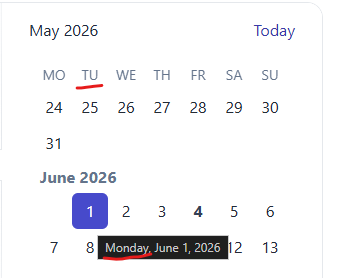
Best regards,
Michael
When the user wants to select a date, the filter closes up and the user is not able to select any date from the calendar.
The issue is happening on tablet device in portrait mode and we found out that it's happening on your documentation too. To reproduce the issue, please go to the "Angular Grid Filter Menu" in your documentation:
https://www.telerik.com/kendo-angular-ui/components/grid/filtering/filter-menu/
Please open the dev tools and set the browser on any tablet portrait size or use Galaxy Tab S4.
In your first example (Angular Grid Filter Menu), please click on the "Date" filter in the grid. When the popup opens up, please click on the calendar icon
of the date input field.
When the calendar shows up, try to select any date. You'll see that the filter closes up and the user is not able to select any date. Demo video attached for reference.
Please fix this bug as we support Samsung Galaxy tablet devices and we're using this feature in our project.
Hi,
in a Treeview bound to flat data (probably does not matter), if I have 3 items, and I drop the first 2 in the last, the loading indicator is stuck.
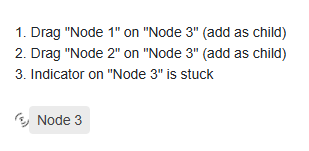
Stackblitz repro: https://stackblitz.com/edit/angular-xiwrcwsx?file=src%2Fapp%2Fapp.component.ts
Can you please take a look at it?
Best regards,
Michael
When enabling the showSelectAll option in a checkbox column on the TreeList component, a checkbox is rendered with the TreeListSelectAllCheckboxDirective. In its constructor, this directive includes some logic that causes the TreeList to instantiate a new ViewCollection every time a selection change occurs. However, the call to ViewCollection.loadView() does not pass the service responsible for determining expanded nodes, so the default fallback (which returns true for all nodes) is used.
Problem
As a result, every checkbox interaction triggers fetchChildren() for all nodes, even those that were never expanded or loaded. This leads to:Unnecessary and potentially expensive backend calls
Performance degradation, especially with large datasets
Inefficient "select all" logic that does not respect the current loaded/visible state
This behavior appears to ignore the fact that TreeList is configured for remote data binding with lazy-loaded children.
Expected Behavior
showSelectAll should only evaluate the currently loaded and visible itemsfetchChildren() should not be called for every nodeIntegration with remote/lazy-loaded data should be respected
Suggested Solutions
Update TreeListSelectAllCheckboxDirective to properly integrate with the expanded node detection logic or allow injection of a custom service.
Provide an override or callback to control the behavior of the "select all" checkbox manually in remote scenarios.
Steps to Reproduce
Configure a TreeList with hasChildren and children to fetch child nodes lazily.
Enable selection with checkbox column and showSelectAll: true.
Click any checkbox inside the TreeList.
Observe that fetchChildren() is triggered for all nodes, not just expanded ones.
StackBlitz repro:
Open console and click on the first cell.
https://stackblitz.com/edit/angular-e2ai4pjx?file=src%2Fapp%2Fapp.component.ts,angular.json
Description
When you move the cursor to a new series item, the tooltip position does not move until you leave the chart area and re-enter. It changes the content based on where the cursor is pointing, but does not change the position.
Steps To Reproduce
- Create a new Angular application
- Add the Kendo UI Chart and paste the following code in the app.component.ts file:
import { Component } from '@angular/core';
import {KENDO_CHARTS} from "@progress/kendo-angular-charts";

@Component({
  selector: 'app-root',
  imports: [KENDO_CHARTS],
  template: `
    <kendo-chart>
      <kendo-chart-legend position="bottom"></kendo-chart-legend>
      <kendo-chart-series>
        <kendo-chart-series-item
          type="donut"
          [data]="data"
          field="value"
          categoryField="category"
          colorField="color"
          [holeSize]="60"
          [tooltip]="{
            visible: true,
            format: '{0:C0}'
          }"
          [highlight]="{ visible: true }"
        >
        </kendo-chart-series-item>
      </kendo-chart-series>
    </kendo-chart>
`,
})
export class App {
  public data = [
    { category: "Electronics", value: 245000, color: "#0058e9" },
    { category: "Clothing", value: 189000, color: "#37b400" },
    { category: "Home & Garden", value: 156000, color: "#f59c1a" },
    { category: "Sports", value: 134000, color: "#ff6358" },
    { category: "Books", value: 98000, color: "#8c43ff" },
    { category: "Toys", value: 78000, color: "#00acc1" },
  ];
}
- Run the application
Screenshots or video
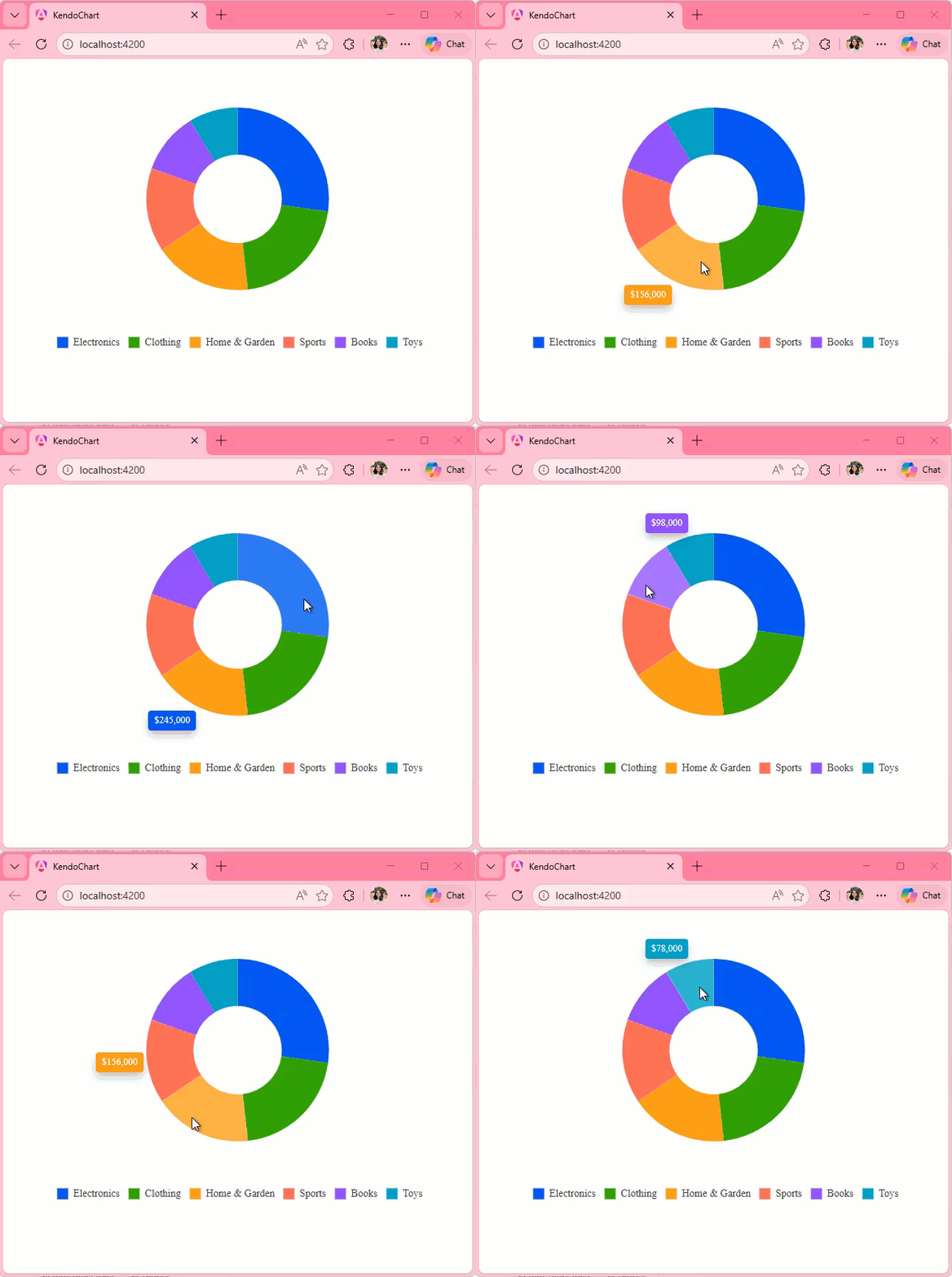
Actual Behavior
The Tooltip position only changes when you leave and reenter the Chart area. It does not change when you move the cursor from one series item to other, it updates the content displayed in the Tooltip though.
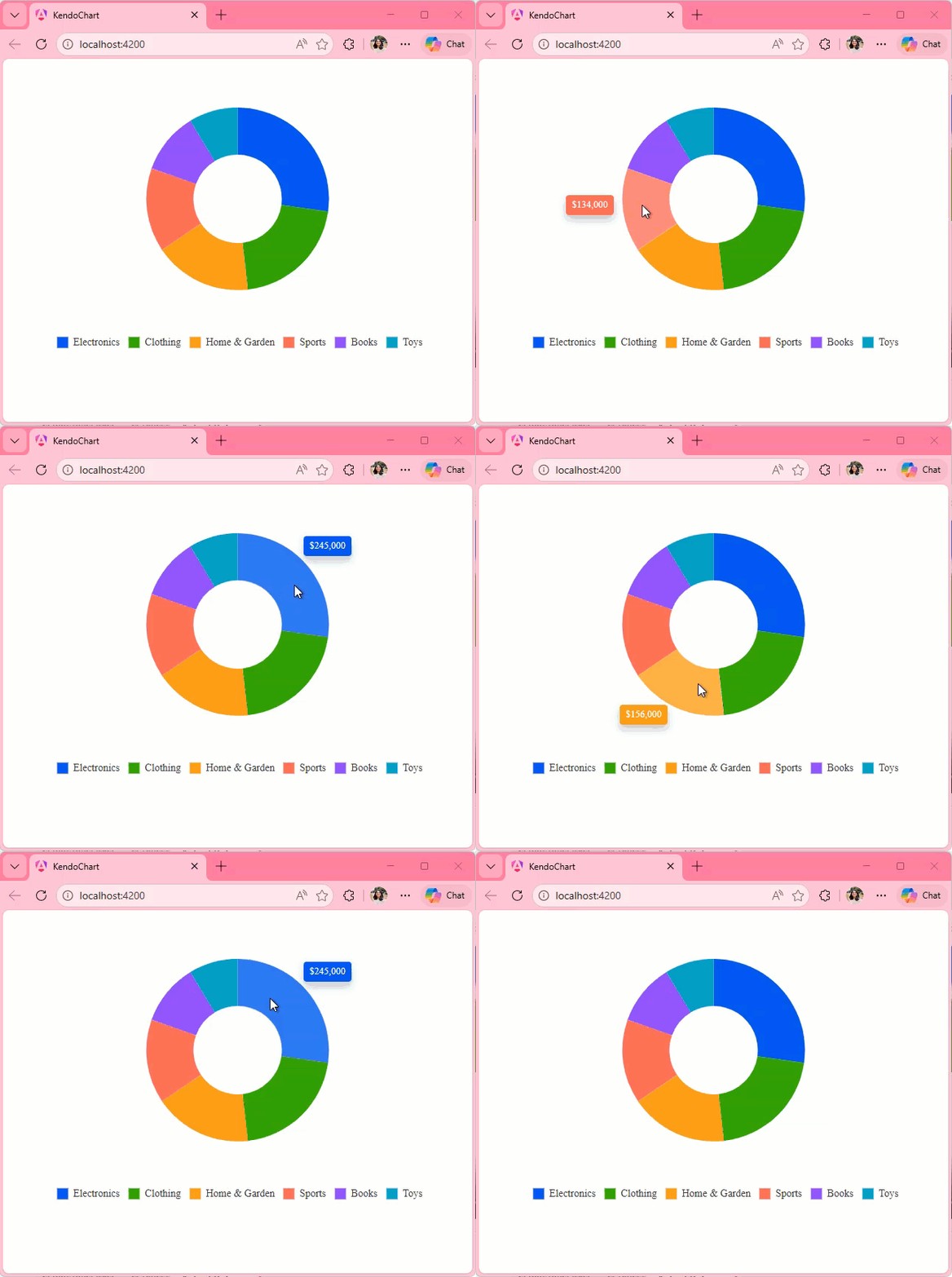
Expected Behavior
The Tooltip position should move with the cursor as seen in the screen recording below:

Because of the CSS, if a parent element has used translate (transform: translateX(0px); ) every child element under it is no longer fixed.
This causes components like kendo-dialog to be relatively positioned inside the drawer - usually cut off.
Even turning off animation still leaves the style rule.
- Disabling animation should also ensure no related CSS is applied (like using transform: none at least)
- Provide a keyframe based animation instead of translateX (example http://jsfiddle.net/whnuLf6v/50/)
For Angular Kendo Scheduler, if the Work week view is selected (default Mon-Fri), and Sunday is selected on the mini calendar to select the date to display - the previous week will be displayed. This is confusing, as simply toggling to Week view will then display the different, current week.
https://www.telerik.com/kendo-angular-ui/components/scheduler/views/day-week/
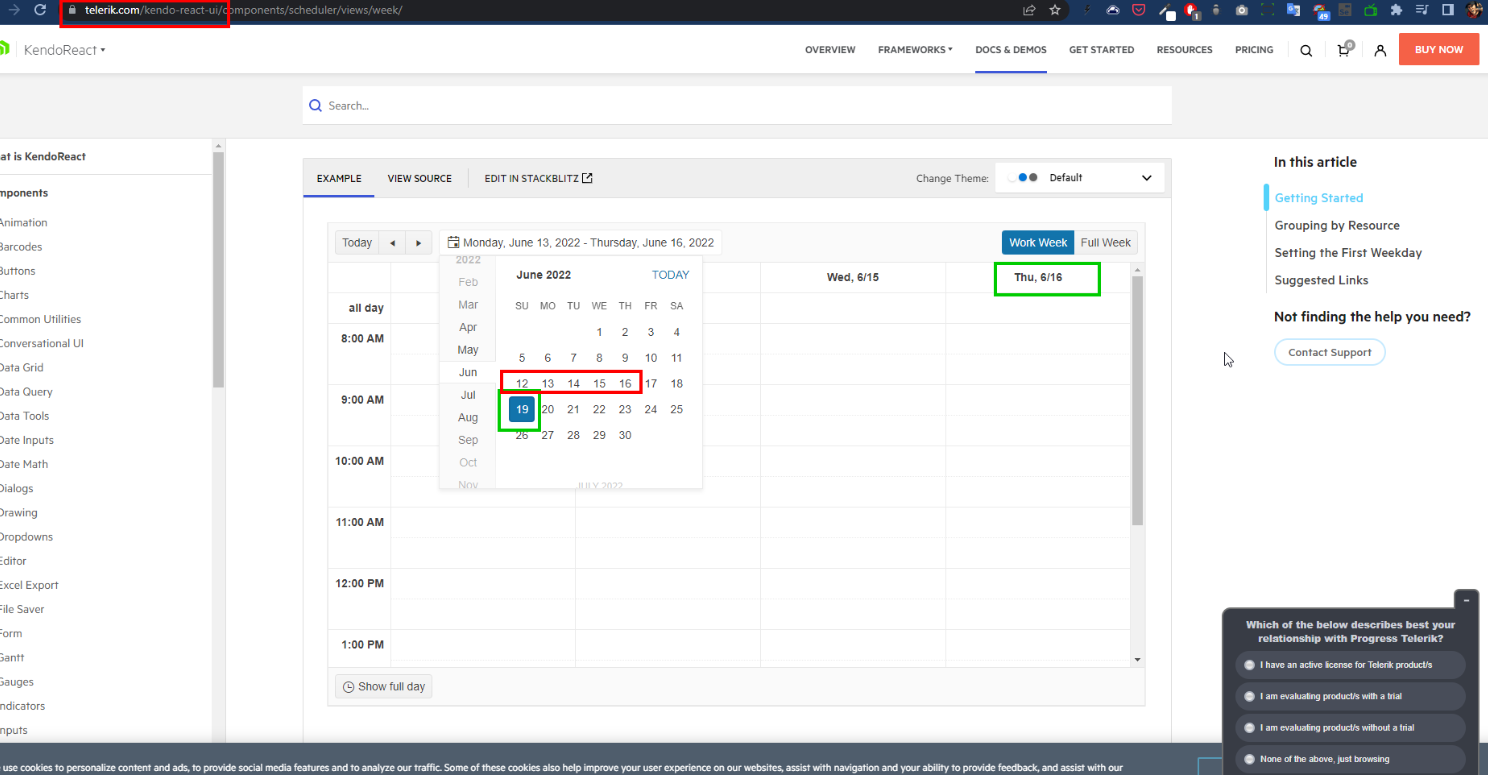
Expected behaviour: current week on mini calendar corresponds to the current week displayed regardless of whether full week or work week view is selected
Actual behaviour: selecting any day up until the desired "work week's start" (even if it's customized to start on e.g. Tuesday - and selecting Monday) will show previous week; switching then to full week view switches the week displayed to the one selected on mini calendar
------
Curiously, this does not happen for Kendo scheduler for JQuery (https://demos.telerik.com/kendo-ui/scheduler/index):
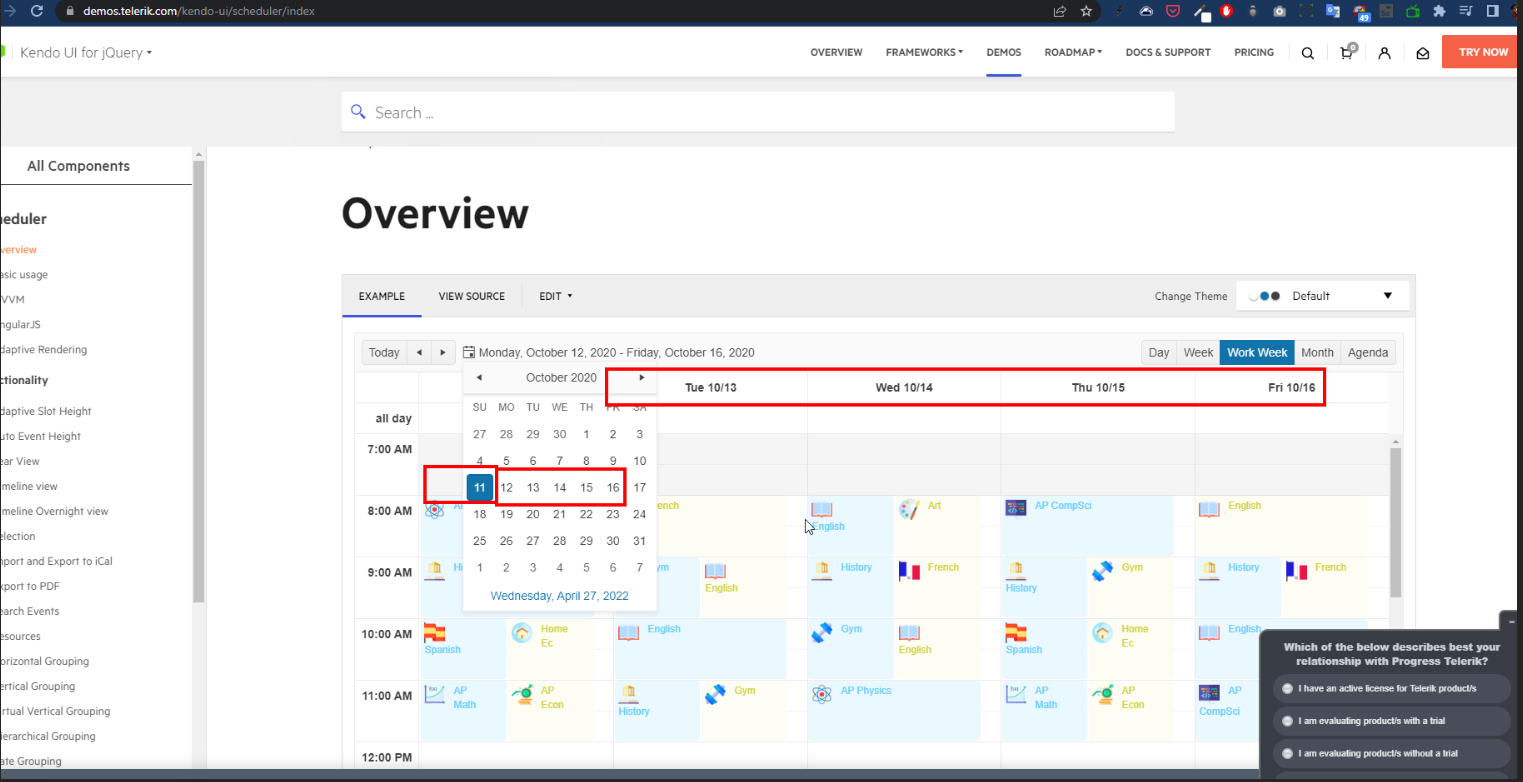
In certain scenario, Popup of the Multiselect component is not quite opened on the correct position. I did not check but this issue is probably reproducible for other dropdown components (such as Combobox, DropdownList, etc) as well.
It seems to me this happens when:
- A width greater than the widht of the input is set
- AND input is too close to the bottom-right edge of the window and as a result popup cannot be shown below the input element but above it instead
THEN in the very first render, the popup is not position quite right and moves a bit in the next render.
Precise steps to reproduce problem:
- Make sure to use minimal reproducible example attached below.
- Click and hold left button of a mouse inside the MultiSelect Component.
- The popup should open up and be positioned above the input but not being quite aligned right with the window nor the input.
- Release the left button of a mouse.
- The popup recalculates its position.
- Problem: The popup should have been positioned correctly when opened (NOT after releasing mouse button).
Minimal reproducible example:
import { Component, ViewEncapsulation } from '@angular/core';
import { FormsModule } from '@angular/forms';
import {
  KENDO_DROPDOWNS,
  PopupSettings,
} from '@progress/kendo-angular-dropdowns';
import { KENDO_INPUTS } from '@progress/kendo-angular-inputs';
import { KENDO_LABELS } from '@progress/kendo-angular-label';

@Component({
  selector: 'my-app',
  imports: [FormsModule, KENDO_DROPDOWNS, KENDO_LABELS, KENDO_INPUTS],
  styles: [
    `
      .app-layout {
        padding: 1rem;
        height: 800px;
        display: grid;
        grid-template-columns: 1fr 230px;
      }

      .sidebar {
        height: 100%;
        padding: 1rem;
        display: flex;
        flex-direction: column;
        justify-content: space-between;
      }

      .unrelated-sidebar-content {
        height: 200px;
      }

      .box {
        border: 1px solid grey;
      }
    `,
  ],
  template: `
    <div class="app-layout">
      <main class="box"> Main Content </main>
      <aside class="box sidebar">
        <div class="box unrelated-sidebar-content">Imagine some other content here</div>
        <kendo-formfield showHints="always">
          <kendo-label text="Favorite sport:">
            <kendo-multiselect
              [data]="listItems"
              [(ngModel)]="value"
              [popupSettings]="popupSettings"
            ></kendo-multiselect>
          </kendo-label>
          <kendo-formhint
            >Add your favourite sport, if it is not in the
            list.</kendo-formhint
          >
        </kendo-formfield>
      </aside>
    </div>
  `,
  encapsulation: ViewEncapsulation.None,
})
export class AppComponent {
  public listItems: Array<string> = [
    'Width Must Be Greater Than Width Of The Multiselect Component Because We Have Super Long Text',
    'When List Is Open, It Moves Slightly To The Right',
    'It Is Not Possible To Align Popup With The Right Edge',
    'It Is Not Possible To Set "anchorAlign" and "popupAlign"',
  ];
  public value: any = [];
  // @see https://www.telerik.com/kendo-angular-ui/components/popup/aligning-positioning#positioning
  public popupSettings: PopupSettings = { width: 500 };
}
Alignment to the right
I believe, this could be simply solved if we were able to configure "anchorAlign" and "popupAlign" as described here: https://www.telerik.com/kendo-angular-ui/components/popup/aligning-positioning#positioning .
In addition, it would be a nice feature in general, to be able to align popup with the element's right edge. Currently, this is pretty much hard coded:
        const horizontalAlign = this.direction === "rtl" ? "right" : "left";
        const anchorPosition = <Align>{ horizontal: horizontalAlign, vertical: "bottom" };
        const popupPosition = <Align>{ horizontal: horizontalAlign, vertical: "top" };
        const appendToComponent = typeof this.popupSettings.appendTo === 'string' && this.popupSettings.appendTo === 'component';

        this.popupRef = this.popupService.open({
            anchor: this.wrapper,
            anchorAlign: anchorPosition,
            animate: this.popupSettings.animate,
            appendTo: this.appendTo,
            content: this.popupTemplate,
            popupAlign: popupPosition,
            popupClass: this.listContainerClasses,
            positionMode: appendToComponent ? 'fixed' : 'absolute'
        });
From the code above, it is clear that the "horizontalAlign" cannot be really configured. In simple terms, you could use "left" alignment as a default intead of it being hard-coded like that; and prefer alignment specified in the "popupSettings".
Please, let me know if something needs to be further clarified.
When Toolbar component is configured to
- Have spacer between two elements: Angular ToolBar Control Types - Kendo UI for Angular
- AND it uses `overflow=menu` strategy: Angular ToolBar Responsive ToolBar - Kendo UI for Angular
- AND when there is sufficient space, so the Toolbar is NOT overflowing. In other words, the visibility of the overflow button is set to hidden.
THEN the elements are not properly aligned with the right edge of the Toolbar component. This is because the overflow button still occupies the space as is the bahviour of the `visibility` style: visibility CSS property - CSS | MDN
- The visibility CSS property shows or hides an element without changing the layout of a document.
Minimal reproducible example:
import { Component } from '@angular/core';
import { KENDO_TOOLBAR } from '@progress/kendo-angular-toolbar';
import { FormsModule } from '@angular/forms';
import { KENDO_INPUTS } from '@progress/kendo-angular-inputs';
import { KENDO_LABELS } from '@progress/kendo-angular-label';

@Component({
  selector: 'my-app',
  imports: [FormsModule, KENDO_TOOLBAR, KENDO_INPUTS, KENDO_LABELS],
  template: `
    <kendo-label [for]="width" text="Set toolbar width"></kendo-label>
    <kendo-slider
      #width
      [(ngModel)]="toolbarWidth"
      style="width: 100%; display: block;"
      [showButtons]="false"
      [min]="0"
      [max]="100"
      [largeStep]="1"
      tickPlacement="none"
    ></kendo-slider>

    <kendo-toolbar overflow="menu" [style.width.%]="toolbarWidth">
      <kendo-toolbar-button text="My Kendo Angular Toolbar Button A" />

      <kendo-toolbar-spacer></kendo-toolbar-spacer>

      <kendo-toolbar-button text="My Kendo Angular Toolbar Button B" />
    </kendo-toolbar>
  `,
})
export class AppComponent {
  toolbarWidth = 100;
}
Expected behaviour: The overflow button does not occupy that space in the scenario described above.
- EITHER has `display: none` OR it is completely removed from the DOM when there is sufficient space.