

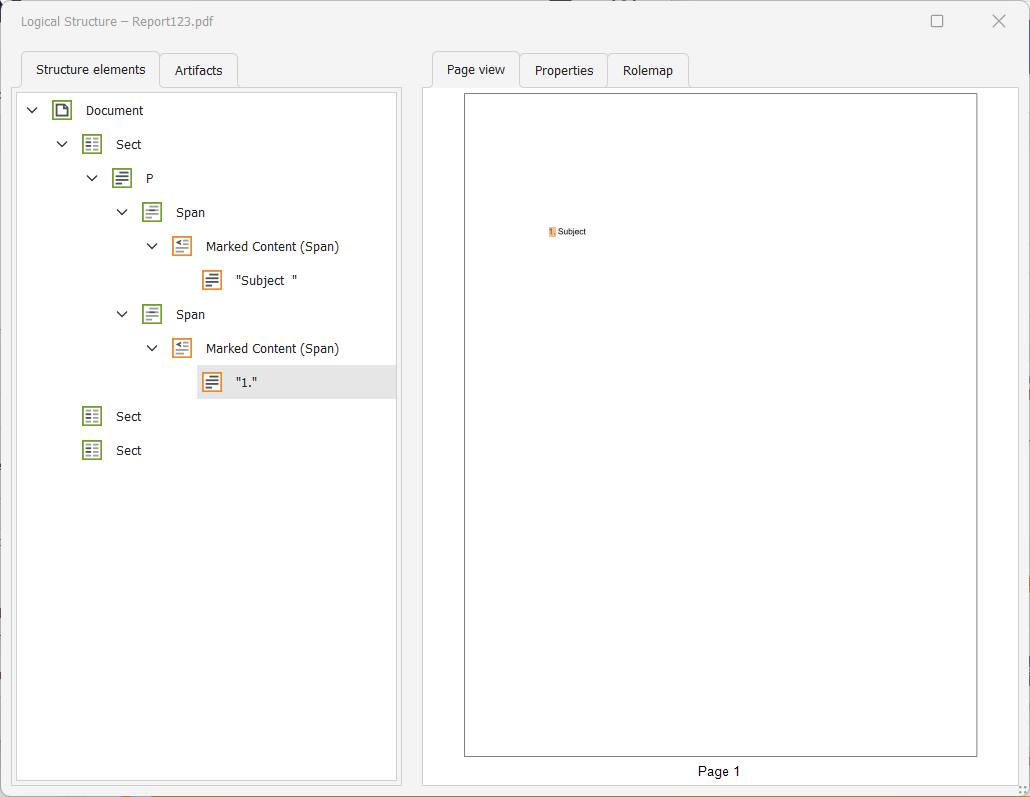
I have a report with an HtmlTextBox item, which contains an ordered list(<ol>). When I export this report to PDF, and inspect the logical tree of the document with a tool like the PDF Accessibility Checker, I can see that the span with the text is inserted above the number.
As a result, when I read the document with a screen-reading tool like Adobe's "Read Out Loud" feature or NVDA, the text is read before the current number in the list, which I find unexpected.
I have a Website ASP.NET project, and I am trying to implement the Reporting REST Service in it. To do that, I have tried to install the Telerik.Reporting.Services.WebApi package to my solution. However, when I attempt that, I get the following error:
The package 'Telerik.Reporting.Services.WebApi' tried to add a framework reference to 'System.Web.Http' which was not found in the GAC. This is possibly a bug in the package. Please contact the package owners for assistance.
Cannot find assembly 'System.Web.Http'.
It seems that the package requires that the System.Web.Http.dll assembly is available in the GAC, otherwise, the package cannot be installed.
The workaround to be able to install the package is to manually install the assembly to the GAC, or paste it in C:\Program Files (x86)\Reference Assemblies\Microsoft\Framework\.NETFramework\v4.8.

Currently, the GetDesignerResource endpoint of the Web Report Designer service is case-insensitive, which can lead to issues if the URL is made lowercase at some point, such as by a URL rewrite rule, or similar scenarios.
For example, the following reference to the Web Report Designer script will load return the file:
<script src="api/reportdesigner/designerresources/js/webReportDesigner"></script>But if lowercase is used, for example, like this:
<script src="api/reportdesigner/designerresources/js/webreportdesigner"></script>The request will return a 404(Not Found) response.
Using Blazor native reporting component. Our underlying email sending service requires that Subject is not blank, however the UI does not validate the Subject field.
Need to be able to validate that Subject is not blank when user attempts to submit email form.
We are experiencing issues with Telerik Reporting related to RTL text (culture 'ar-JO') rendering, as outlined below:
- Text wrapping is not working correctly within the HTML5 Report Viewer. The text seems to overflow the TextBox.
- When exporting to PDF, the text exceeds its boundaries, does not wrap as expected, and in some cases is cut off.
I use an approved government font for the reports. I have specified it in the `privateFonts` option of the report engine configuration. However, on Linux, it is not picked up during rendering. In FontForge, the font shows the following warning:
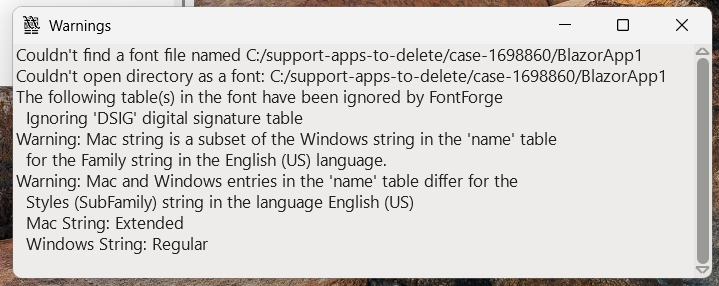
On Windows, it causes no issues.
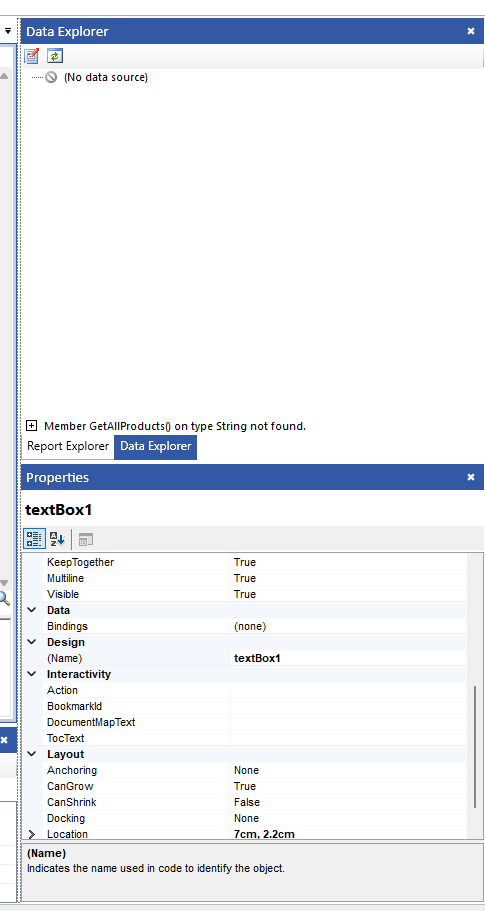
I'm getting an error in Telerik Report Designer (Data Explorer): "Member x on type String not found"
The version is: 19.3.25.1119
Steps to Reproduce:
- Open SRD.NET.
- Configure the Assembly References through the SRD.NET UI to include a DLL.
- Open an existing report file.
- Observation: The Data Explorer tool window is populated correctly, showing all fields and methods as expected.
- Close Telerik Report Designer.
- Re-open Telerik Report Designer.
- Verify that the Assembly References are still correctly configured (they are).
- Open the same report file.
- The Data Explorer is not populated. Instead, it throws an error:
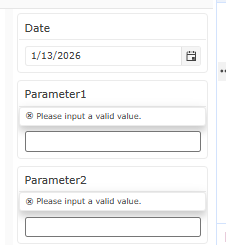
Please note the spelling error in the k-notificaiton-error class name. Should be k-notification-error:
<div class="trv-parameter-error k-notification k-notificaiton-error" style="">
<span class="k-notification-status k-icon k-i-x-outline"></span>
<span class="trv-parameter-error-message k-notification-content">Parameter value cannot be empty.</span>
</div>
Because of this, error messages are rendered with incorrect color (should be red):
I just recently updated to the latest reporting release 2025 Q1 in addition to updating to the newest Visual Studio Community 2022 (64-bit) - Current
Version 17.13.2
I installed the newest reporting update and updated my VS project.
I must have at least 50 different reports which I have previously designed and have been working fine. The DataSource is set to the object exposing all the key fields using gets. Works fine when running the program but after all the updates, all of a sudden I can see, in the designer, the fields in the fields list when editing an element value reference or in the the Data Explorer.
Played with a sample element in the detail panel. The form has the data source set correctly. The toolbox also shows the reporting tools. No go.
I verified the new reporting DLL is intact.
Same situation with all my reports. All work fine running, just the designer interface is not working.
I even tried on another computer, also updated, and experienced the same problem.
Again, now all my reports don't show the list - something intrinsically has changed. with the setup and recognition of the DS.
Eric
This also triggers multiple requests without an instance ID and document ID, resulting in 404 Not Found responses.
When my application runs in full trust permissions set, the following error is thrown if I have used the Telerik.Reporting.OpenXmlRendering NuGet package and try exporting to any of the OpenXML formats :
ERROR: Attempt by security transparent method 'Telerik.Reporting.OpenXmlRendering.Spreadsheet.Workbook..ctor()' to access security critical method 'DocumentFormat.OpenXml.Packaging.SpreadsheetDocument.Create(System.IO.Stream, DocumentFormat.OpenXml.SpreadsheetDocumentType)' failed.

I use the kendovalidator before rendering the report to check the correct parameter of initial and final date.
However, the validation fails because additional inputs (for the "Send Email" functionality) are included in the HTML output of the viewer even though I have disabled it.
I believe that if the "Send Email" option is disabled the mail data panel should not be created.
I am using the obsolete `Telerik.Reporting.Chart` type for a chart in a report. When I attempt to preview the report, an error is thrown:
The type "Telerik.Reporting.Chart" contained in assembly "Telerik.Reporting, Version=19.2.25.1001, Culture=neutral, PublicKeyToken=a9d7983dfcc261be" cannot be loaded.
To help improve the application's security, the reporting engine prevents loading types that are not essentially needed or listed as trusted by the user. If you consider particular types or assemblies as trusted include them in the corresponding TypeReferences or AssemblyReferences element of the 'Telerik.Reporting' configuration section in the application's configuration file.
The PDF with enabled Accessibility looks fine in the Adobe PDF reader.
However, when I check it with the PAC tool, it shows in the logical structure the Detail section first, then the Page Header, and then the Page Footer.

I want to be able to localize my reports for particular languages/cultures,
So they may be consumed by diverse end-users.
When using screen reader applications like JAWS or Narrator, those tools read accessible reporting PDFs in an incorrect order. For example, if I have two items in the report, the reader will read the second item first.
Additionally, images whose AccessibleDescription I have set may be read multiple times..
I had an issue with watermarks being present in the generated PDF despite the license validation passing. In the trace log, I was seeing this:
x.x.x.x.exe Information: 0 : *** ReportProcessor.ProcessReport STARTED ***
x.x.x.x.exe Information: 0 : SQLite x64: v3.50.4
x.x.x.x.exe Information: 0 :
x.x.x.x.exe Information: 0 : *** ProcessReport #0 "Invoice" STARTED ***
x.x.x.x.exe Information: 0 : *** ProcessReport #0 "Invoice" DONE in 00:00:00.6363067 ***
x.x.x.x.exe Information: 0 :
x.x.x.x.exe Information: 0 : *** ReportProcessor.ProcessReport DONE in 00:00:00.7891276 ***
x.x.x.x.exe Information: 0 :
x.x.x.x.exe Information: 0 : License check for assembly Telerik.Reporting, Version=19.3.25.1119, Culture=neutral, PublicKeyToken=a9d7983dfcc261be: True
x.x.x.x.exe Information: 0 :
x.x.x.x.exe Information: 0 : *** Render Report #0 "Invoice" STARTED ***
x.x.x.x.exe Information: 0 : ReportName: Invoice; DocumentName: Invoice; Extension: PDF
x.x.x.x.exe Information: 0 : DeviceInfo Contents
x.x.x.x.exe Information: 0 : ===================
x.x.x.x.exe Information: 0 : ChangingPermissionType: ""
x.x.x.x.exe Information: 0 : ComplianceLevel: "None"
x.x.x.x.exe Information: 0 : CopyingPermissionType: ""
x.x.x.x.exe Information: 0 : DocumentAuthor: ""
x.x.x.x.exe Information: 0 : DocumentCreator: ""
x.x.x.x.exe Information: 0 : DocumentKeywords: ""
x.x.x.x.exe Information: 0 : DocumentNaturalLanguage: ""
x.x.x.x.exe Information: 0 : DocumentProducer: ""
x.x.x.x.exe Information: 0 : DocumentSubject: ""
x.x.x.x.exe Information: 0 : DocumentTitle: ""
x.x.x.x.exe Information: 0 : EnableAccessibility: "False"
x.x.x.x.exe Information: 0 : EndPage: "0"
x.x.x.x.exe Information: 0 : FontEmbedding: "None"
x.x.x.x.exe Information: 0 : ForceLicenseWatermark: "True"
The issue turned out to be due to caching, but the output puzzled me while I was debugging this. Turned out `ForceLicenseWatermark` is always true (the misleading part), but only has an effect when the license validation fails.
After dragging a report viewer control from the Visual Studio toolbox to the surface of a Windows Form, the viewer is added to the component tray but it is not added to the Controls collection of the form. Thus, the viewer is not displayed when running the application.
Also, some properties of the report viewer, such as the ReportSource property, are not serialized properly after being modified through the Visual Studio properties window.
Currently, one can work around these issues by manually editing the InitializeComponent component method of the form's .Designer.cs file.